
TAA i.3.29.2
Typewritten report on the selpuchral statuettes called shabti figures, page 2.

© Griffith Institute,
University of Oxford
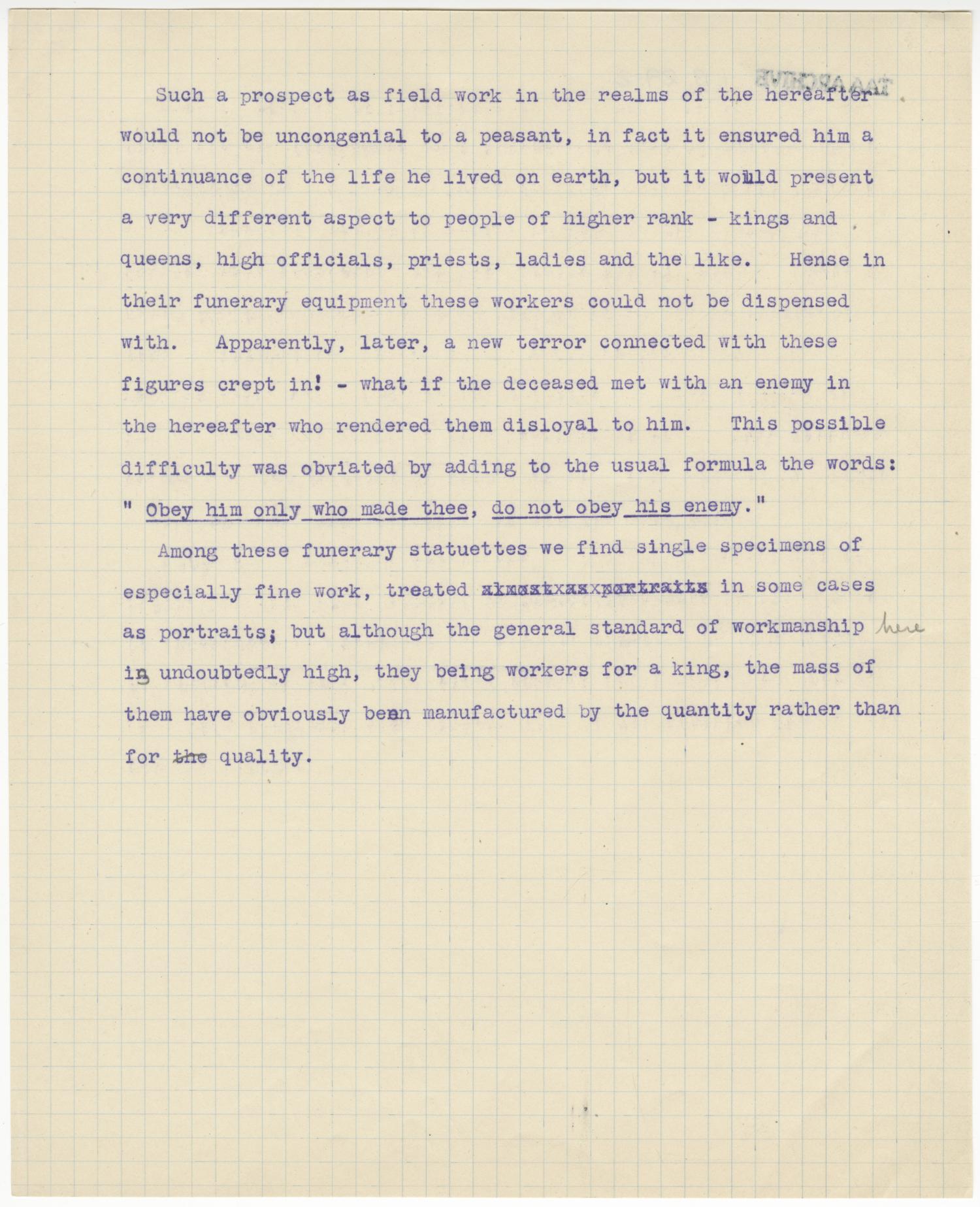
Such a prospect as field work in the realms of the hereafter
would not be uncongenial to a peasant, in fact it ensured him a
continuance of the life he lived on earth, but it wol/<u>ld present
a very different aspect to people of higher rank – kings and
queens, high officials, priests, ladies and the like. Hensesic in
their funerary equipment these workers could not be dispensed
with. Apparently, later, a new terror connected with these
figures crept in! – what if the deceased met with an enemy in
the hereafter who rendered them disloyal to him. This possible
difficulty was obviated by adding to the usual formula the words:
"Obey him only who made thee, do not obey his enemy."
Among these funerary statuettes we find single specimens of
especially fine work, treated almost as portraits in some cases
as portraits; but although the general standard of workmanship <here>
in/<s> undoubtedly high, they being workers for a king, the mass of
them have obviously bea/<e>n manufactured by the quantity rather than
for the quality.