
TAA i.12.06
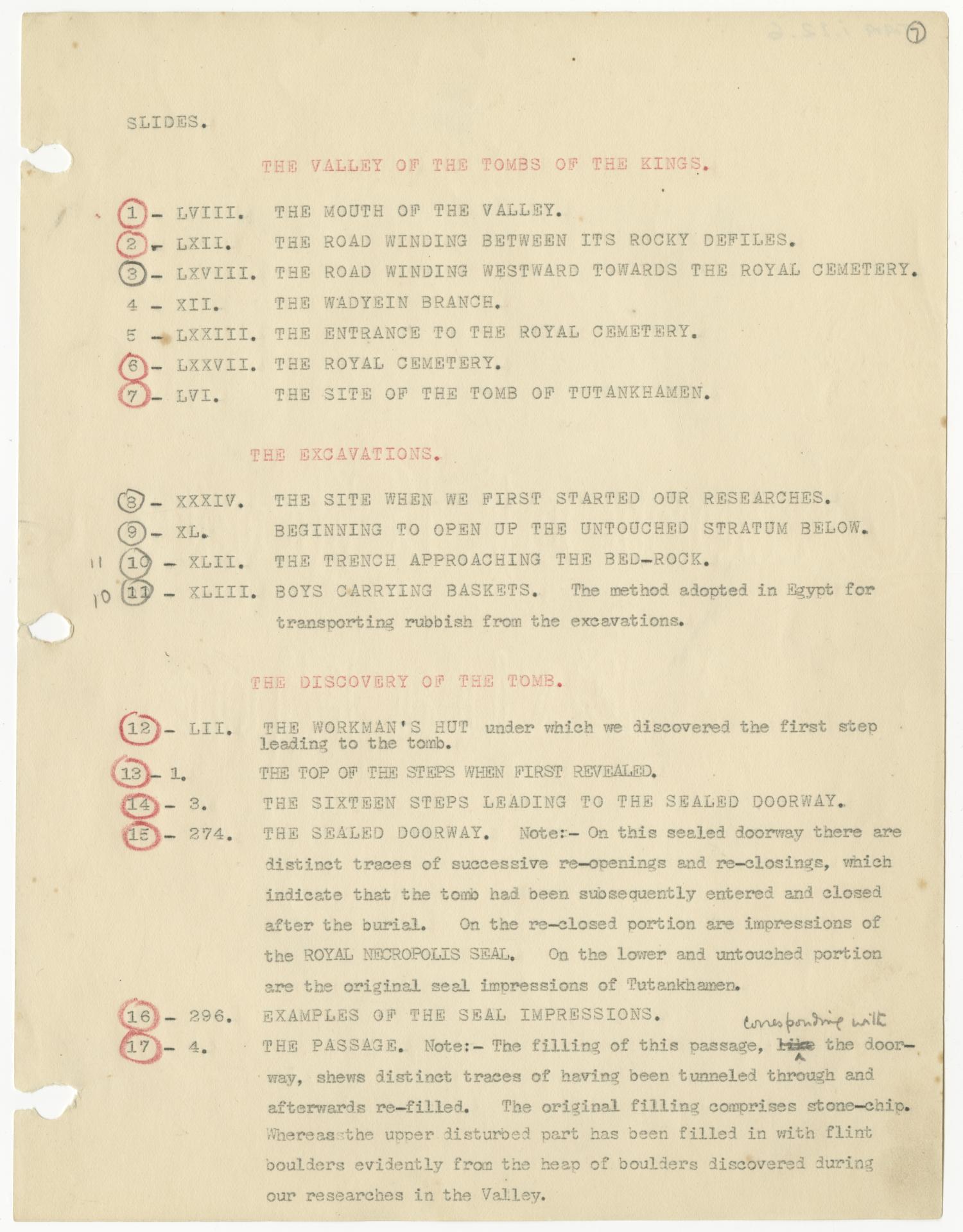
List of slides numbered 1 to 17 (the order used in Carter's lecture), accompanied by the corresponding Burton image numbers.
Carter references the image Burton P0296 which shows a part of the sealed doorway leading into the Annexe (Carter number 171) but he presents this image in the context of talking about the first sealed doorway (Carter number 4).

© Griffith Institute,
University of Oxford
(7)
SLIDES.
THE VALLEY OF THE TOMB OF THE KINGS.
1 - LVIII. THE MOUTH OF THE VALLEY.
2 - LXII. THE ROAD WINDING BETWEEN ITS ROCKY DEFILES.
3 - LXVIII. THE ROAD WINDING WESTWARD TOWARDS THE ROYAL CEMETERY.
4 - XII. THE WADYEIN BRANCH.
5 - LXXIII. THE ENTRANCE TO THE ROYAL CEMETERY.
6 - LXXVII. THE ROYAL CEMETERY.
7 - LVI. THE SITE OF THE TOMB OF TUTANKHAMEN.
THE EXCAVATIONS.
8 - XXXIV. THE SITE WHEN WE FIRST STARTED OUR RESEARCHESsic.
9 - XL. BEGINNING TO OPEN UP THE UNTOUCHED STRATUM BELOW.
<11>10 - XLII. THE TRENCH APPROACHING THE BED-ROCK.
<10>11 - XLIII. BOYS CARRYING BASKETS. The method adopted in Egypt for
transporting rubbish from the excavation.
THE DISCOVERY OF THE TOMB.
12 - LII. THE WORKMAN’S HUT under which we discovered the first step
leading to the tomb.
13 - 1. THE TOP OF THE STEPS WHEN FIRST REVEALED.
14 - 3. THE SIXTEEN STEPS LEADING TO THE SEALED DOORWAY.
15 - 274 THE SEALED DOORWAY. Note:- On this sealed doorway there are
distinct traces of successive re-openings and re-closings, which
indicate that the tomb has been subsequently entered and closed
after the burial. On the re-closed portion are impressions of
the ROYAL NECROPOLIS SEAL. On the lower and untouched portion
are the original seal impressions of Tutankhamen.
16 - 296 EXAMPLES OF THE SEAL IMPRESSIONS.
17 - 4. THE PASSAGE.
Note:- The filling of this passage, like/<corresponding with> the door-
way, shewssic distinct traces of having been tunneled through and
afterwards re-filled. The original filling comprises stone-chipsic.
Whereas the upper disturbed part has been filled in with flint
boulders evidently from the heap of boulders discovered during
our researchessic in the Valley.