
Carter MSS i.G.4
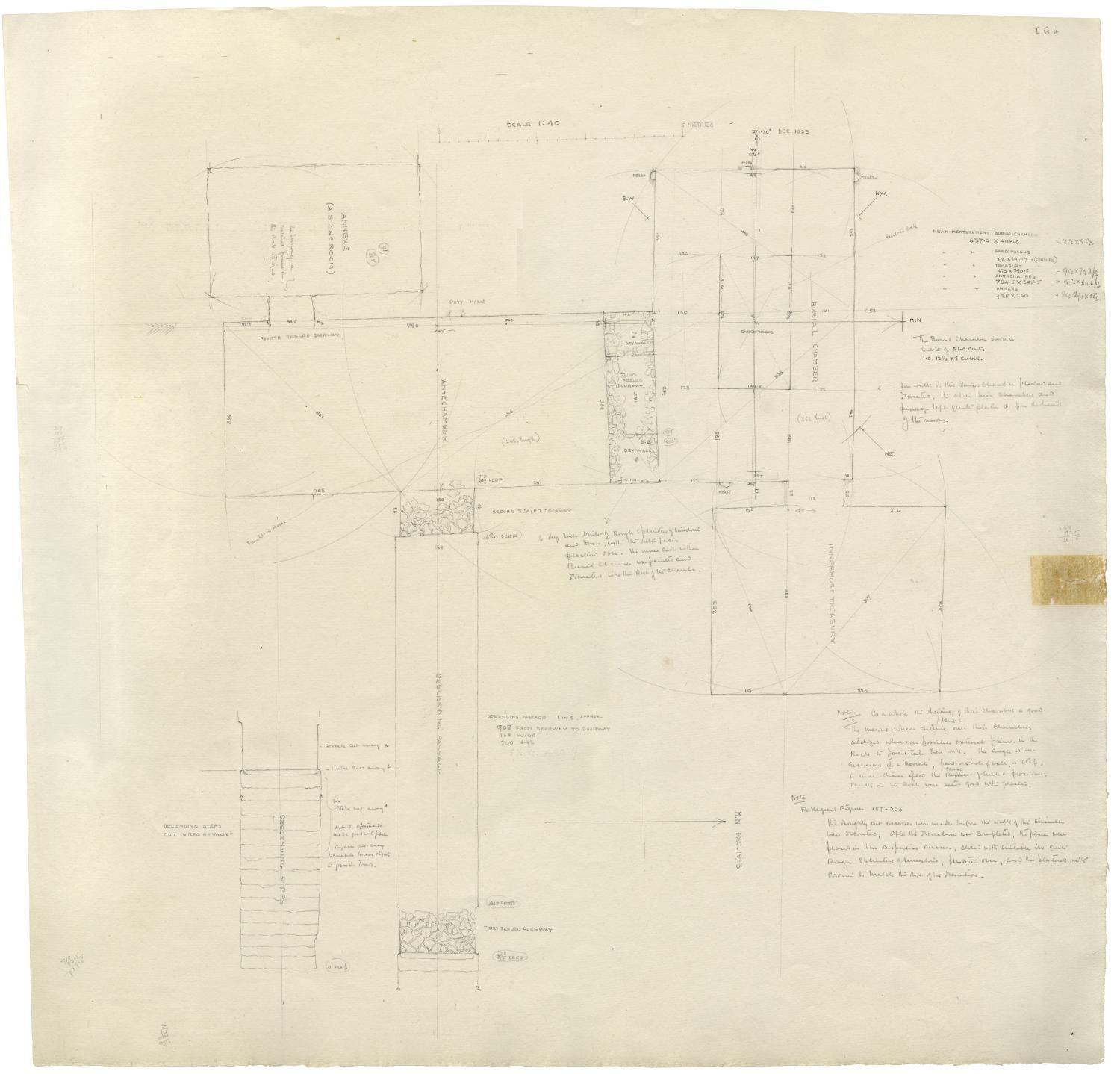
Although dated 'December 1923' the plan cannot have been completed before 1930, as the four niches in the Burial chamber are illustrated in the plan. The first niche was recorded by Carter as being opened on 3 November 1930.
Everything in (italics) in the transcription below indicates the position of the texts.

© Griffith Institute,
University of Oxford
(upper left)
Annexe –
(A Store Room)
the doorway a
Natural fissure in
The Rock utilized.
Fourth Sealed Doorway Putt Hole
Antechamber
(upper centre)
Dry Wall
Third Sealed Doorway
Dry Wall
(upper right)
fault in rock
Mean measurement Burial Chamber
637·5 x 408·0 = 12Cs x 8 Cs.
“ “ Sarcophagus
274 x 147·7 (Cornice)
“ “ Treasury
475 x 380·5 = 9Cs x 7G 2ps
“ “ Antechamber
784·5 x 355·5 = 15Cs x 6cs 6ps
“ “ Annexe
435 x 260 = 8Cs. 2ps x 5Cs.
Sarcophagus
Burial Chamber
The Burial Chamber shows a
Cubit of 51·0 cents
i.e. 12 ½ x 8 Cubits.
(centre left)
fault in rock
(centre)
Second Sealed Doorway
A dry wall built of Rough splinters of limestone
and dust[?] with the outer faces
plastered over. the inner side within
Burial Chamber was painted and
decorated like the Rest of the Chamber.
(centre right)
from walls of this Burial Chamber plastered and
decorated. the other three chambers and
passage left quite plain as from the hands
of the masons.
Innermost
Treasury
(lower left)
Descending Steps
Cut in Bed of Valley
reveals cut away
Reveals cut away
Descending inter[?] cut away
Steps six steps cut away
a, b, c. afterwards
made good with plaster
they were cut away
to enable larger objects
to pass in Tomb.
First Sealed Doorway
(lower centre)
Descending
Passage
Descending Passage 1 in 3 approx.
908 from Doorway to Doorway
168 wide
200 high
(lower right)
Note
As a whole the hewing of these chambers is good
But:
The masons when cutting out these chambers
utilized wherever possible Natural fissures in the
Rock to facilitate their work. The angle or un-
evenness of a ‘Reveal’, part or whole of wall, or step,
is more than often the Result <cause> of such a procedure.
Faults in the Rock were made good with plaster.
M.N. Dec 1923
Note
Re Magical Figures 257-260
The Roughly-cut Recesses were made before the walls of the chamber
were decorated; after the decoration was completed, the figures were
placed in their respective Recesses, closed with suitable but quite
Rough splinters of limestone, plastered over, and the plastered parts
coloured to match the Rest of the decoration[?].