
TAA i.2.4.13
Most of the text is fully struck through on this page but is not indicated in the transcription, see document image for reference. Strikethrough is reserved for the author’s edits and deletions within the main body of the text, which would otherwise be difficult to distinguish.
Part of the text on this page is reproduced in the publication: Carter, Howard 1933. The tomb of Tut.ankh.Amen vol. 3. London: Cassell [PDF, 8.47 MB], 40, 45, 46.

© Griffith Institute,
University of Oxford
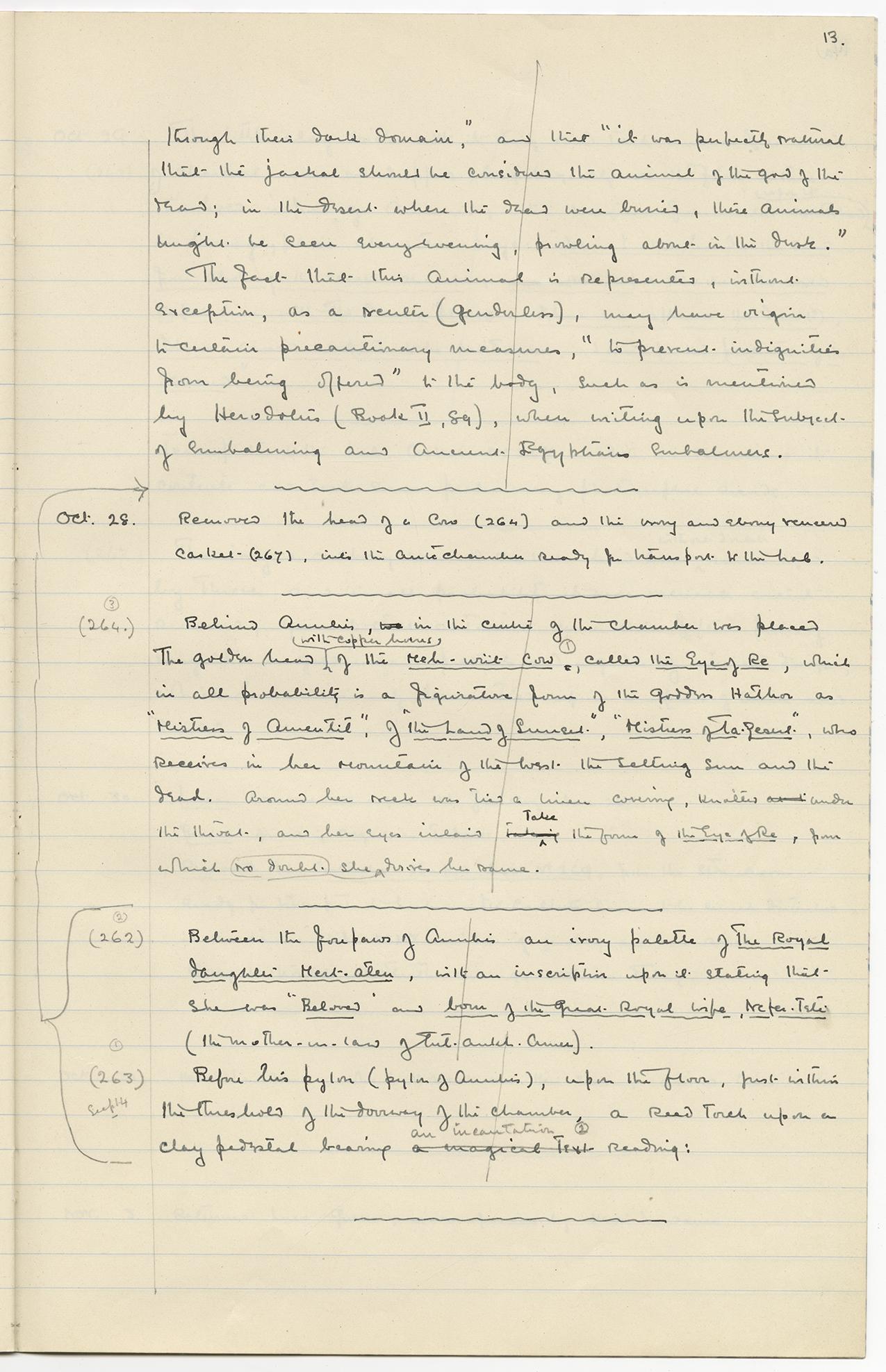
through their dark domain," and that "it was perfectly natural
that the jackal should be considered the animal of the god of the
dead; in the desert where the dead were buried, these animals
might be seen every evening, prowling about in the dusk."
The fact that this animal is represented, without
exception, as a neuter (genderless), may have origin
to certain precautionary measures, "to prevent indignities
from being offered" to the body, such as is mentioned
by Herodotus (Book II, 89), when writing upon the subject
of embalming and ancient Egyptian embalmers.
<(2)
(262)
Between the forepaws of Anubis an ivory palette of the Royal
daughter Mert-Aten, with an inscription upon it stating that
she was "Beloved" and born of the Great Royal wife, Nefer.Tete
(the mother-in-law of Tut.ankh.Amen).>
<(2)
(Carter Newberry, Tomb of Thothmes IV, p. 9.)
Magical Flame (of the Southern Wall). Text from Chap. CLI (f) of the B. of the Dead: -
[ 𓂀 ]
[ 𓂀 ] = Thothmes IV. According to the
rubric given in the papyri, the flame was a torch of Uaa-reeds
(Gardiner, Tomb of Amenemhet, p. 117.)
"It is I who hinder the sand from choking the secret chamber, and who repel
that one who would repel him with the desert-flame. I have set aflame the
desert(?), I have caused the path to be mistaken. I am for the protection of the
Osiris N.">
<(1)
(263)
See pl. 4
Before his pylon (pylon of Anubis), upon the floor, just within
the threshold of the doorway of the chamber, a Reed Torch upon a
clay pedestal bearing a magical text/<an incantation (2)> reading:>
<(1)
[ 𓂀 ] Pap. Ani, pls. 8, 37, chaps. 17, 186.
[ 𓂀 ] Mḥt wrt. (Erman voc. p. 68).
[ 𓂀 ], ỉrt Rʿ, the Eye of Re = name of Hathor (Erman voc. p. 16).
cf Erman, Eg. Religion, pp. 12, 28 and 31.
[ 𓂀 ]
[ 𓂀 ]
[ 𓂀 ]. pap. Ani pl. 37.>
Oct. 28.
Removed the head of a Cow (264) and the ivory and ebony veneered
casket (267), into the Antechamber ready for transport to the Lab.
(3)
(264.)
Behind Anubis, we in the centre of the Chamber was placed
the golden head <with copper horns> of the Meh-wrït Cow (1)./<,> called the Eye of Re, which
in all probability is a figurative form of the goddess Hathor as
"Mistress of Amentit", of "the Land of Sunset", "Mistress of Ta.Zesur[?]", who
receives in her mountain of the West the Setting Sun and the
dead. Around her neck was tied a linen covering, knotted at t under
the throat, and her eyes inlaid taking/<take> the form of the Eye of Re, from
which she <no doubt> derives her name.