
TAA i.2.1.33

© Griffith Institute,
University of Oxford
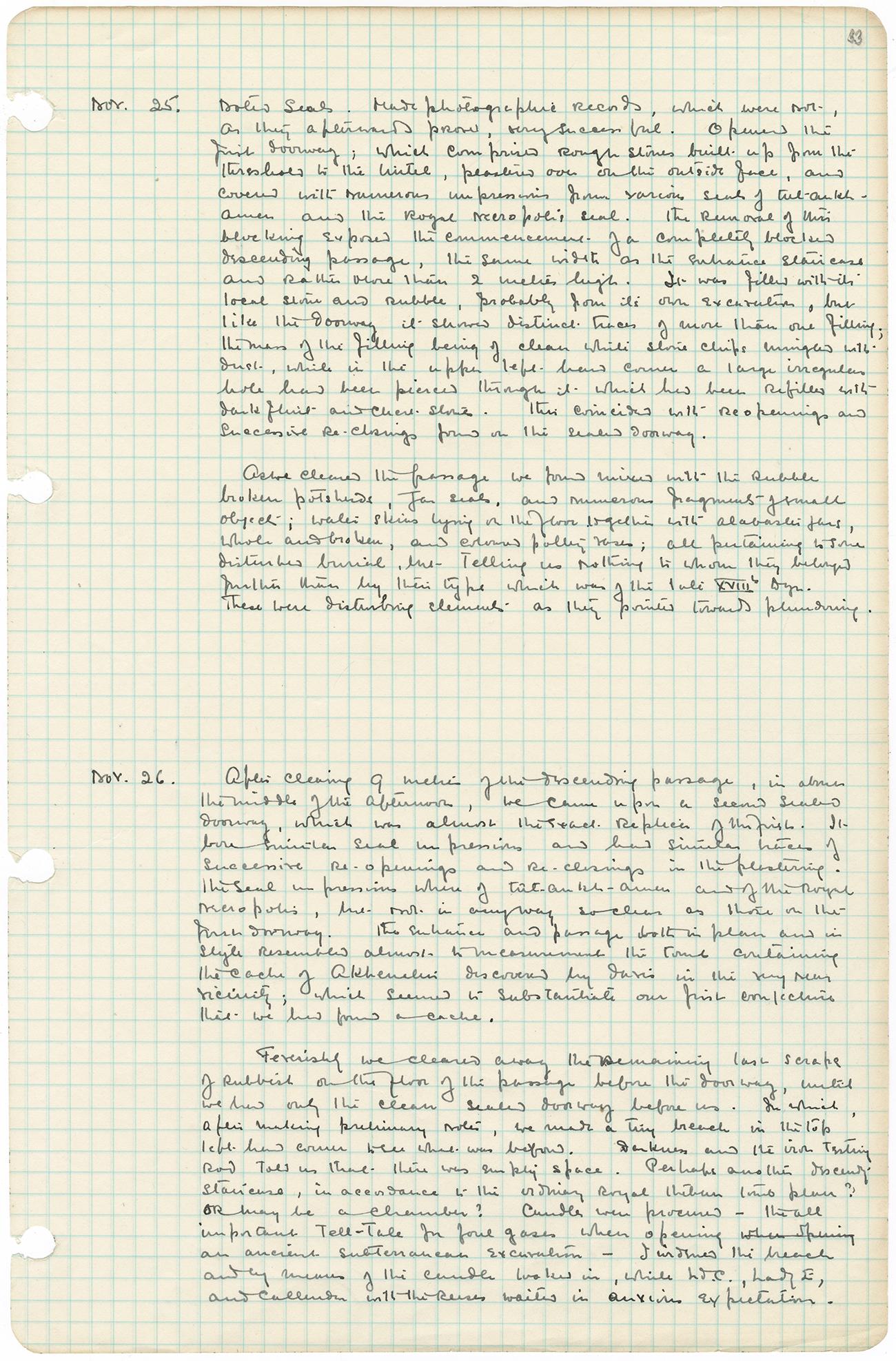
Nov. 25.
Noted seals. Made photographic records which were not,
as they afterwards proved, very successful. Opened the
first doorway; which comprised rough stones built up from the
threshold to the lintel, plastered over on the outside face, and
covered with numerous impressions from various seals of Tut-Ankh-
Amen and the Royal Necropolis seal. The removal of this
blocking exposed the commencement of a completely blocked
descending passage, the same width as the Entrance Staircase
and rather more than 2 metres high. It was filled with its
local stone and rubble, probably from its own excavation, but
like the doorway it showed distinct traces of more than one filling;
the mass of the filling being of clean white stone chips mingled with
dust, while in the upper left hand corner a large irregular
hole had been pierced through it which had been refilled with
dark flint and chert stones. This coincided with reopenings and
successive re-closings found on the sealed doorway.
As we cleared the passage we found mixed with the rubble
broken potsherds, Jar seals, and numerous fragments of small
objects; water skins lying on the floor together with alabaster jars,
whole and broken, and coloured pottery vases; all pertaining to some
disturbed burial, but telling us nothing to whom they belonged
further than by their type which was of the late XVIIIth Dyn.
These were disturbing elements as they pointed towards plundering.
Nov. 26.
After clearing 9 metres of the descending passage, in about
the middle of the afternoon, we came upon a second sealed
doorway, which was almost the exact replica of the first. It
bore similar seal impressions and had similar traces of
successive re-openings and re-closings in the plastering.
The seal impressions wheresic {were} of Tût-Ankh-Amen and of the Royal
Necropolis, but not in anyway so clear as those on the
first doorway. The Entrance and passage both in plan and in
style resembled almost to measurement the tomb containing
the cache of Akhenaten discovered by Davis in the very near
vicinity; which seemed to substantiate our first conjecture
that we had found a cache.
Feverishly we cleared away the remaining last scraps
of rubbish on the floor of the passage before the doorway, until
we had only the clean sealed doorway before us. In which,
after making preliminary notes, we made a tiny breach in the top
left hand corner to see what was beyond. Darkness and the iron testing
rod told us that there was empty space. Perhaps another descending
staircase, in accordance to the ordinary Royal Theban tomb plan?
OR may be a chamber? Candles were procured - the all
important Tell-Tale for foul gases when opening when opening
an ancient subterranean excavation - I widened the breach
and by means of the candle looked in, while Ld. C., Lady E,
and Callender with the Reises waited in anxious expectation.