
TAA i.3.9.9
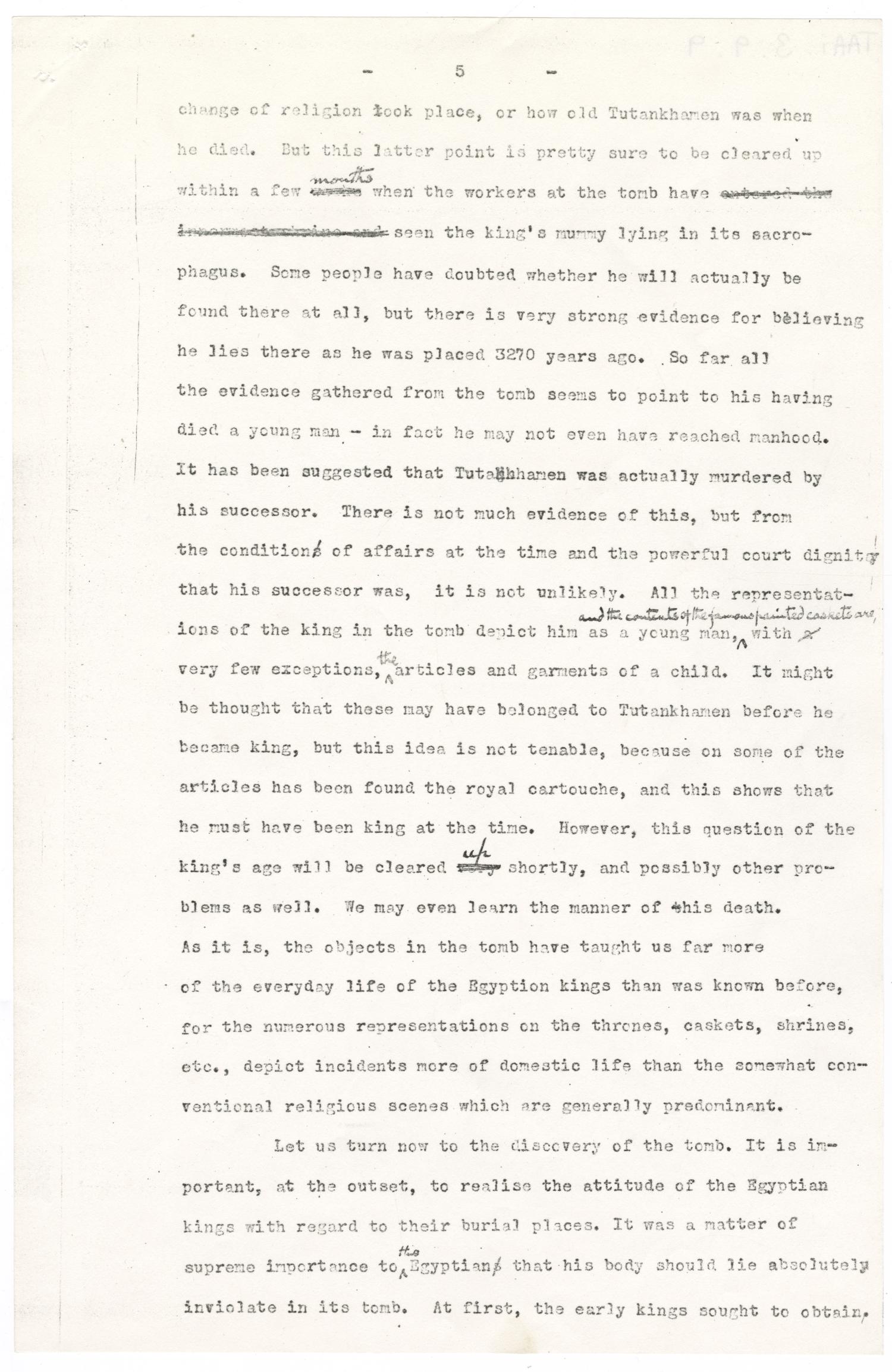
Photocopy of typewritten and annotated notes for a lecture titled 'Scientific Aspects of the Egyptian Discoveries', page 5.

© Griffith Institute,
University of Oxford
– 5 –
change of religion l/<t>ook place, or how old Tutankhamen was when
he died. But this latter point is pretty sure to be cleared up
within a few weeks/<months> when the workers at the tomb have entered the
inner most shrine and seen the king’s mummy lying in its sacro-
phagussic. Some people have doubted whether he will actually be
found there at all, but there is very strong evidence for bl/<e>lieving
he lies there as he was placed 3270 years ago. So far all
the evidence gathered from the tomb seems to point to his having
died a young man – in fact he may not even have reached manhood.
It has been suggested that Tutax[?]/<h>k/<h>hamen was actually murdered by
his successor. There is not much evidence of this, but from
the conditions of affairs at the time and the powerful court dignita/<y>
that his successor was, it is not unlikely. All the representat-
ions of the king in the tomb depict him as a young man, <and the contents of the famous painted caskets are> with a
very few exceptions, <the> articles and garments of a child. It might
be thought that these may have belonged to Tutankhamen before he
became king, but this idea is not tenable, because on some of the
articles has been found the royal cartouche, and this shows that
he must have been king at the time. However, this question of the
king’s age will be cleared very/<up> shortly, and possibly other pro-
blems as well. We may even learn the manner of this death.
As it is, the objects in the tomb have taught us far more
of everyday life of the Egyptionsic kings than was known before,
for the numerous representations on the thrones, caskets, shrines,
etc., depict incidents more of domestic life than the somewhat con-
ventional religious scenes which are generally predominant.
Let us turn now to the discovery of the tomb. It is im-
portant, at the outset, to realise the attitude of the Egyptian
kings with regard to their burial places. It was a matter of
supreme importance to <the> Egyptians that his body should lie absolutely
inviolate in its tomb. At first, the earlier kings sought to obtain.