
TAA i.3.9.27
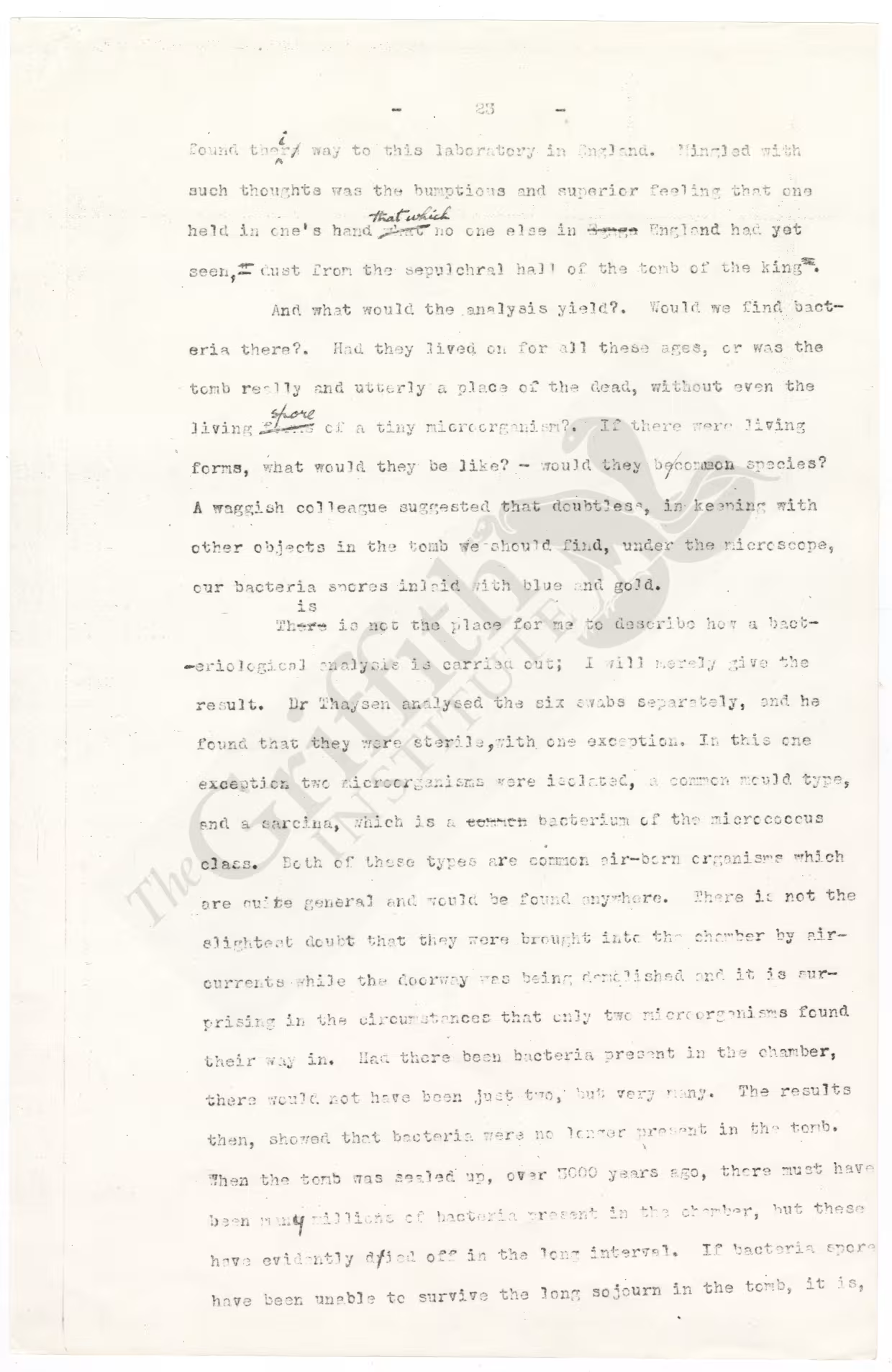
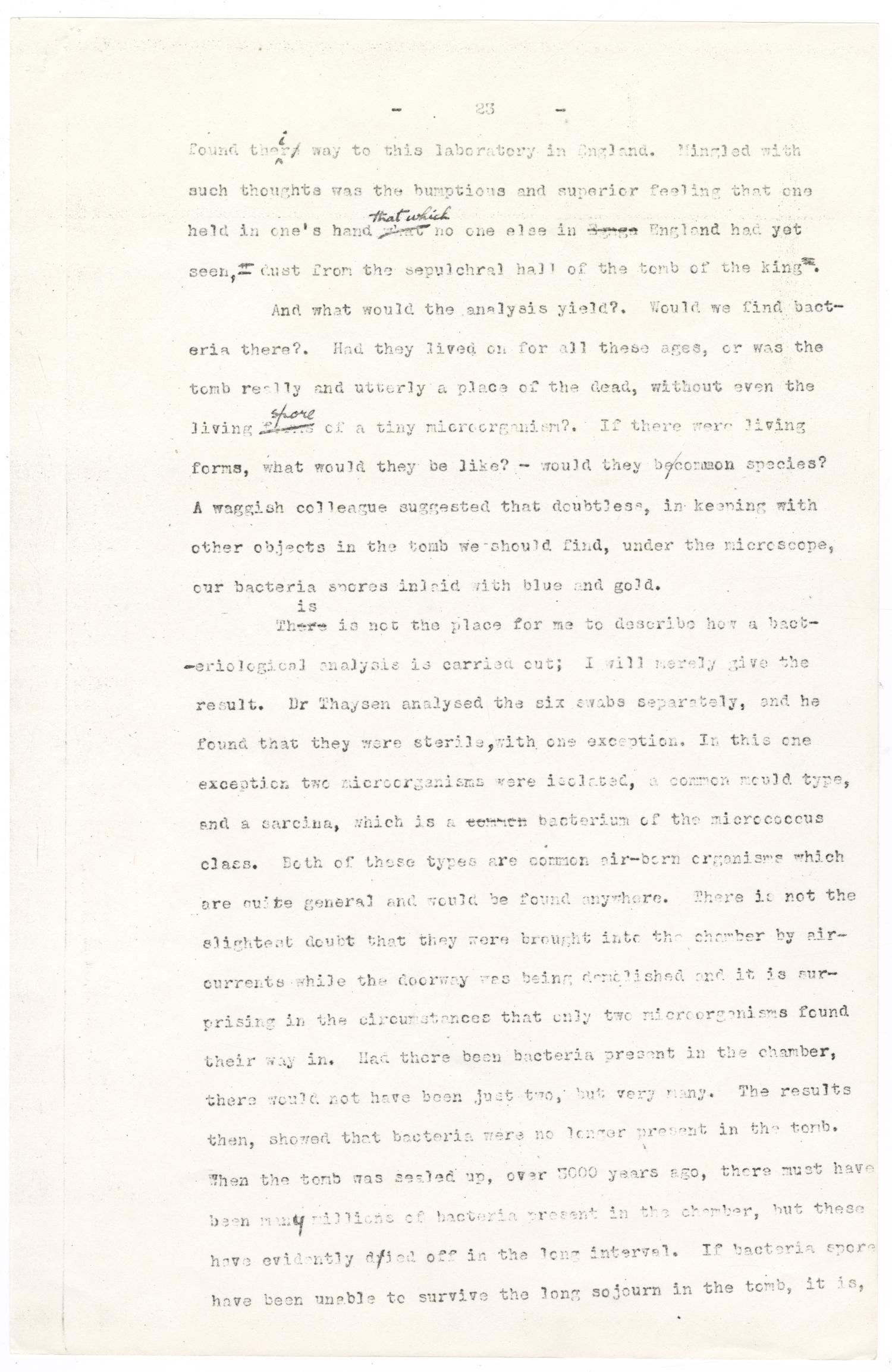
Photocopy of typewritten and annotated notes for a lecture titled 'Scientific Aspects of the Egyptian Discoveries', page 23.
Dr Theysen is mentioned on this page.
© Griffith Institute,
University of Oxford
– 23 –
found the<i>re way to this laboratory in England. Mingled with
such thoughts was the bumptious and superior feeling that one
held in one's hand what/<that which> no one else in Egngn England had yet
seen<, ">dust from the sepulchral hall of the tomb of the king".
And what would the analysis yield?. Would we find bact-
eria there?. Had they lived on for all these ages, or was the
tomb really and utterly a place of the dead, without even the
living forms/<spore> of a tiny microorganism?. If there were living
forms, what would they be like? – would they be </> come/<mon> species?
A waggish colleague suggested that doubtless, in keeping with
other objects in the tomb we should find, under the microscope,
our bacteria spores inlaid with blue and gold.
There/<is> is not the place for me to describe how a bact-
-eriological analysis is carried out; I will merely give the
result. Dr Thaysen analysed the six swabs separately, and he
found that they were sterile, with one exception. In this one
exception two microorganisms were isolated, a common mould type,
and a sarcina, which is a common bacterium of the micrococcus
class. Both of these types are common air-born organisms which
are quite general and would be found anywhere. There is not the
slightest doubt that they were brought into the chamber by air-
currents while the doorway was being demolished and it is sur-
prising in the circumstances that only two microorganisms found
their way in. Had there been bacteria present in the chamber,
there would not have been just two, but very many. The results
then, showed that bacteria were no longer present in the tomb.
When the tomb was sealed up, over 3000 years ago, there must have
been manu/<y> millions of bacteria present in the chamber, but these
have evidently dried off in the long interval. If bacteria spore
have been unable to survive the long sojourn in the tomb, it is,