
TAA i.3.9.26
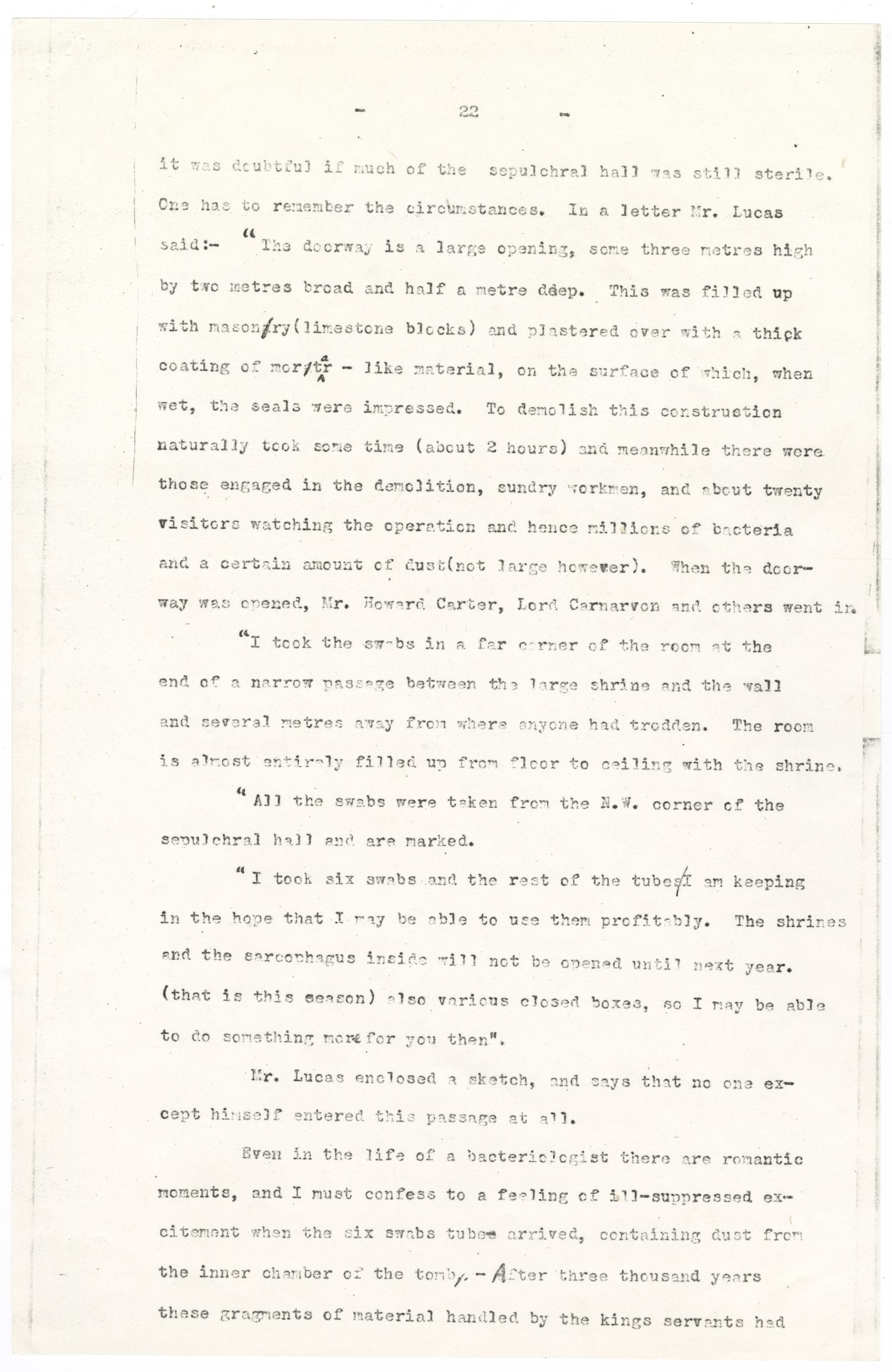
Photocopy of typewritten and annotated notes for a lecture titled 'Scientific Aspects of the Egyptian Discoveries', page 22.
Howard Carter, Lord Carnarvon, and Alfred Lucas are mentioned on this page.

© Griffith Institute,
University of Oxford
– 22 –
it was doubtful if much of the sepulchral hall was still sterile.
One has to remember the circumstances. In a letter Mr. Lucas
said:- <">The doorway is a large opening, some three metres high
by two metres broad and half a metre dd/<e>ep. This was filled up
with masonary (limestone blocks) and plastered over with a thick
coating of morat<a>r – like material, on the surface of which, when
wet, the seals were impressed. To demolish this construs/<c>tion
naturally took some time (about 2 hours) and meanwhile there were
those engaged in the demolition, sundry workmen, and about twenty
visitors watching the operation and hence millions of bacteria
and a certain amount of dust (not large however). When the door-
way was opened, Mr. Howard Carter, Lord Carnarvon and others went in.
<">I took the swabs in a far corner of the room at the
end of a narrow passage between the large shrine and the wall
and several metres away from where anyone had trodden. The room
is almost entirely filled up from floor to ceiling with the shrine.
<">All the swabs were taken from the N.W. corner of the
sepulchral hall and are marked.
<">I took six swabs and the rest of the tubes </> I am keeping
in the hope that I may be able to use them profitably. The shrines
and the sarcophagus inside will not be opened until next year.
(that is this season) also various closed boxes, so I may be able
to do something mor<e> for you then".
Mr. Lucas enclosed a sketch, and says that no one ex-
cept himself entered this passage at all.
Even in the life of a bacteriologist there are romantic
moments, and I must confess to a feeling of ill-suppressed ex-
citement when the six swabs tubes arrived, containing dust from
the inner chamber of the tomb,/<.> – a/<A>fter three thousand years
these gragmentssic of material handled by the kings servants had