TAA i.3.9.25
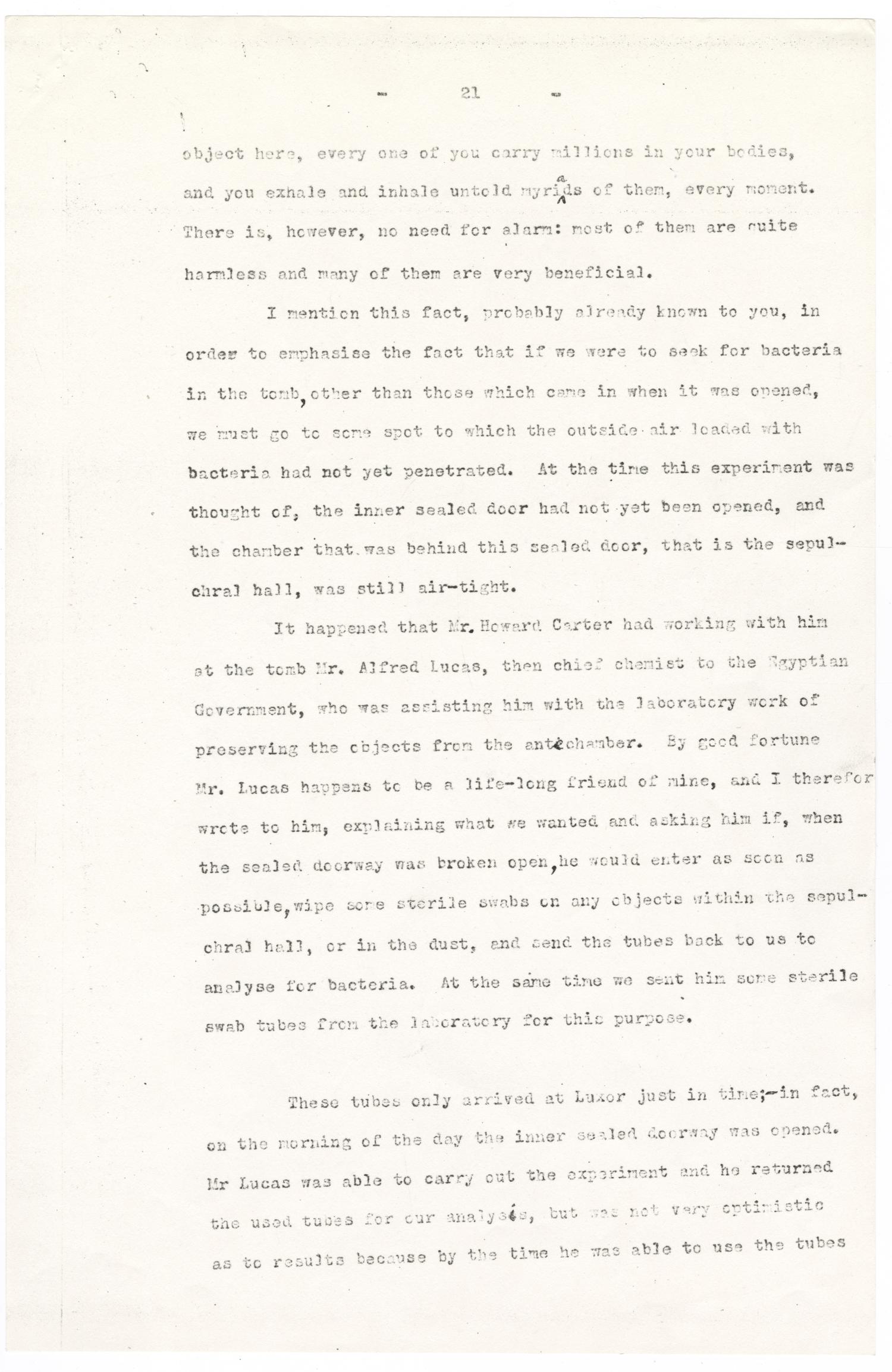
Photocopy of typewritten and annotated notes for a lecture titled 'Scientific Aspects of the Egyptian Discoveries', page 21.
Howard Carter and Alfred Lucas are mentioned on this page.

© Griffith Institute,
University of Oxford
– 21 –
object here, every one of you carry millions in your bodies,
and you exhale and inhale untold myri<a>ds of them, every moment.
There is, however, no need for alarm: most of them are quite
harmless and many of them are very beneficial.
I mention this fact, probably already known to you, in
order to emphasise the fact that if we were to seek for bacteria
in the tomb<,> other than those which came in when it was opened,
we must go to some spot to which the outside air loaded with
bacteria had not yet penetrated. At the time this experiment was
thought of, the inner sealed door had not yet been opened, and
the chamber that was behind this sealed door, that is the sepul-
chral hall, was still air-tight.
It happened that Mr. Howard Carter had working with him
at the tomb Mr. Alfred Lucas, then chief chemist to the Egyptian
Government, who was assisting him with the laboratory work of
preserving the objects from the anti/<e>chamber. By good fortune
Mr. Lucas happens to be a life-long friend of mine, and I therefor[e]
wrote to him, explaining what we wanted and asking him if, when
the sealed doorway was broken open<,> he would enter as soon as
possible<,> wipe some sterile swabs on any objects within the sepul-
chral hall, or in the dust, and send the tubes back to us to
analyse for bacteria. At the same time we sent him some sterile
swab tubes from the laboratory for this purpose.
These tubes only arrived at Luxor just in time<;-> in fact,
on the morning of the day the inner sealed doorway was opened.
Mr Lucas was able to carry out the experiment and he returned
the used tubes for our analyse/<i>s, but was not very optimistic
as to results because by the time he was able to use the tubes