
TAA i.3.9.24
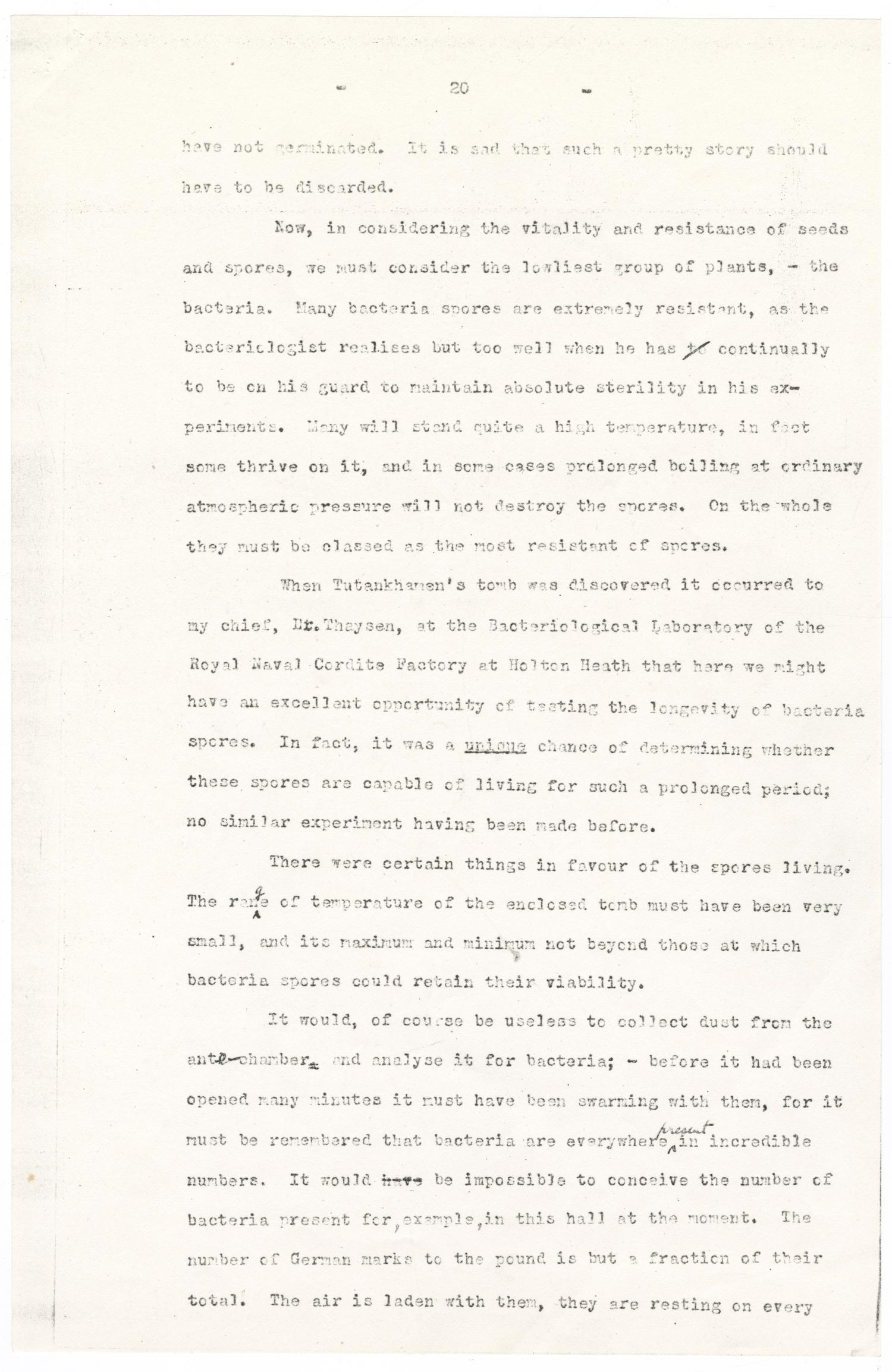
Photocopy of typewritten and annotated notes for a lecture titled 'Scientific Aspects of the Egyptian Discoveries', page 20.
Dr. Theysen is mentioned on this page.

© Griffith Institute,
University of Oxford
– 20 –
have not germinated. It is sad that such a pretty story should
have to be discarded.
Now, in considering the vitality and resistance of seeds
and spores, we must consider the lowliest group of plants, – the
bacteria. Many bacteria spores are extremely resistant, as the
bacteriologist realises but too well when he has to continually
to be on his guard to maintain absolute sterility in his ex-
periments. Many will stand quite a high temperature, in fact
some thrive on it, and in some cases prolonged boiling at ordinary
atmospheric pressure will not destroy the spores. On the whole
they must be classed as the most resistant of spores.
When Tutankhamen's tomb was discovered it occurred to
my chief, Dx[?]/<r>. Theysen, at the Bacteriological Laboratory of the
Royal Naval Cordite Factory at Holton Heath that here we might
have an excellent opportunity of testing the longevity of bacteria
spores. In fact, it was a unique chance of determining whether
these spores are capable of living for such a prolonged period;
no similar experiment having been made before.
There were certain things in favour of the spores living.
The ran<g>e of temperature of the enclosed tomb must have been very
small, and its maximum and minimum not beyond those at which
bacteria spores could retain their viability.
It would, of course be useless to collect dust from the
anti/<e>-chamber, and analyse it for bacteria; – before it had been
opened many minutes it must have been swarming with them, for it
must be remembered that bacteria are everywhere <present> in incredible
numbers. It would have be impossible to conceive the number of
bacteria present for<,> example<,> in this hall at the moment. The
number of German marks to the pound is but a fraction of their
total. The air is laden with them, they are resting on every