
TAA i.3.9.22
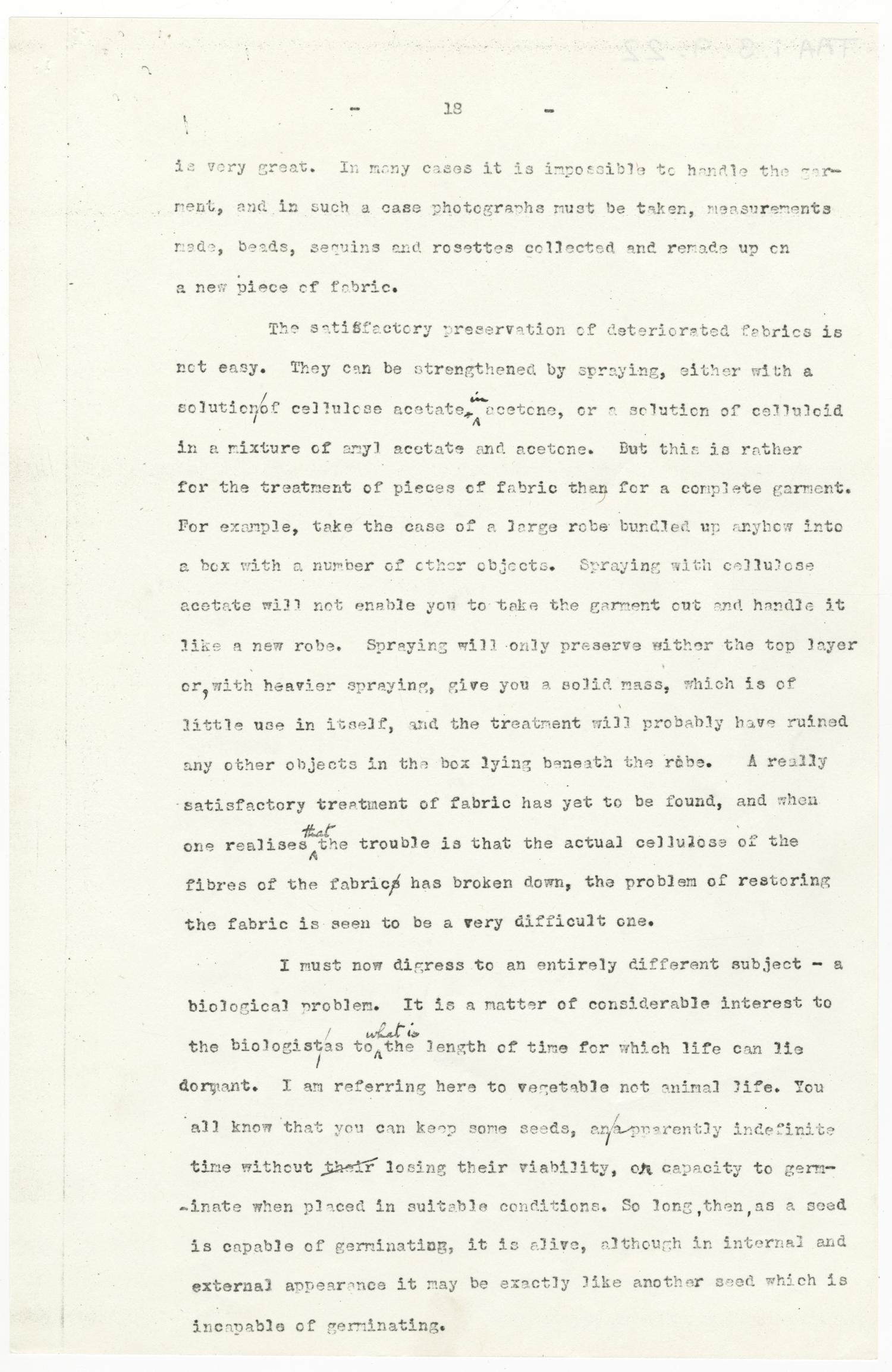
Photocopy of typewritten and annotated notes for a lecture titled 'Scientific Aspects of the Egyptian Discoveries', page 18.

© Griffith Institute,
University of Oxford
– 18 –
is very great. In many cases it is impossible to handle the gar-
ment, and in such case photographs must be taken, measurements
made, beads, sequins and rosettes collected and remade up on
a new piece of fabric.
The satif/<s>factory preservation of deteriorated fabrics is
not easy. They can be strengthened by spraying, either with a
solution </> of cellulose acetate, <in> acetone, or a solution of celluloid
in a mixture of amyl acetate and acetone. But this is rather
for the treatment of pieces of fabric then for a complete garment.
For example, take the case of a large robe bundled up anyhow into
a box with a number of other objects. Spraying with cellulose
acetate will not enable you to take the garment out and handle it
like a new robe. Spraying will only preserve w/<e>ither the top layer
or<,> with heavier spraying, give you a solid mass, which is of
little use in itself, and the treatment will probably have ruined
any other objects in the box lying beneath the robe. A really
satisfactory treatment of fabric has yet to be found, and when
one realises <that> the trouble is that the actual cellulose of the
fibres of the fabrics has broken down, the problem of restoring
the fabric is seen to be a very difficult one.
I must now digress to an entirely different subject – a
biological problem. It is a matter of considerable interest to
the biologist </> as to <what is> the length of time for which life can lie
dormant. I am referring here to vegetable not animal life. You
all know you can keep some seeds, an </> a pparently indefinite
time without their losing their viability, on/<r> capacity to germ-
<->inate when placed in suitable conditions. So long, then, as a seed
is capable of germinating, it is alive, although in internal and
external appearance it may be exactly like another seed which is
incapable of germinating.