
TAA i.3.9.21
Photocopy of typewritten and annotated notes for a lecture titled 'Scientific Aspects of the Egyptian Discoveries', page 17.

© Griffith Institute,
University of Oxford
– 17 –
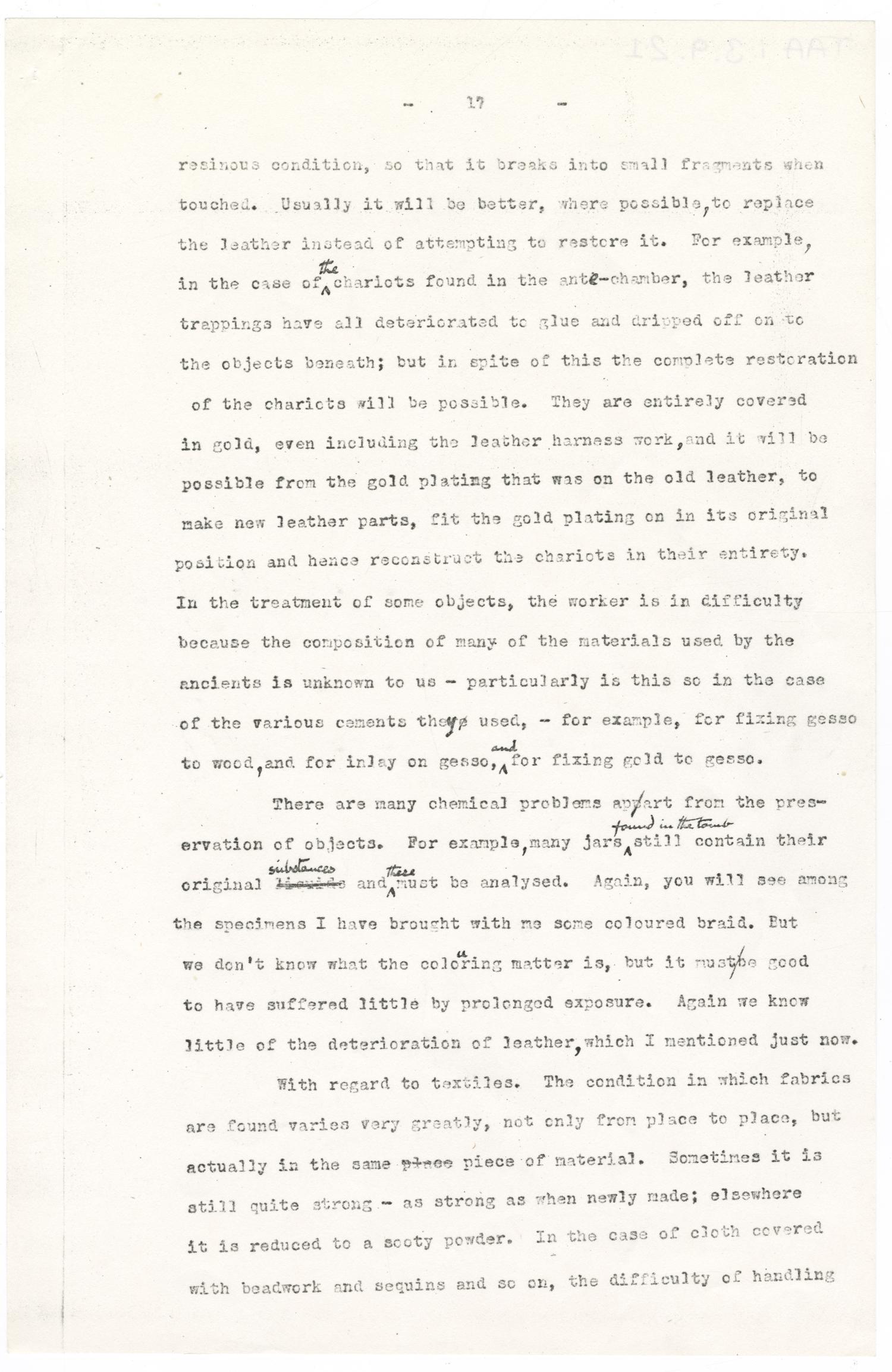
resinous condition, so that it breaks into small fragments when
touched. Usually it will be better, where possible<,> to replace
the leather instead of attempting to restore it. For example<,>
in the case of <the> chariots found in the anti/<e>-chamber, the leather
trappings have all deteriorated to glue and dripped off on to
the objects beneath; but in spite of this the complete restoration
of the chariots will be possible. They are entirely covered
in gold, even including the leather harness work<,> and it will be
possible from the gold plating that was on the old leather, to
make new leather parts, fit the gold plating on in its original
position and hence reconstruct the chariots in their entirety.
In the treatment of some objects, the worker is in difficulty
because the composition of many of the materials used by the
ancients is unknown to us – particularly is this so in the case
of the various cements ther/<y>e used, – for example, for fixing gesso
to wood<,> and for inlay on gesso, <and> for fixing gold to gesso.
There are many chemical problems appart from the pres-
ervation of objects. For example<,> many jars <found in the tomb> still contain their
original liquids/<substances> and <these> must be analysed. Again, you will see among
the specimens I have brought with me some coloured braid. But
we don’t know what the colo<u>ring matter is, but it must </> be good
to have suffered little by prolonged exposure. Again we know
little of the deterioration of leather<,> which I mentioned just now.
With regard to textiles. The condition in which fabrics
are found varies very greatly, not only from place to place, but
actually in the same place piece of material. Sometimes it is
still quite strong – as strong as when newly made; elsewhere
it is reduced to a sooty powder. In the case of cloth covered
with beadwork and sequins and so on, the difficulty of handling