TAA i.3.9.19
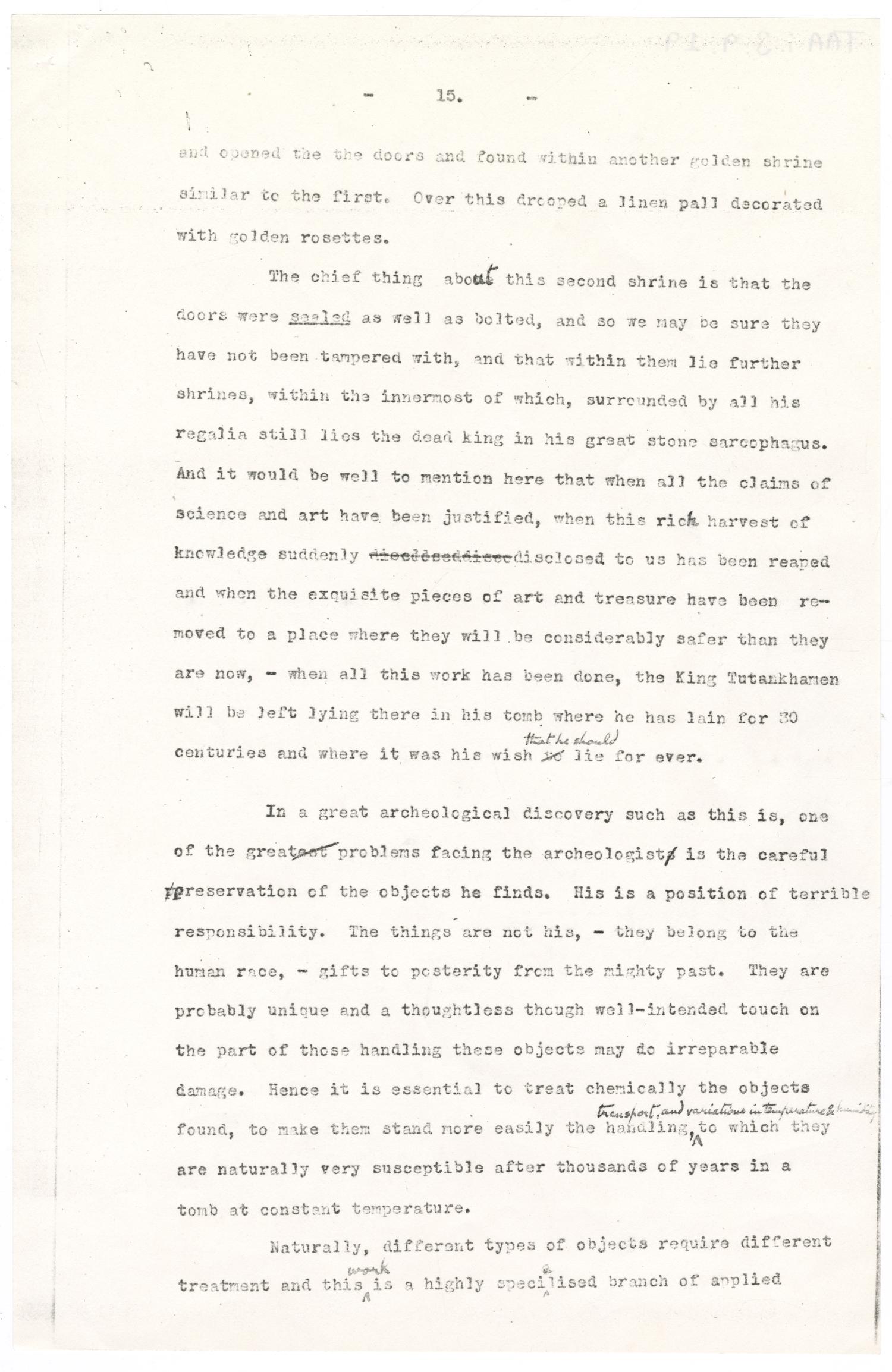
Photocopy of typewritten and annotated notes for a lecture titled 'Scientific Aspects of the Egyptian Discoveries', page 15.

© Griffith Institute,
University of Oxford
– 15. –
and opened the doors and found within another golden shrine
similar to the first. Over this drooped a linen pall decorated
with golden rosettes.
The chief thing aboue/<ut> this second shrine is that the
doors were sealed as well as bolted, and so we may be sure they
have not been tampered with, and that within them lie further
shrines, within the innermost of which, surrounded by all his
regalia still lies the dead king in his great stone sarcophagus.
And it would be well to mention here that when all the claims of
science and art have been justified, when this ric<h> harvest of
knowledge suddenly dieeddeeddisee disclosed to us has been reaped
and when the exquisite pieces of art and treasure have been re-
moved to a place where they will be considerably safer than they
are now, – when all this work has been done, the King Tutankhamen
will be left lying there in his tomb where he has lain for 30
centuries and where it was his wish to/<that he should> lie for ever.
In a great archeologicalsic discovery such as this is, one
of the greatest problems facing the archeologistssic is the careful
r/<p>reservation of the objects he finds. His is a position of terrible
responsibility. The things are not his, – they belong to the
human race, – gifts to posterity from the mighty past. They are
probably unique and a thoughtless though well-intended touch on
the part of those handling these objects may do irreparable
damage. Hence it is essential to treat chemically the objects
found, to make them stand more easily the handling<,> <transport, and variation in temperature & humidity> to which they
are naturally very susceptible after thousands of years in a
tomb at constant temperature.
Naturally, different types of objects require different
treatment and this <work> is a highly speci<a>lised branch of applied