
TAA i.3.9.17
Photocopy of typewritten and annotated notes for a lecture titled 'Scientific Aspects of the Egyptian Discoveries', page 13.

© Griffith Institute,
University of Oxford
– 13 –
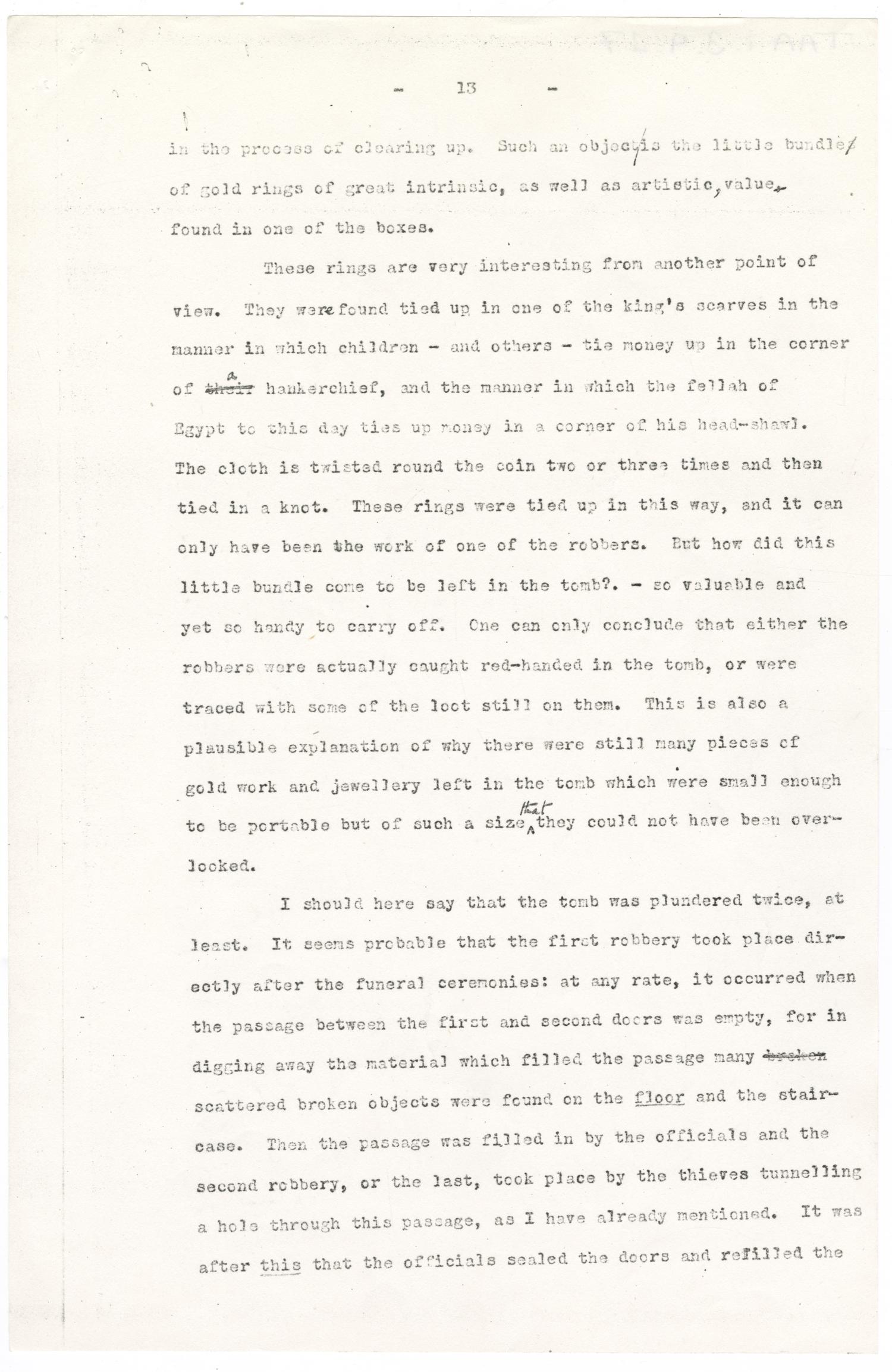
in the process of clearing up. Such an object</>is the little bundles
of gold rings of great intrinsic, as well as artistic<,> value,
found in one of the boxes.
These rings are very interesting from another point of
view. They wer<e> found tied up in one of the king’s scarves in the
manner in which children – and others – tie money up in the corner
of their/<a> hankerchiefsic, and the manner in which the fellah of
Egypt to this day ties up money in a corner of his head-shawl.
The cloth is twisted round the coin two or three times and then
tied in a knot. These rings were tied up in this way, and it can
only have been s/<t>he work of one of the robbers. But how did this
little bundle come to be left in the tomb?. – so valuable and
yet so handy to carry off. One can only conclude that either the
robbers were actually caught red-handed in the tomb, or were
traced with some of the loot still on them. This is also a
plausible explanation of why there were still many pieces of
gold work and jewellery left in the tomb which were small enough
to be portable but of such a size <that> they could not have been over-
looked.
I should here say that the tomb was plundered twice, at
least. It seems probable that the first robbery took place dir-
ectly after the funeral ceremonies: at any rate, it occurred when
the passage between the first and second doors was empty, for in
digging away the material which filled the passage many broken
scattered broken objects were found on the floor and the stair-
case. Then the passage was filled in by the officials and the
second robbery, or the last, took place by the thieves tunnelling
a hole through this passage, as I have already mentioned. It was
after this that the officials sealed the doors and refilled the