
TAA i.3.9.13
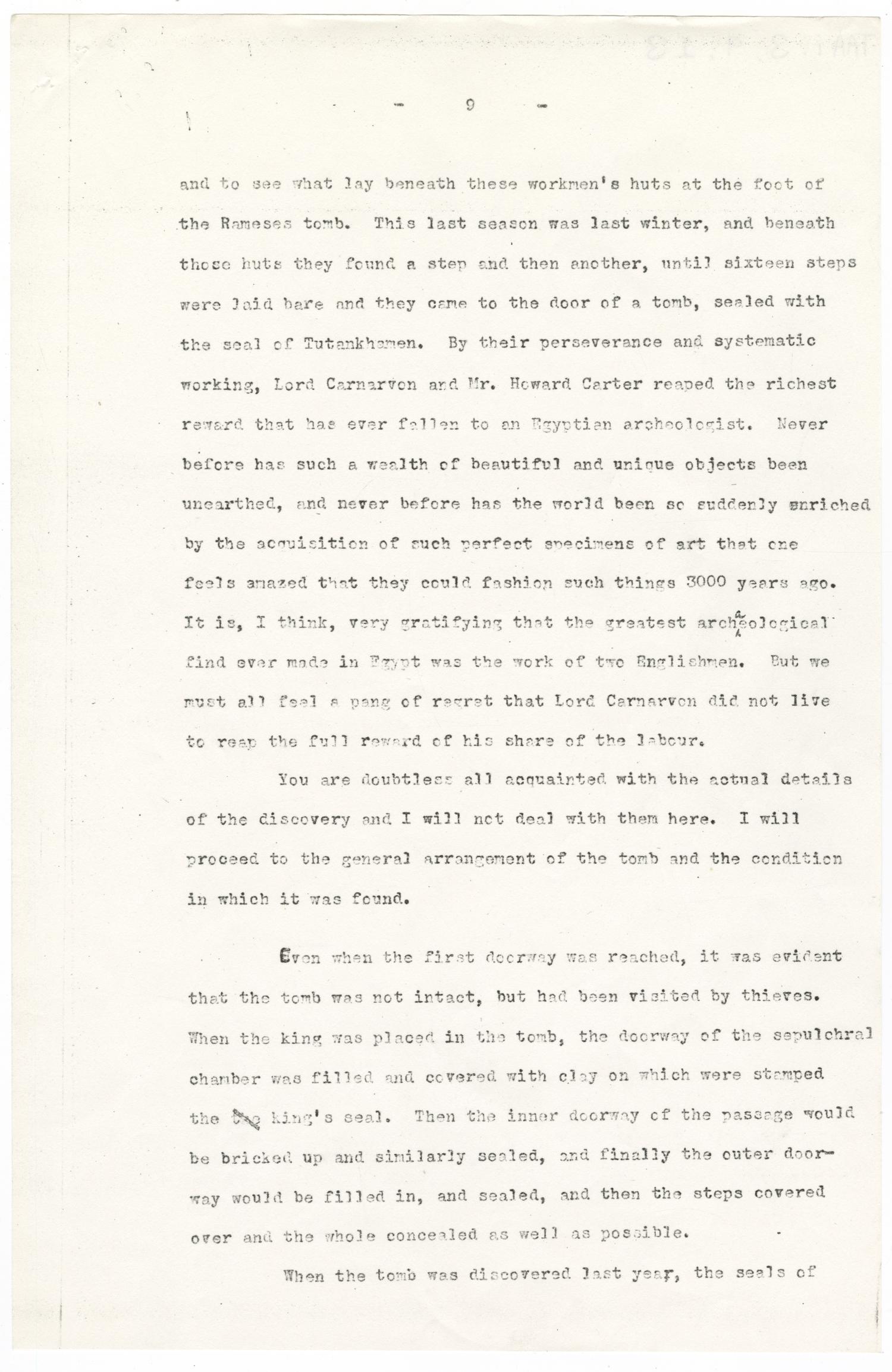
Photocopy of typewritten and annotated notes for a lecture titled 'Scientific Aspects of the Egyptian Discoveries', page 9.
Lord Carnarvon and Howard Carter are also mentioned on this page.

© Griffith Institute,
University of Oxford
– 9 –
and to see what lay beneath these workmen’s huts at the foot of
the Rameses tomb. This last season was last winter, and beneath
those huts they found a step and then another, until sixteen steps
were laid bare and they came to the door of a tomb, sealed with
the seal of Tutankhamen. By their perseverance and systematic
working, Lord Carnarvon and Mr. Howard Carter reaped the richest
reward that has ever fallen to an Egyptian archeologistsic. Never
before has such a wealth of beautiful and unique objects been
unearthed, and never before has the world been so suddenly n/<e>nriched
by the acquisition of such perfect specimens of art that one
feels amazed that they could fashion such things 3000 years ago.
It is, I think, very gratifying that the greatest arch<a>eological
find ever made in Egypt was the work of two Englishmen. But we
must all feel a pang of regret that lord Carnarvon did not live
to reap the full reward of his share of the labour.
You are doubtless all acquainted with the actual details
of the discovery and I will not deal with them here. I will
proceed to the general arrangement of the tomb and the condition
in which it was found.
H/<E>ven when the first doorway was reached, it was evident
that the tomb was not intact, but had been visited by thieves.
When the king was placed in the tomb, the doorway of the sepulchral
chamber was filled and covered with clay on which were stamped
the the king’s seal. Then the inner doorway of the passage would
be bricked up and similarly sealed, and finally the outer door-
way would be filled in, and sealed, and then the steps covered
over and the wholesic concealed as well as possible.
When the tomb was discovered last yea,/<r>, the seals of