
TAA i.3.9.12
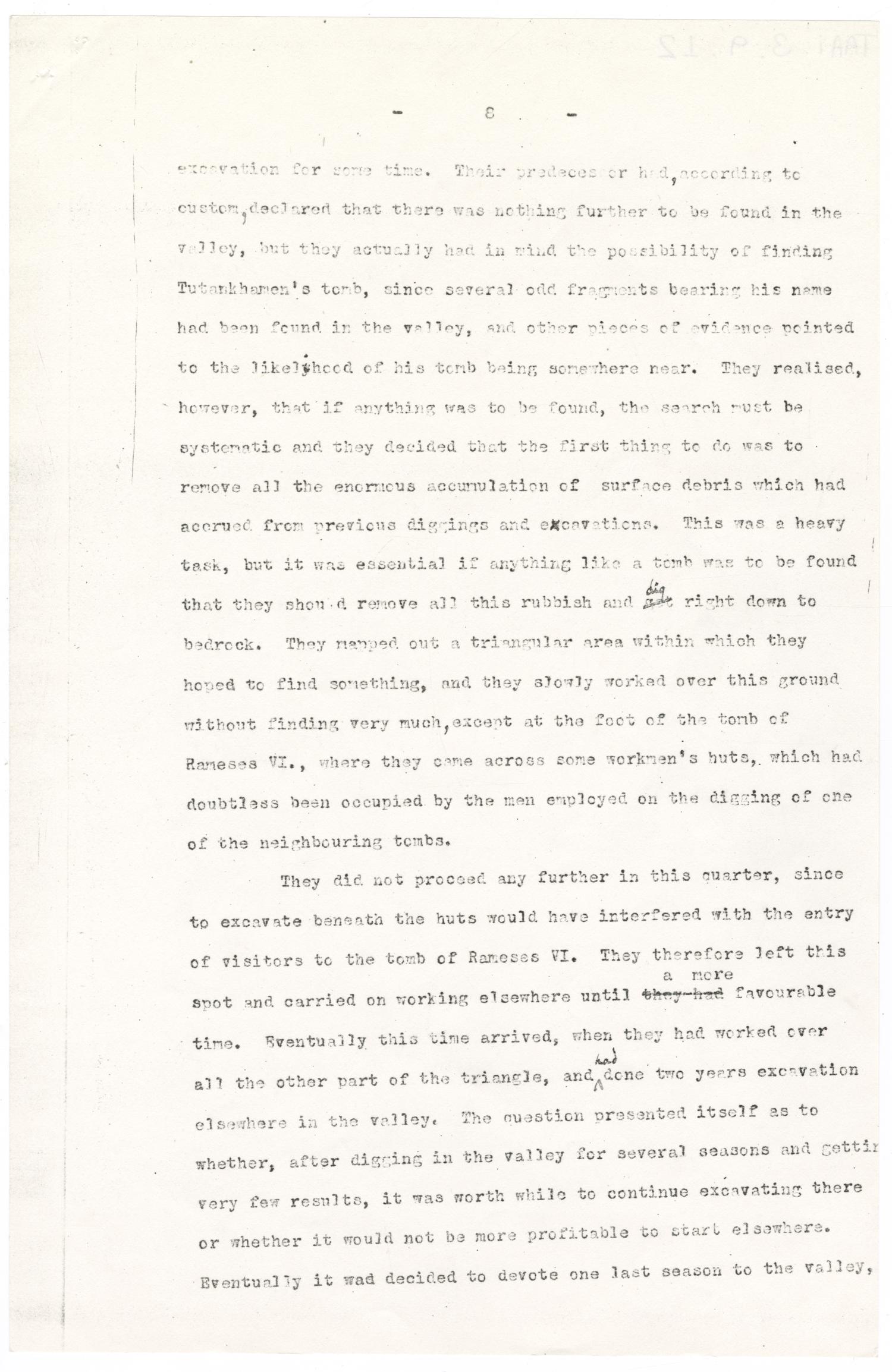
Photocopy of typewritten and annotated notes for a lecture titled 'Scientific Aspects of the Egyptian Discoveries', page 8.

© Griffith Institute,
University of Oxford
– 8 –
excavation for some time. Their predecessor had<,> according to
Custom<,> declared that there was nothing further to be found in the
valley, but there actually had in mind the possibility of finding
Tutankhamen’s tomb. since several odd fragments bearing his name
had been found in the valley, and other pieces of evidence pointed
to the likely/<i>hood of his tomb being somewhere near. They realised,
however, that if anything was to be found, the search must be
systematic and they decided that the first thing to do was to
remove all the enormous accumulation of surface debris which had
accrued from previous diggings and es/<x>cavations. This was a heavy
task, but it was essential if anything like a tomb was to be found
that they should remove all this and get/<dig> right down to
bedrock. They mapped out a triangular area within which they
hoped to find something, and they slowly worked over this ground
without finding very much<,> except at the foot of the tomb of
Rameses VI., where they came across some workmen’s huts, which had
doubtless been occupied by the men employed on the digging of one
of the neighbouring tombs.
They did not proceed any further in this quarter, since
to excavate beneath the huts would have interfered with the entry
of visitors to the tomb of Rameses VI. They therefore left this
spot and carried on working elsewhere until they had/<a more> favourable
time. Eventually this time arrived, when they had worked over
all the other part of the triangle, and <had> done two years excavation
elsewhere in the valley. The question presented itself as to
whether, after digging in the valley for several seasons and gettin[g]
very few results, it was worth while to continue excavating there
or whether it would not be more profitable to start elsewhere.
Eventually it wad/<s> decided to devote one last season to the valley,