
TAA i.3.8.43
Handwritten and annotated notes on chariots, page A2.

© Griffith Institute,
University of Oxford
A (2)
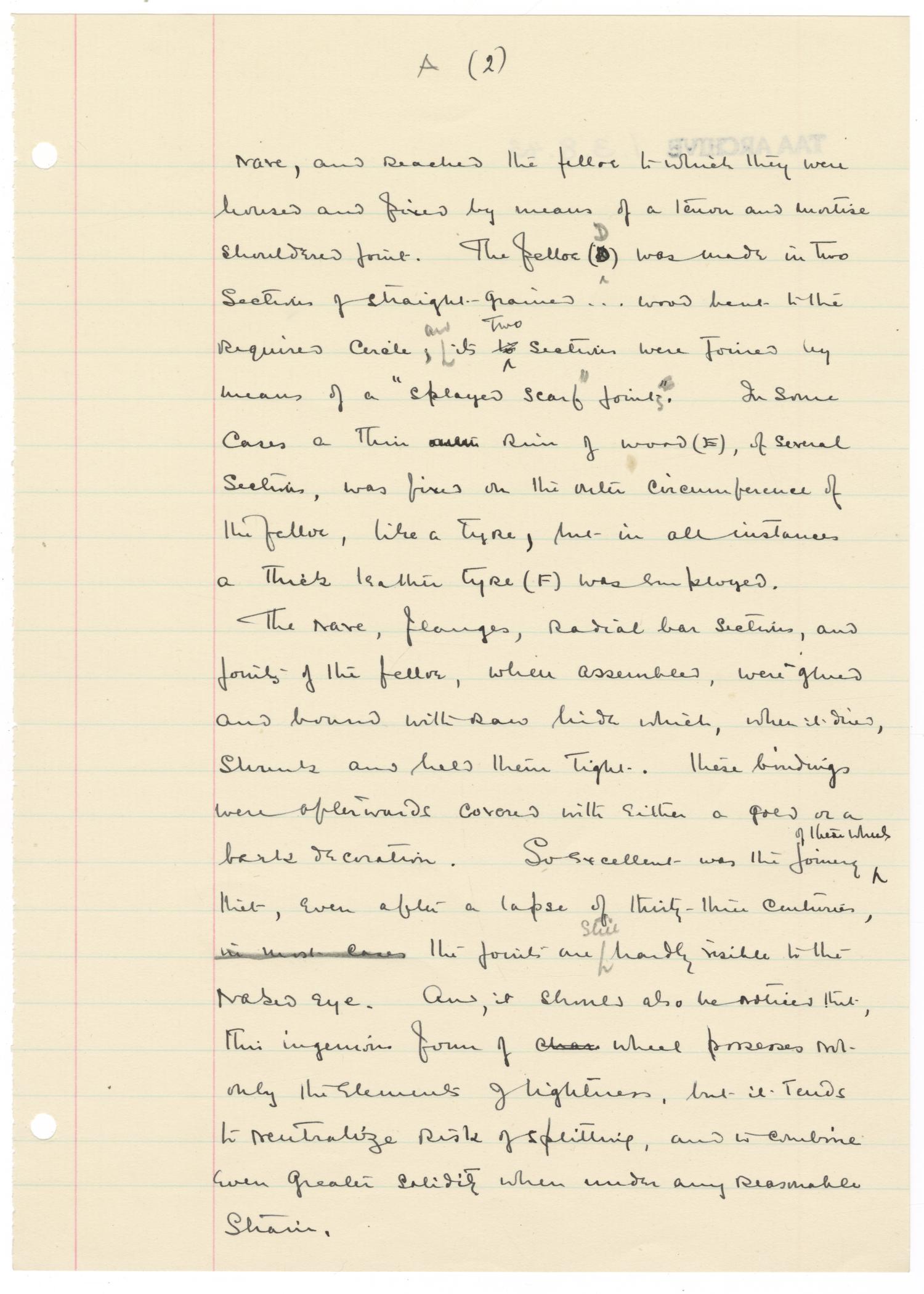
nave, and reached the felloe to which they were
housed and fixed by means of a tenon and mortise
shouldered joint. The felloe (B/<D>) was made in two
sections of straight-grained ... wood bent to the
required circle, <and> its to/<two> sections were joined by
means of a "splayed scarf<"> joint<s>". In some
cases a thin outer rim of wood (E), of several
sections, was fixed on the outer circumference of
the felloe, like a tyre, but in all instances
a thick leather tyre (F) was employed.
The nave, flanges, radial bar sections, and
joints of the felloe, when assembled, were glued
and bound with raw hide which, when it dried,
shrunk and held them tight. These bindings
were afterwards covered with either a gold or a
bark decoration. So excellent was the joinery <of these wheels>
that, even after a lapse of thirty-three centuries, in most cases the joints are <still> hardly visible to the
naked eye. And, it should also be noticed that,
this ingenious form of char wheel possesses not
only the elements of lightness, but it tends
to neutralize risk of splitting, and to combine
even greater solidity when under any reasonable
strain.