
TAA i.3.8.42
Handwritten and annotated notes on chariots, page A1.

© Griffith Institute,
University of Oxford
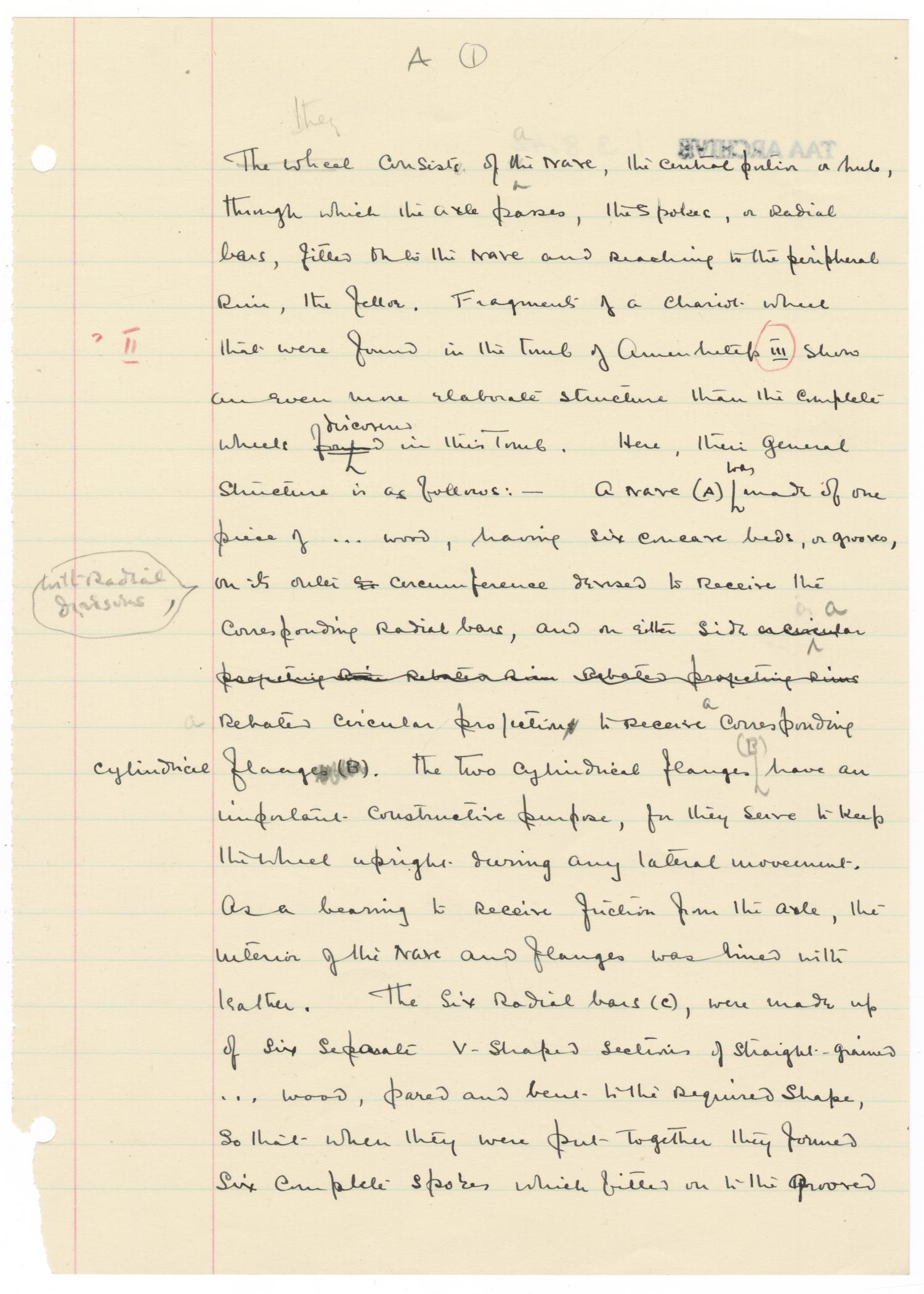
A (1)The wheel/<They> consist of the/<a> nave, the central portion or hub,
through which the axle passes, the spokes, or radial
bars, fitted onto the nave and reaching to the peripheral
rim, the felloe. Fragments of a chariot wheel
that were found in the tomb of Amenhotep III <?II> show
an even more elaborate structure than the complete
wheels found/<discovered> in this tomb. Here, their general
structure is as follows:- A nave (A) <was> made of one
piece of ... wood, having six concave beds, or grooves,
<with radial divisions,> on its outer ex circumference devised to receive the
corresponding radial bars, and on either side a circular/<a> projecting rein rebated rein rebated projecting reins
rebated circular projections to receive <a> corresponding
<cylindrical> flanges (B). The two cylindrical flanges <(B)> have an
important constructive purpose, for they serve to keep
the wheel upright during any lateral movement.
As a bearing to receive friction from the axle, the
interior of the nave and flanges was lined with
leather. The six radial bars (C), were made up
of six separate v-shaped sections of straight-grained
... wood, pared and bent to the required shape,
so that when they were put together they formed
six complete spokes which fitted on to the x[?]/<g>rooved