
TAA i.3.8.41.recto
Handwritten and annotated notes on chariots, page 1.
The whole text or part of the text is fully struck through on this page but is not indicated in the transcription. On this page, strikethrough formatting is reserved for the author’s edits and deletions within the main body of the text, which would otherwise be difficult to distinguish.

© Griffith Institute,
University of Oxford
(1)
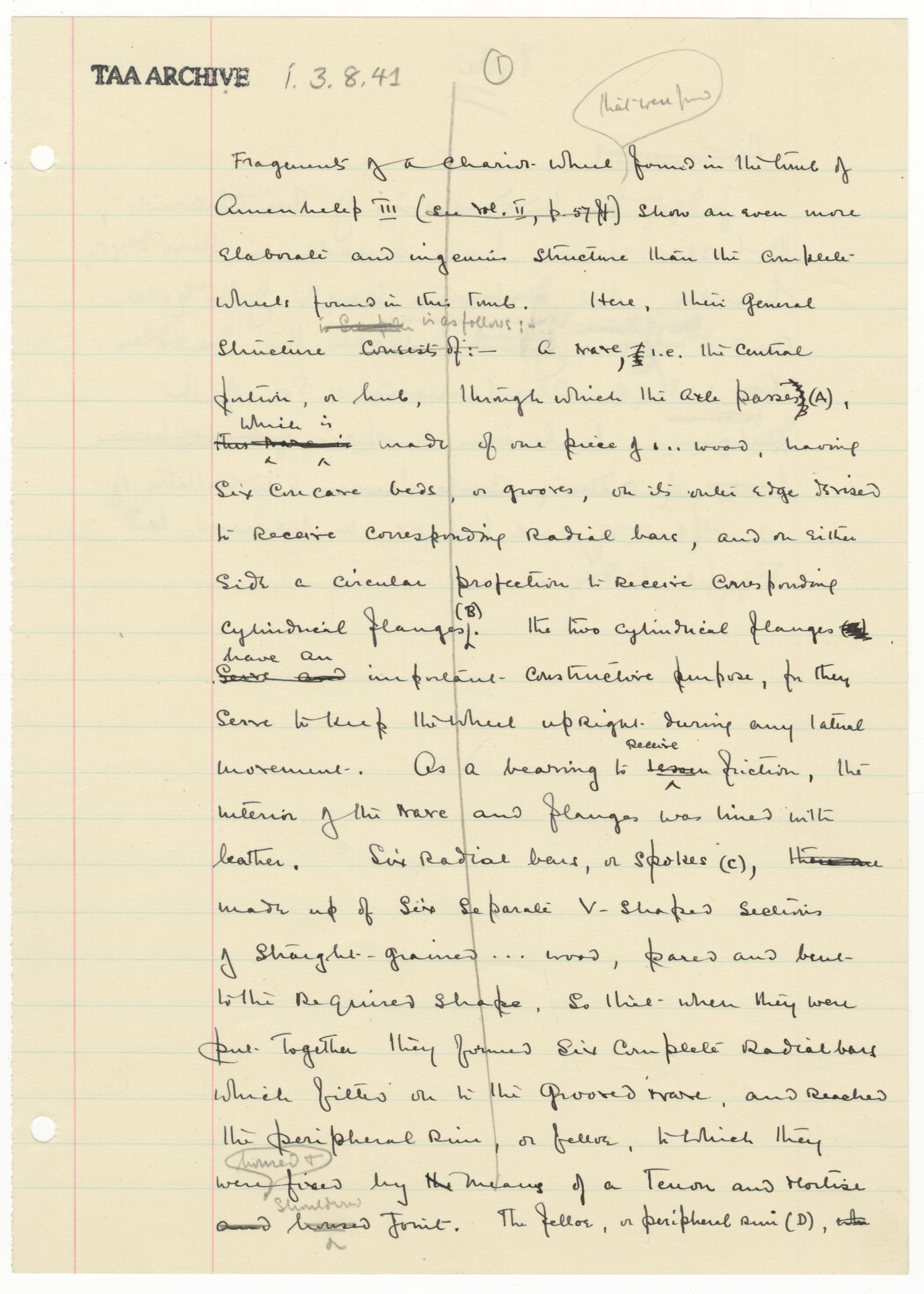
Fragments of a chariot wheel which <that were found> found in the tomb of
Amenhotep III (see Vol. II, p. 57 ff) show an even more
elaborate and ingenious structure than the complete
wheels found in this tomb. Here, their general
structure <is sculpted[?]> consists of/<is as follows:-> a nave, (i.e. the central
portion, or hub, through which the axle passes) (A), this axle is/<which is> made of one piece of ... wood, having
six concave beds, or grooves, on its outer edge devised
to receive corresponding radial bars, and on either
side a circular projection to receive corresponding
cylindrical flanges <(B)>. The two cylindrical flanges (B)serve and/<have an> important constructive purpose, for they
serve to keep the wheel upright during any lateral
movement. As a bearing to lessen/<receive> friction, the
interior of the nave and flanges was lined with
leather. Six radial bars, or spokes (C), these are
made up of six separate V-shaped sections
of straight-grained ... wood, pared and bent
to the required shape, so that when they were
put together they formed six complete radial bars
which fitted on to the grooved nave, and reached
the peripheral rim, or felloe, to which they
were <bound &> fixed by the means of a tenon and mortise and housed/<shouldered> joint. The felloe, or peripheral rim (D), whi