
TAA i.3.8.37
Handwritten and annotated notes on chariots, page 1 (for typewritten copy, see TAA i.3.8.18-19).

© Griffith Institute,
University of Oxford
THE CHARIOT
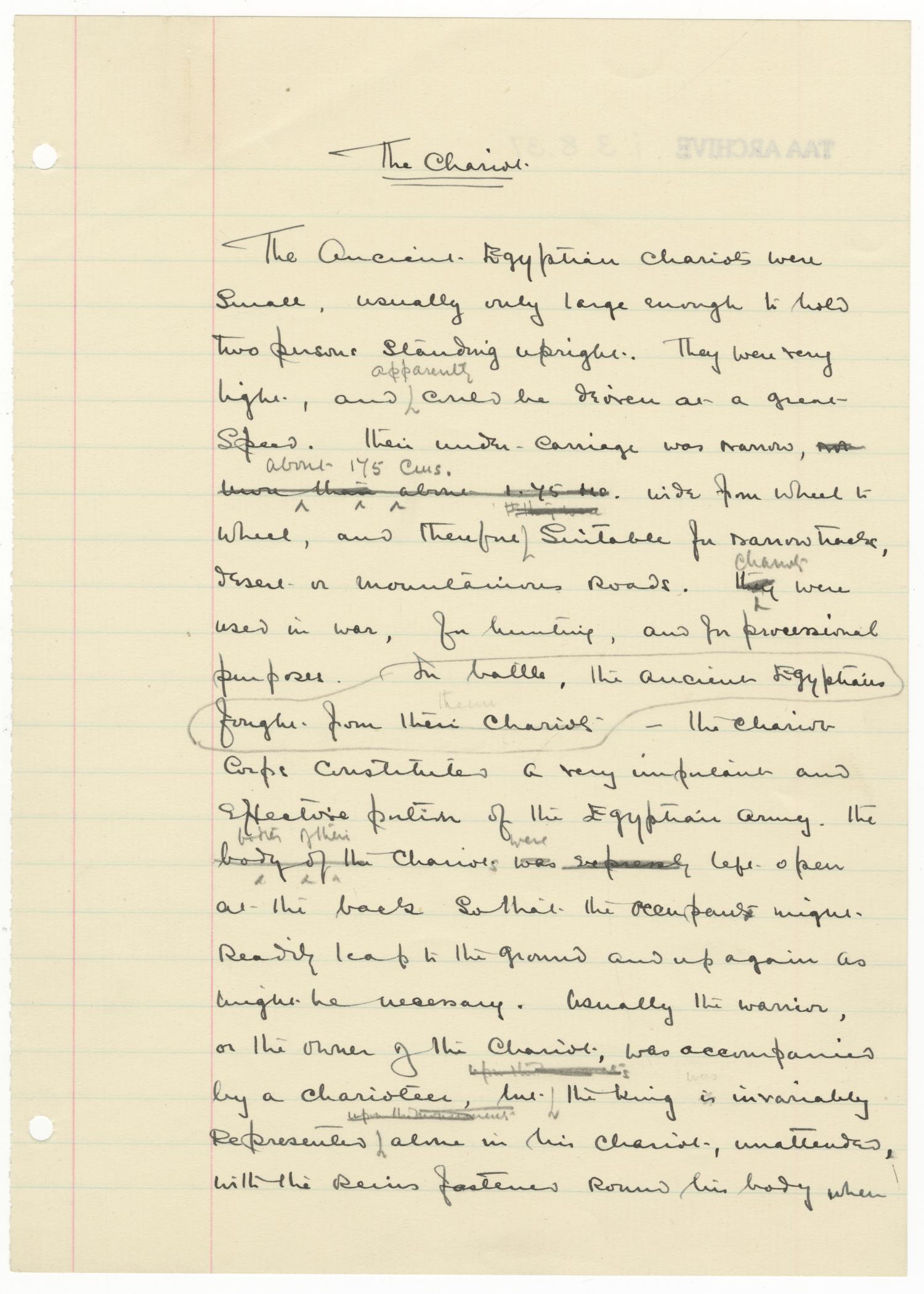
The ancient Egyptian chariots were
small, usually only large enough to hold
two persons standing upright. They were very
light, and <apparently> could be driven at a great
speed. Their under-carriage was narrow, notmore than about 1.75ms./< about 175cms.> wide from wheel to
wheel, and therefore <they were> suitable for narrow tracks,
desert, or mountainous roads. They/<chariots> were
used in war, for hunting, and for processional
purposes. <In battle, the ancient Egyptians
fought from their chariots> – the chariot
corps constituted a very important and
effective portion of the Egyptian army. The body of the/<bodies of their> chariots was/<were> expressly left open
at the back so that the occupants might
readily leap to the ground and up again as
might be necessary. Usually the warrior,
or the owner of the chariot, was accompanied
by a charioteer, but <upon the chariots[?]> the king is invariably
represented < upon the chariots>, alone in his chariot, unattended,
with the reins fastened round his body when