
TAA i.3.8.22
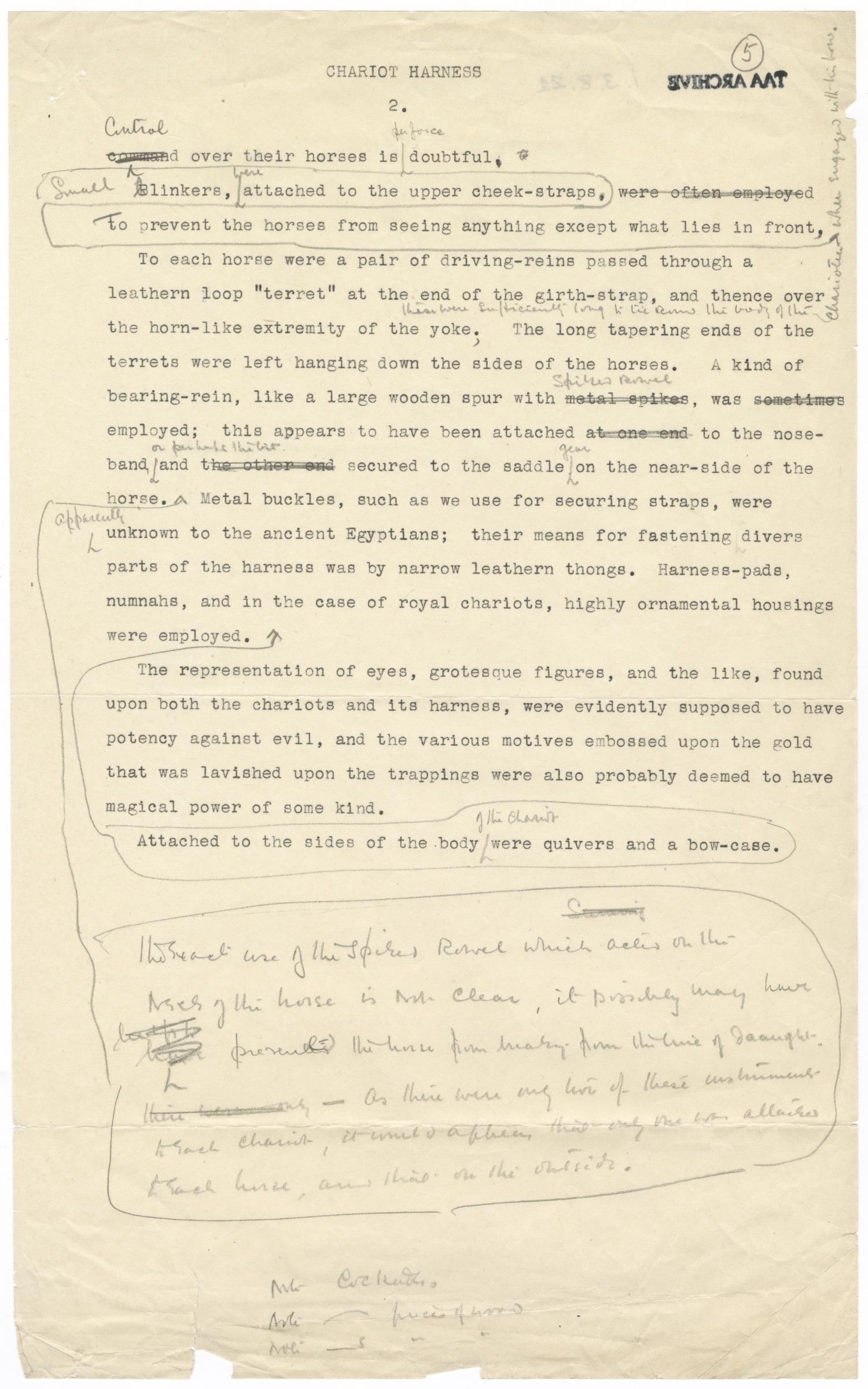
Typewritten and annotated notes on chariots page 5, with details on the chariot harness, numbered page 2.

© Griffith Institute,
University of Oxford
(5)
CHARIOT HARNESS
2.command/<control> over their horses is <perforce> doubtful.
<Small> B/<b>linkers, <were> attached to the upper cheek-straps,/<.> were often employedt/<T>o prevent the horses from seeing anything except what lies in front./<,>
To each horse were a pair of driving-reins passed through a
leathern loop "terret" at the end of the girth-strap, and thence over
the horn-like extremity of the yoke./<;> <these were sufficiently long to tie round the body of the charioteer when engaged with his bow.> The long tapering ends of the
terrets were left hanging down the sides of the horses. A kind of
bearing-rein, like a large wooden spur with metal spikes/<spiked rowel>, was sometimes
employed; this appears to have been attached at one end to the nose-
band <or perhaps the bit> and the other end secured to the saddle <gear> on the near-side of the horse. <The exact use of the spiked rowel which <securing> acted on the
neck of the horse is not clear, it possibly may have xxx[?] prevenx[?]/<t>ed the horse from breaking from the line of draught.
these were only – as there were only two of these instruments
to each chariot, it would appear that only one was attached
to each horse, and that on the outside.> Metal buckles, such as we use for securing straps, were <apparently> unknown to the ancient Egyptians; their means for fastening divers
parts of the harness was by narrow leathern thongs. Harness-pads,
numnahs, and in the case of royal chariots, highly ornamental housings
were employed. <Attached to the sides of the body <of the chariot> were quivers and a bow-case.>
The representation of eyes, grotesque figures, and the like, found
upon both the chariots and its harness, were evidently supposed to have
potency against evil, and the various motives embossed upon the gold
that was lavished upon the trappings were also probably deemed to have
magical power of some kind.
Note cockades
Note [ 𓂀 ] pieces of wood
Note [ 𓂀 ] " "