
TAA i.3.8.21
Typewritten and annotated notes on chariots page 4, with details on the chariot harness, numbered page 1.
© Griffith Institute,
University of Oxford
(4)
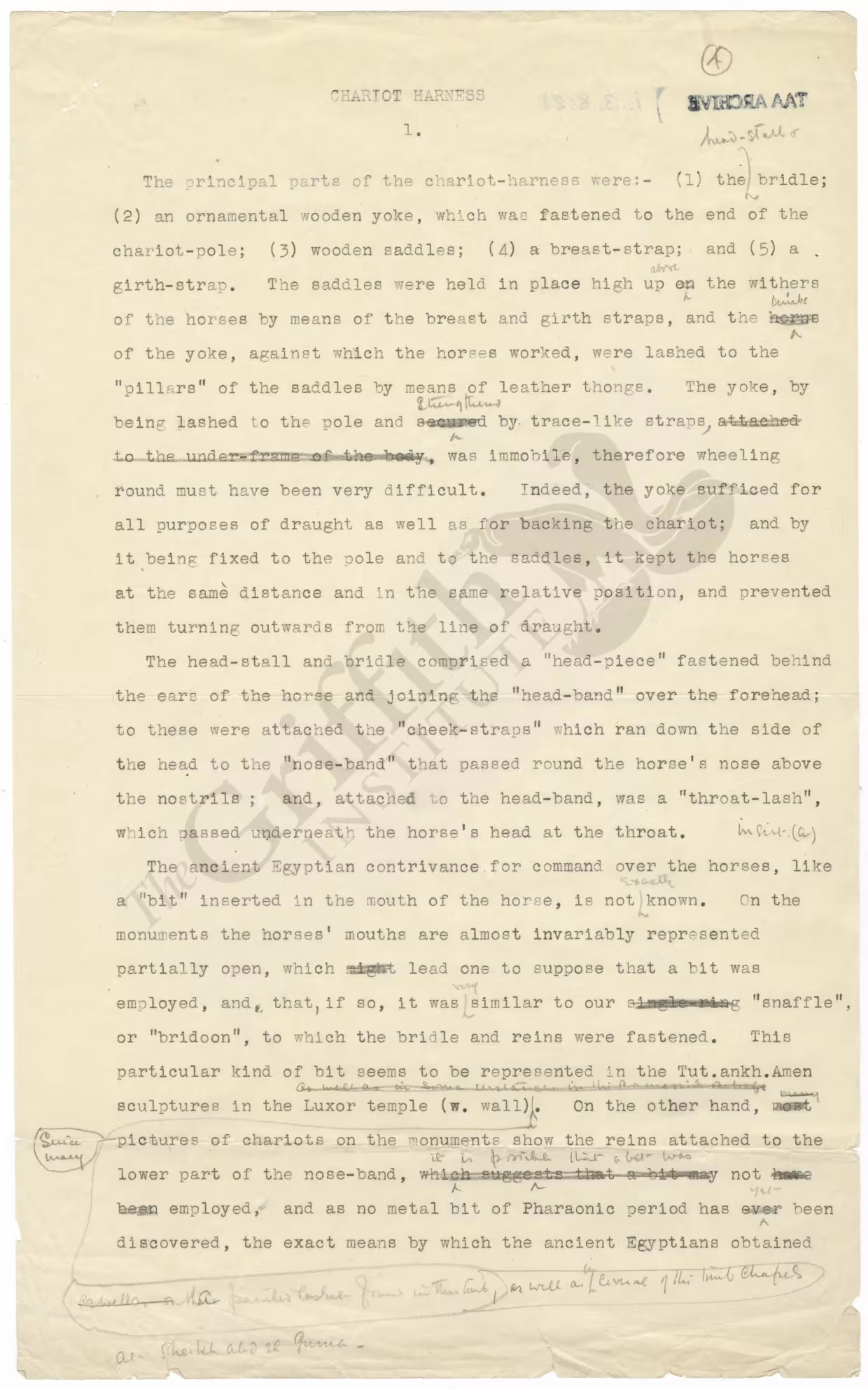
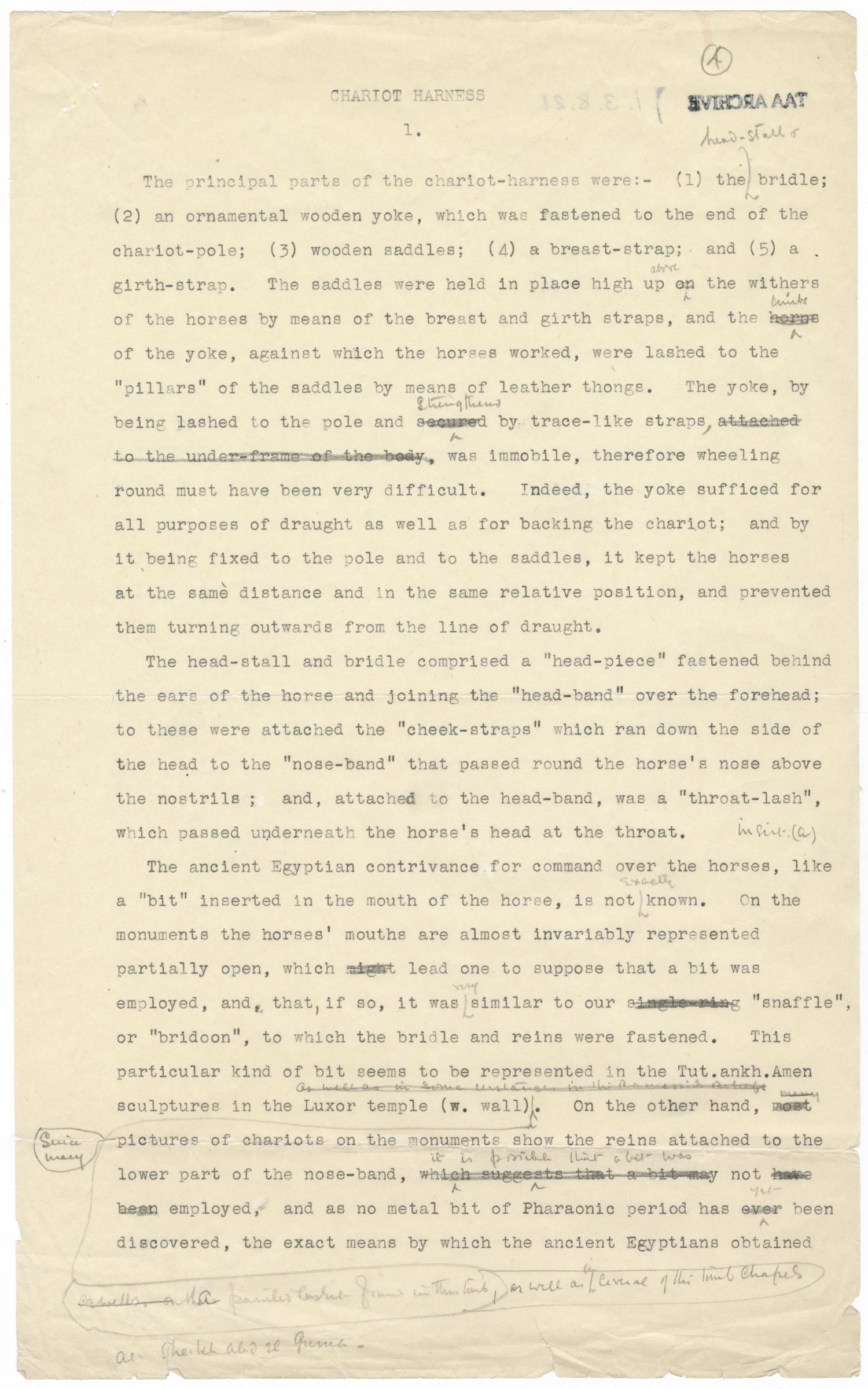
CHARIOT HARNESS
1.
The principal parts of the chariot-harness were:- (1) the <head-stall &> bridle;
(2) an ornamental wooden yoke, which was fastened to the end of the
chariot-pole; (3) wooden saddles; (4) a breast-strap; and (5) a
girth-strap. The saddles were held in place high up <above> on the withers
of the horses by means of the breast and girth straps, and the horns/<limbs>
of the yoke, against which the horses worked, were lashed to the
"pillars" of the saddles by means of leather thongs. The yoke, by
being lashed to the pole and secured/<strengthened> by trace-like straps<,> attachedto the under-frame of the body, was immobile, therefore wheeling
round must have been very difficult. Indeed, the yoke sufficed for
all purposes of draught as well as for backing the chariot; and by
it being fixed to the pole and to the saddles, it kept the horses
at the same distance and in the same relative position, and prevented
them turning outwards from the line of draught.
The head-stall and bridle comprised a "head-piece" fastened behind
the ears of the horse and joining the "head-band" over the forehead;
to these were attached the "cheek-straps" which ran down the side of
the head to the "nose-band" that passed round the horse's nose above
the nostrils; and, attached to the head-band, was a "throat-lash",
which passed underneath the horse's head at the throat. <insert (a)>
The ancient Egyptian contrivance for command over the horses, like
a "bit" inserted in the mouth of the horse, is not <exactly> known. On the
monuments the horses' mouths are almost invariably represented
partially open, which might lead one to suppose that a bit was
employed, and that<,> if so, it was <very> similar to our single-ring "snaffle",
or "bridoon", to which the bridle and reins were fastened. This
particular kind of bit seems to be represented in the Tut.ankh.Amen
sculptures in the Luxor temple (w. wall) <as well as in some instances in the Ramessid reliefs>/<as well as on a painted casket found in this tomb, as well as <in> several of the tomb chapels at Sheikh Abd el Gurna.> On the other hand, most/<many>
<since many> pictures of chariots on the monuments show the reins attached to the
lower part of the nose-band, which suggests that a bit may/<it is possible that a bit was> not have been employed, and as no metal bit of Pharaonic period has ever/<yet> been
discovered, the exact means by which the ancient Egyptians obtained