
TAA i.3.8.20
Typewritten and annotated notes on chariots, page 3.

© Griffith Institute,
University of Oxford
(3)
THE CHARIOT.
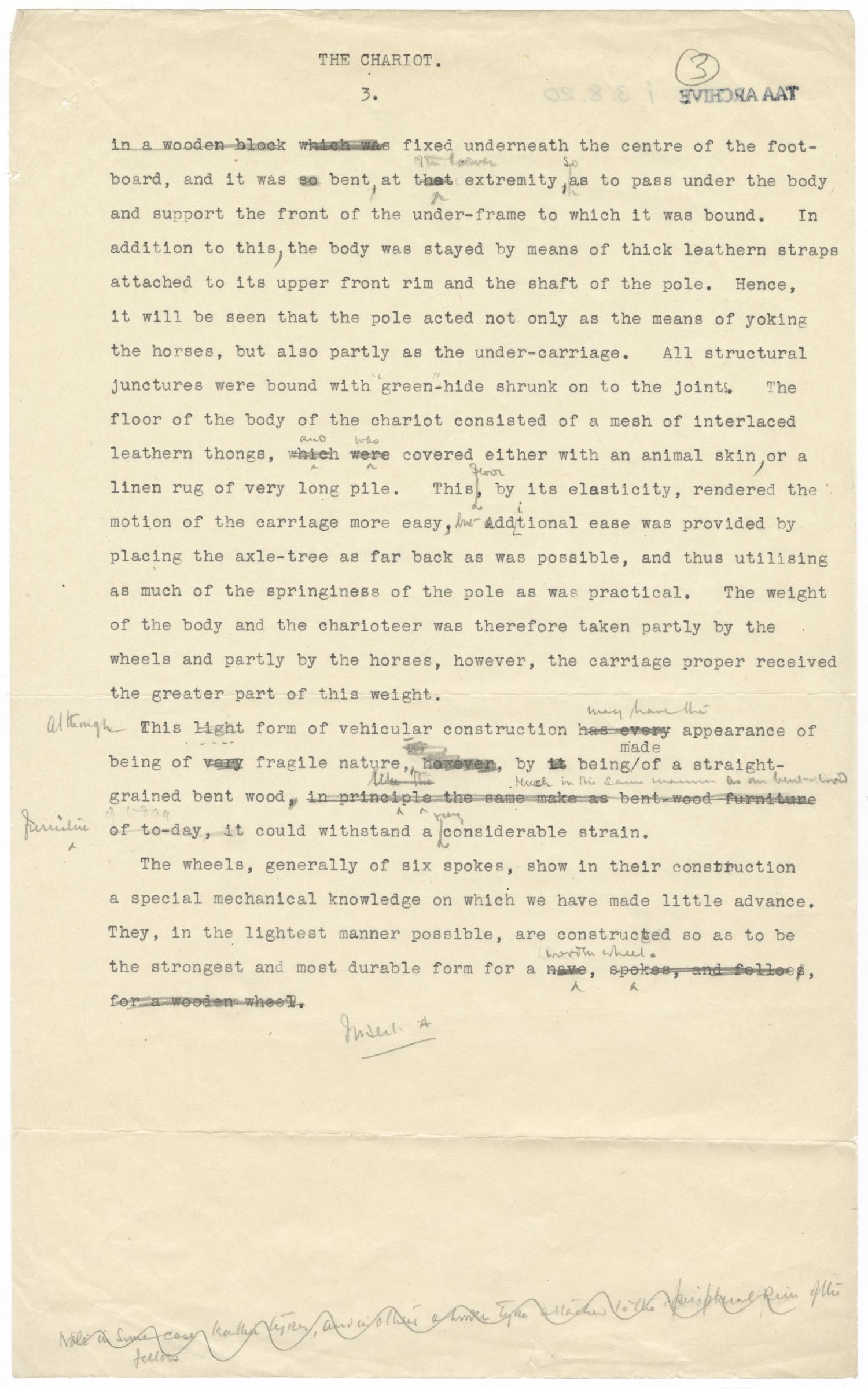
3.in a wooden block which was fixed underneath the centre of the foot-
board, and it was so bent at that/<the lower> extremity<, so> as to pass under the body
and support the front of the under-frame to which it was bound. In
addition to this<,> the body was stayed by means of thick leathern straps
attached to its upper front rim and the shaft of the pole. Hence,
it will be seen that the pole acted not only as the means of yoking
the horses, but also partly as the under-carriage. All structural
junctures were bound with <“>green-hide<”> shrunk on to the joint<s>. The
floor of the body of the chariot consisted of a mesh of interlaced
leathern thongs, which were/<and was> covered either with an animal skin<,> or a
linen rug of very long pile. This <floor>, by its elasticity, rendered the
motion of the carriage more easy./<,> <but> A/<a>dd<i>tional ease was provided by
placing the axle-tree as far back as was possible, and thus utilising
as much of the springiness of the pole as was practical. The weight
of the body and the charioteer was therefore taken partly by the
wheels and partly by the horses, however, the carriage proper received
the greater part of this weight.
<Although> T/<t>his light form of vehicular construction has every/<may have the> appearance of
being of very fragile nature, however, by it being <made> of a straight-
grained bent wood, in principle <like the> the same make as/<much in the same manner as our bent-wood> bent-wood furniture
<furniture> of to-day, it could withstand a <very> considerable strain.
The wheels, generally of six spokes, show in their conx[?]/<st>ruction
a special mechanical knowledge on which we have made little advance.
They, in the lightest manner possible, are constructed so as to be the
strongest and most durable form for a nave/<wooden wheel.>, spokes, and felloes,for a wooden wheel.
Insert A
Note in some case rather tyres, and in other a wooden tyre attached to the perpetual[?] ruin of the felloes