
TAA i.3.8.18.recto
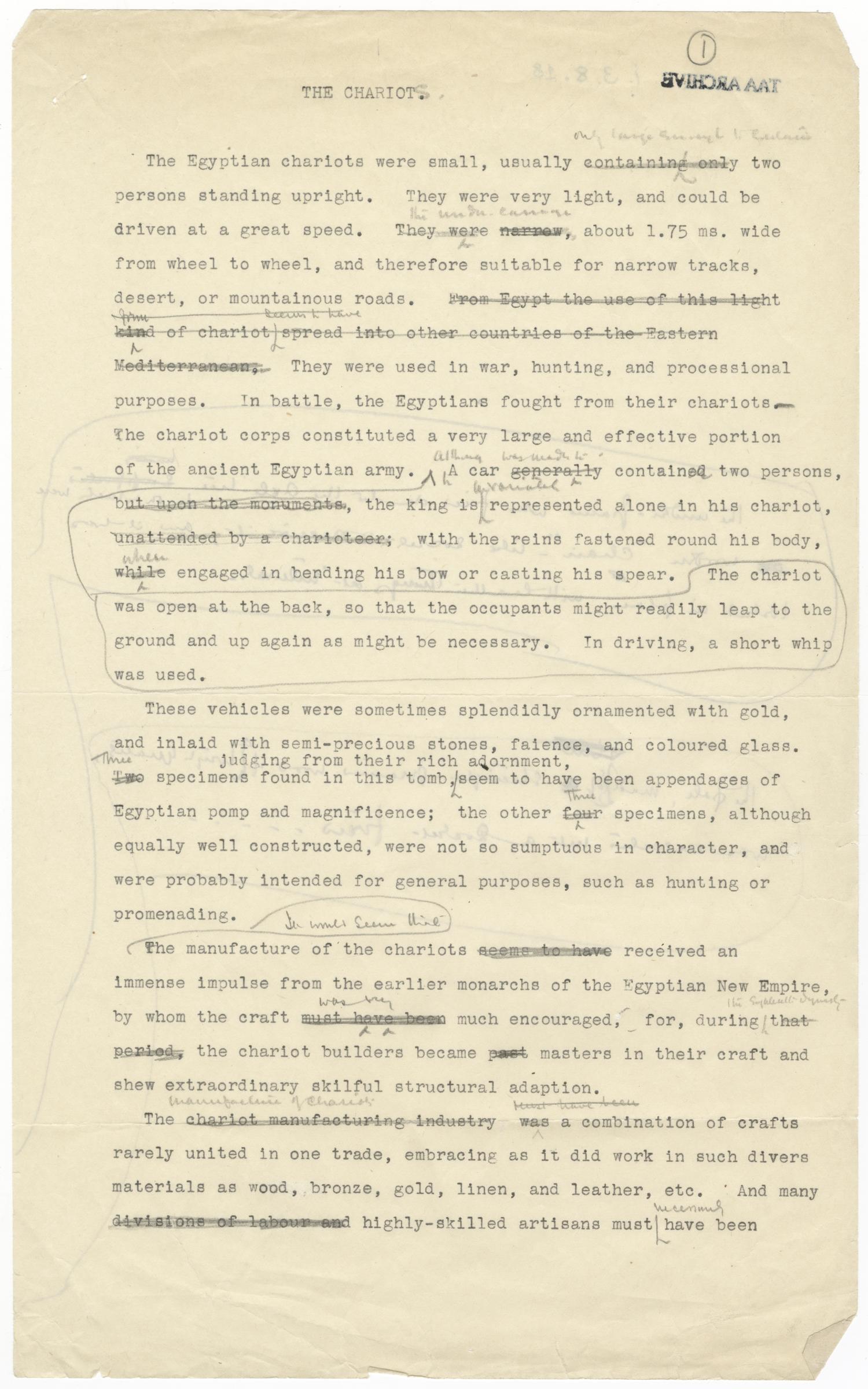
Typewritten and annotated notes on chariots, page 1 (for handwritten copy of annotated notes, see TAA i.3.8.37-39).

© Griffith Institute,
University of Oxford
(1)
THE CHARIOTS.
The Egyptian chariots were small, usually containing only/<only large enough to contain> two persons standing upright. They were very light, and could be
driven at a great speed. They were narrow/<The under-carriage>, about 1.75 ms. wide
from wheel to wheel, and therefore suitable for narrow tracks,
desert, or mountainous roads. From Egypt the use of this lightkind/<form> of chariot <seems to have> spread into other countries of the EasternMediterranean. They were used in war, hunting, and processional
purposes. In battle, the Egyptians fought from their chariots –
The chariot corps constituted a very large and effective portion
of the ancient Egyptian army. <Although> A car generally/<was made to> contained two persons, but upon the monuments, the king is invariably represented alone in his chariot,unattended by a charioteer; with the reins fastened round his body,while/<when> engaged in bending his bow or casting his spear. <The chariot
was open at the back, so that the occupants might readily leap to the
ground and up again as might be necessary. In driving, a short whip
was used.>
These vehicles were sometimes splendidly ornamented with gold,
and inlaid with semi-precious stones, faience, and coloured glass. Two/<Three> specimens found in this tomb, <judging from their rich adornment,> seem to have been appendages of
Egyptian pomp and magnificence; the other four/<three> specimens, although
equally well constructed, were not so sumptuous in character, and
were probably intended for general purposes, such as hunting or
promenading.
<It would seem that> T/<t>he manufacture of the chariots seems to have received an immense impulse from the earlier monarchs of the Egyptian New Empire,
by whom the craft must have been/<was very> much encouraged, for, during <the Eighteenth dynasty> thatperiod, the chariot builders became past masters in their craft and
shew extraordinary skilful structural adaptation.
The chariot manufacturing industry/<manufacture of chariots> was/<must have been> a combination of crafts
rarely united in one trade, embracing as it did work in such divers
materials as wood, bronze, gold, linen, and leather, etc. And many divisions of labour and highly-skilled artisans must <necessarily> have been