TAA i.3.8.15
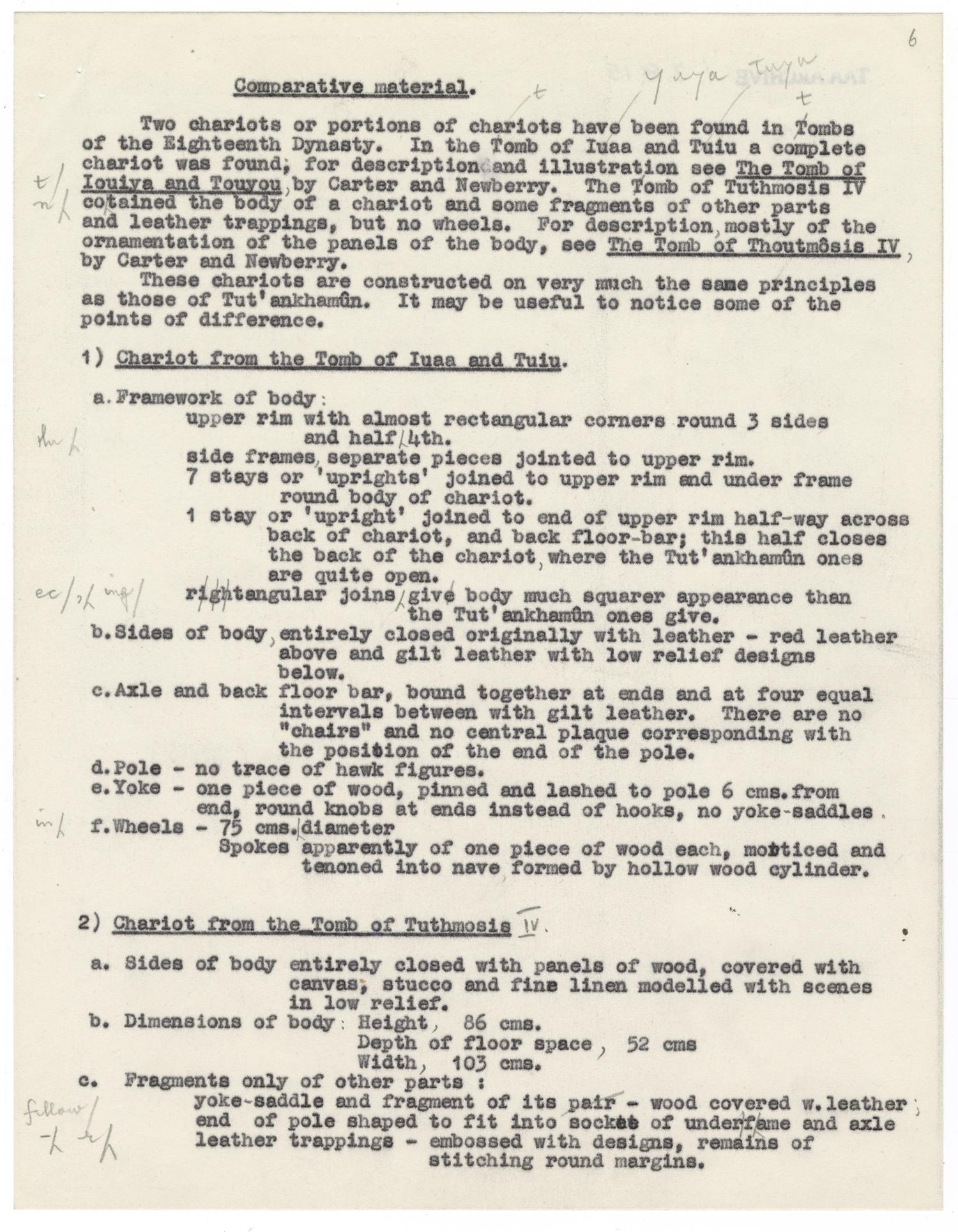
Typewritten notes on chariots based on Howard Carter's notes, with annotations probably made by Mrs Jane Waley (Griffith Institute staff), page 6. Howard Carter and Percy Newberry are mentioned on this page.

© Griffith Institute,
University of Oxford
6
Comparative material.
Two chariots or portions of chariots have been found in T/<t>ombs
of the Eighteenth Dynasty. In the T/<t>omb of Iuaa/<Yuya> and Tuiu/<Tuya> a complete chariot was found; for description and illustration see The Tomb of
Iouiya and Touyou<,> by Carter and Newberry. The T/<t>omb of Tuthmosis IV
co<n>tained the body of a chariot and some fragments of other parts
and leather trappings, but no wheels. For description, mostly of the
ornamentation of the panels of the body, see The Tomb of Thoutmôsis IV<,>
by Carter and Newberry.
These chariots are constructed on very much the same principles
as those of Tut'ankhamûn. It may be useful to notice some of the
points of difference.
1) Chariot from the Tomb of Iuaa and Tuiu.
a. Framework of body:
upper rim with almost rectangular corners round 3 sides
and half <the> 4th.
side frames<,> separate pieces jointed to upper rim.
7 stays or 'uprights' joined to upper rim and under frame
round body of chariot.
1 stay or 'upright' joined to end of upper rim half-way across
back of chariot, and back floor-bar; this half closes
the back of the chariot<,> where the Tut'ankhamûn ones
are quite open.
righ/<ec>tangular joins, give/<ing> body much squarer appearance than
the Tut'ankhamûn ones give.
b. Sides of body<,> entirely closed originally with leather – red leather
above and gilt leather with low relief designs
below.
c. Axle and back floor bar, bound together at ends and at four equal
intervals between with gilt leather. There are no
"chairs" and no central plaque corresponding with
the posix[?]/<t>ion of the end of the pole.
d. Pole – no trace of hawk figures.
e. Yoke – one piece of wood, pinned and lashed to pole 6 cms. from
end, round knobs at ends instead of hooks, no yoke-saddles<.>
f. Wheels – 75 cms. <in> diameter
Spokes apparently of one piece of wood each, mo x[?]/<r>ticed and
tenoned into nave formed by hollow wood cylinder.
2) Chariot from the Tomb of Tuthmosis <IV>.
a. Sides of body entirely closed with panels of wood, covered with
canvas, stucco and fine linen modelled with scenes
in low relief.
b. Dimensions of body<:> Height<,> 86 cms.
Depth of floor space<,> 52 cms
Width<,> 103 cms.
c. Fragments only of other parts:
yoke-saddle and fragment of its pair/<fellow> – wood covered w. leather;
end of pole shaped to fit into sockee/<t> of under-f<r>ame and axle
leather trappings – embossed with designs, remains of
stitching round margins.