TAA i.3.6.17
Typewritten copy of notes made by Nina Davies (for another typewritten copy, see TAA i.3.6.13).
© Griffith Institute,
University of Oxford
COPY
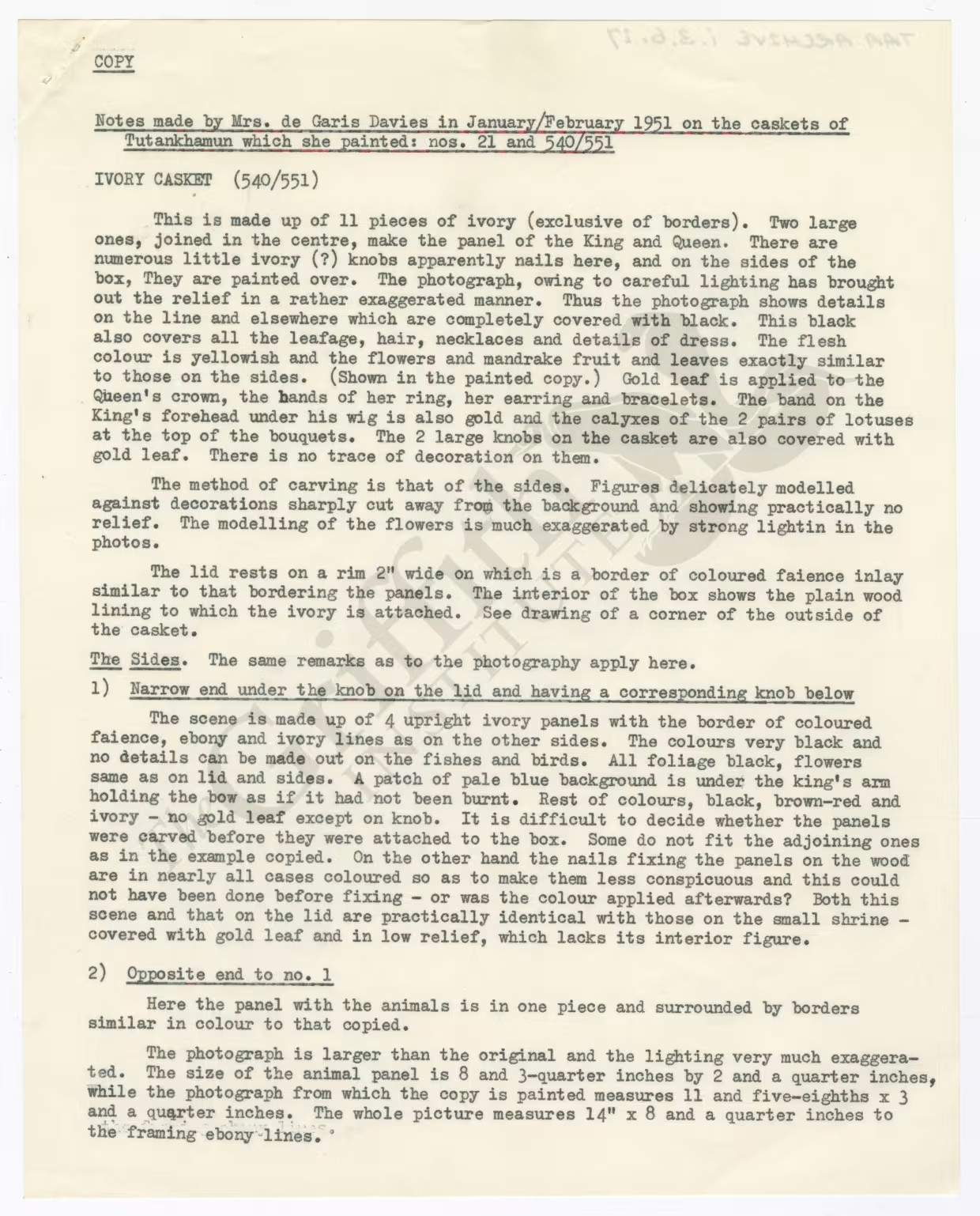
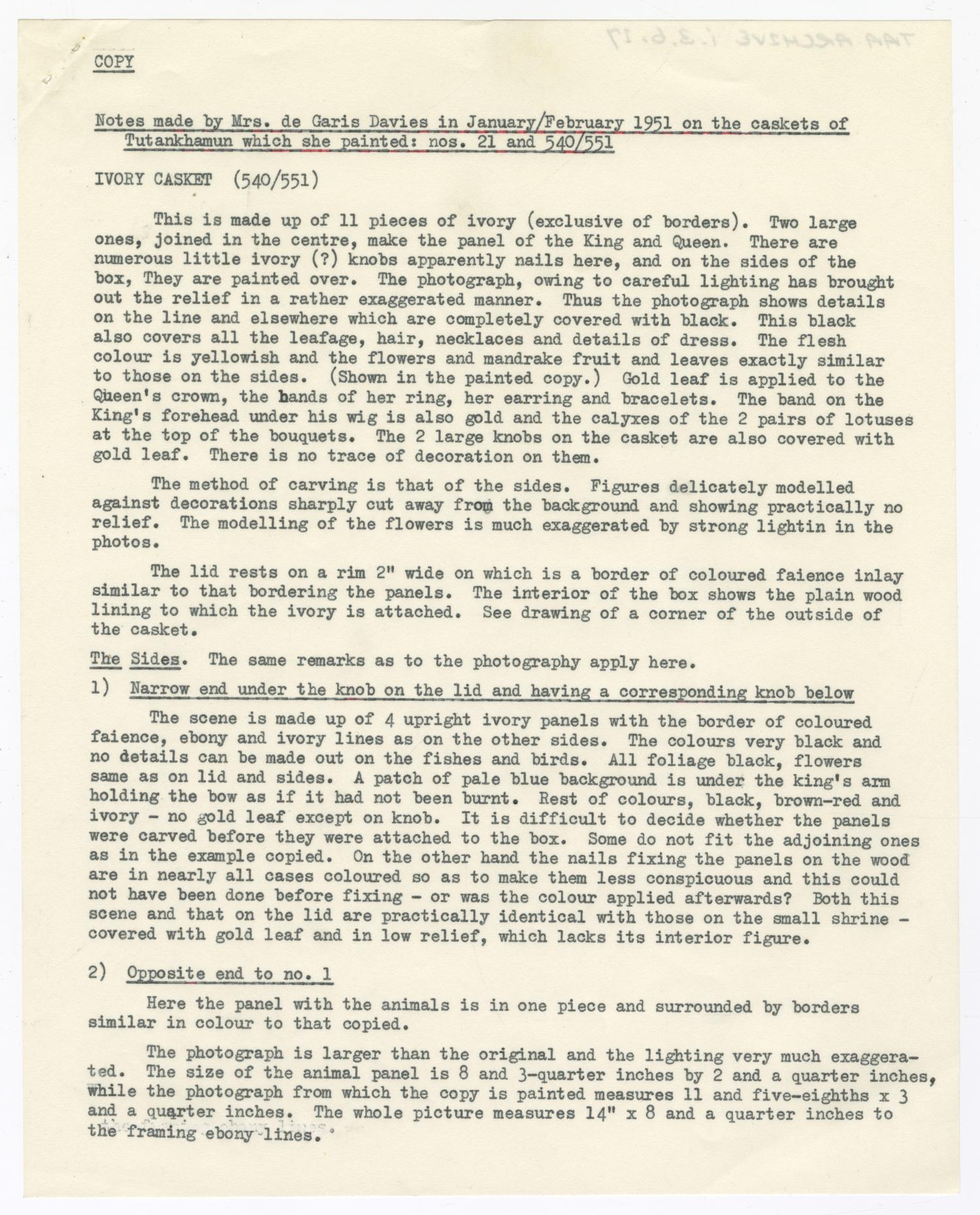
Notes made by Mrs. de Garis Davies in January/February 1951 on the caskets of
Tutankhamun which she painted: nos. 21 and 540/551
IVORY CASKET (540/551)
This is made up of 11 pieces of ivory (exclusive of borders). Two large
ones, joined in the centre, make the panel of the King and Queen. There are
numerous little ivory (?) knobs apparently nails here, and on the sides of the
box, They are painted over. The photograph, owing to careful lighting has brought
out the relief in a rather exaggerated manner. Thus the photograph shows details
on the line and elsewhere which are completely covered with black. This black
also covers all the leafage, hair, necklaces and details of dress. The flesh
colour is yellowish and the flowers and mandrake fruit and leaves exactly similar
to those on the sides. (Shown in the painted copy.) Gold leaf is applied to the
Queen’s crown, the hands of her ring, her earring and bracelets. The band on the
King’s forehead under his wig is also gold and the calyxes of the 2 pairs of lotuses
at the top of the bouquets. The 2 large knobs on the casket are also covered with
gold leaf. There is no trace of decoration on them.
The method of carving is that of the sides. Figures delicately modelled
against decorations sharply cut away froj/<m> the background and showing practically no
relief. The modelling of the flowers is much exaggerated by strong lightinsic in the
photos.
The lid rests on a rim 2” wide on which is a border of coloured faience inlay
similar to that bordering the panels. The interior of the box shows the plain wood
lining to which the ivory is attached. See drawing of a corner of the outside of
the casket.
The Sides. The same remarks as to the photography apply here.
1) Narrow end under the knob on the lid and having a corresponding knob below
The scene is made up of 4 upright ivory panels with the border of coloured
faience, ebony and ivory lines as on the other sides. The colours very black and
no details can be made out on the fishes and birds. All foliage black, flowers
same as on lid and sides. A patch of pale blue background is under the king’s arm
holding the bow as if it had not been burnt. Rest of colours, black, brown-red and
ivory – no gold leaf except on knob. It is difficult to decide whether the panels
were carved before they were attached to the box. Some do not fit the adjoining ones
as in the example copied. On the other hand the nails fixing the panels on the wood
are in nearly all cases coloured so as to make them less conspicuous and this could
not have been done before fixing – or was the colour applied afterwards? Both this
scene and that on the lid are practically identical with those on the small shrine –
covered with gold leaf and in low relief, which lacks its interior figure.
2) Opposite end to no. 1
Here the panel with the animals is in one piece and surrounded by borders
similar in colour to that copied.
The photograph is larger than the original and the lighting very much exaggera-
ted. The size of the animal panel is 8 and 3-quarter inches by 2 and a quarter inches,
while the photograph from which the copy is painted measures 11 and five-eighths x 3
and a quarter inches. The whole picture measures 14” x 8 and a quarter inches to
the framing ebony lines.