TAA i.3.6.14
Typewritten copy of notes made by Nina Davies (for originals, see TAA i.3.6.11 - TAA i.3.6.12). Another typewritten copy also exists (see TAA i.3.18).

© Griffith Institute,
University of Oxford
2
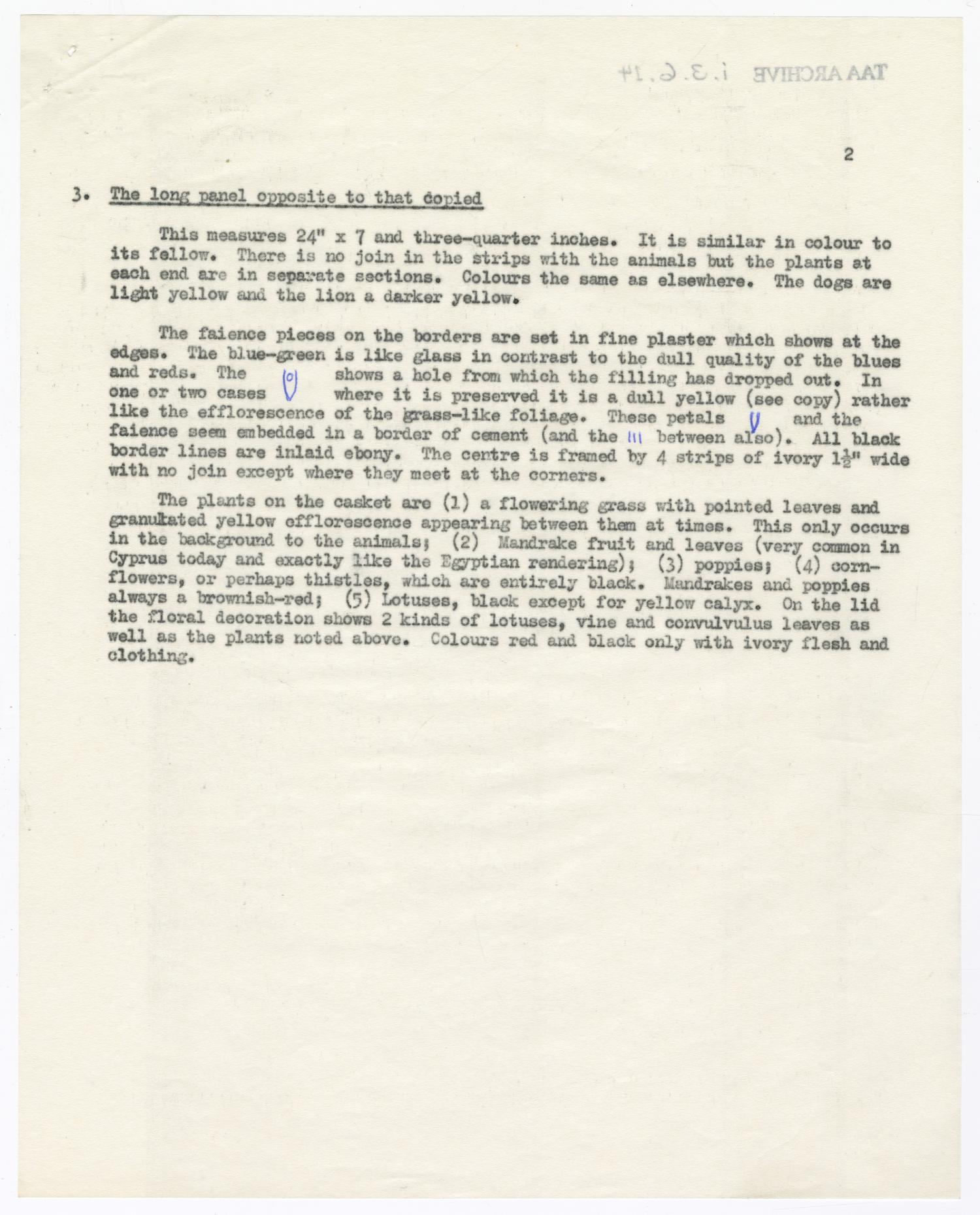
3. The long panel opposite to that copied
This measures 24” x 7 and three-quarter inches. It is similar in colour to
its fellow. There is no join in the strips with the animals but the plants at
each end are in separate sections. Colours the same as elsewhere. The dogs are
light yellow and the lion a darker yellow.
The faience pieces on the borders are set in fine plaster which shows at the
edges. The blue-green is like glass in contrast to the dull quality of the blues
and reds. The [ 𓂀 ] shows a hole from which the filling has dropped out. In
one or two cases where it is preserved it is a dull yellow (see copy) rather
like the efflorescence of the grass-like foliage. These petals [ 𓂀 ] and the
faience seem embedded in a border of cement (and the [ 𓂀 ] between also). All black
border lines are inlaid ebony. The centre is framed by 4 strips of ivory 1½” wide
with no join except where they meet at the corners.
The plants on the casket are (1) a flowering grass with pointed leaves and
grant/<l>ulated yellow efflorescence appearing between them at times. This only occurs
in the background to the animals; (2) Mandrake fruit and leaves (very common in
Cyprus today and exactly like the Egyptian rendering); (3) poppies; (4) corn-
flowers, or perhaps thistles, which are entirely black. Mandrakes and poppies
always a brownish-red; (5) Lotuses, black except for yellow calyx. On the lid
the floral decoration shows 2 kinds of lotuses, vine and convulvulussic leaves as
well as the plants noted above. Colours red and black only with ivory flesh and
clothing.