
TAA i.3.25.7
Report on the second sepulchral shrine, page 1. Boodle is also mentioned on this page.

© Griffith Institute,
University of Oxford
THE THIRD SHRINE NO. 237.
. . . . . . . . . . .
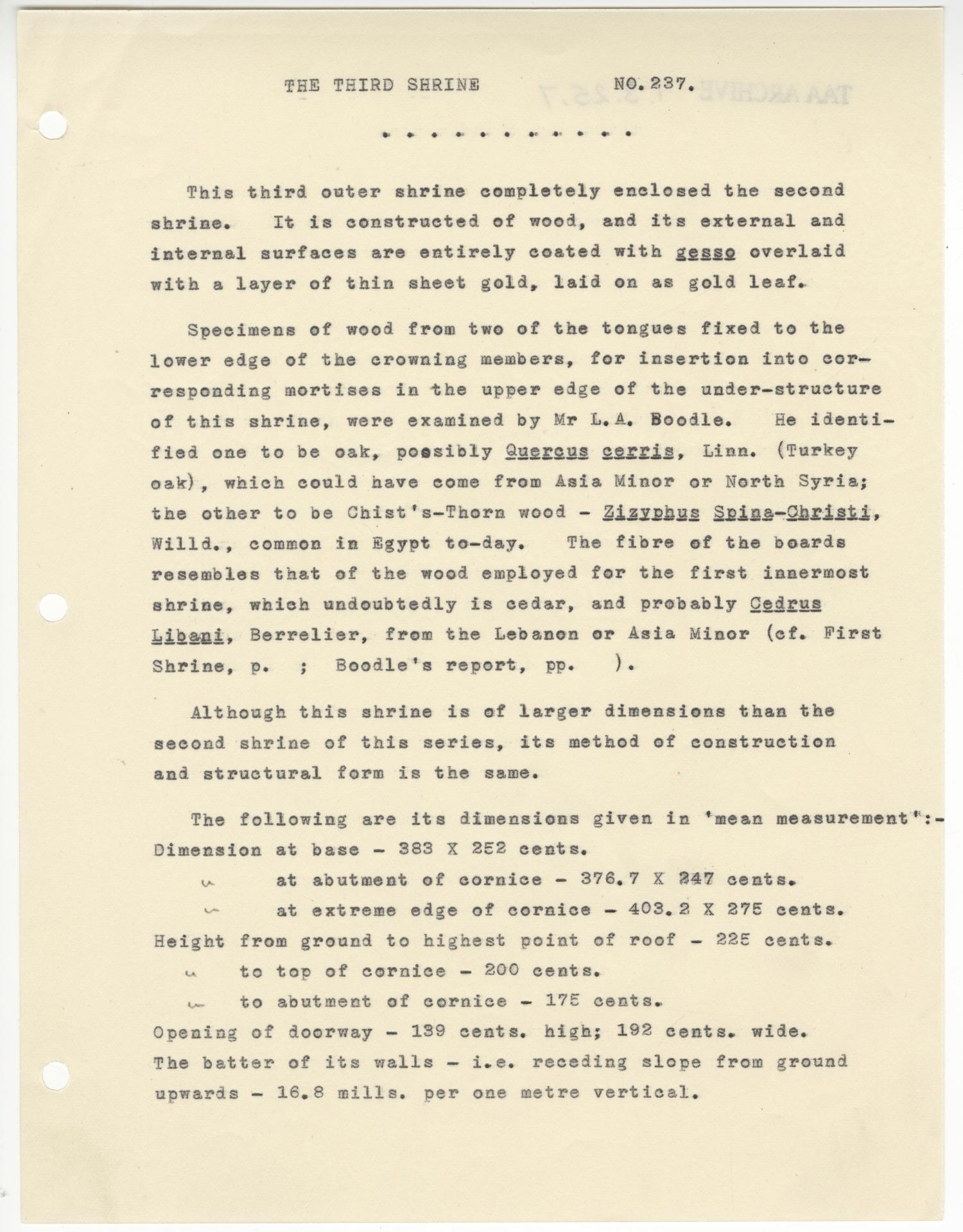
This third outer shrine completely enclosed the second
shrine. It is constructed of wood, and its external and
internal surfaces are entirely coated with gesso overlaid
with a layer of thin sheet gold, laid on as gold leaf.
Specimens of wood from two of the tongues fixed to the
lower edge of the crowning members, for insertion into cor-
responding mortises in the upper edge of the under-structure
of this shrine, were examined by Mr L.A. Boodle. He identi-
fied one to be oak, poo/<s>sibly Quercus cerris, Linn. (Turkey
oak), which could have come from Asia Minor or North Syria;
the other to be Christ’s-Thorn wood – Zizyphus Spina-Christi,
Willd., common in Egypt to-day. The fibre of the boards
resembles that of the wood employed for the first innermost
shrine, which undoubtedly is cedar, and probably Cedrus
Libani, Berrelier, from the Lebanon or Asia Minor (cf. First
Shrine, p. ; Boodle’s report, pp. ).
Although this shrine is of larger dimensions than the
second shrine of this series, its method of construction
and structural form is the same.
The following are its dimensions given in ‘mean measurement’:-
Dimension at base – 383 X 252 cents.
“ at abutment of cornice – 376.7 X 247 cents.
“ at extreme edge of cornice – 403.2 X 275 cents.
Height from ground to highest point of roof – 225 cents.
“ to top of cornice – 200 cents.
“ to abutment of cornice – 175 cents.
Opening of doorway – 139 cents. high; 192 cents. wide.
The batter of its walls – i.e. receding slope from ground
upwards – 16.8 mills. per one metre vertical.