
TAA i.3.24.6
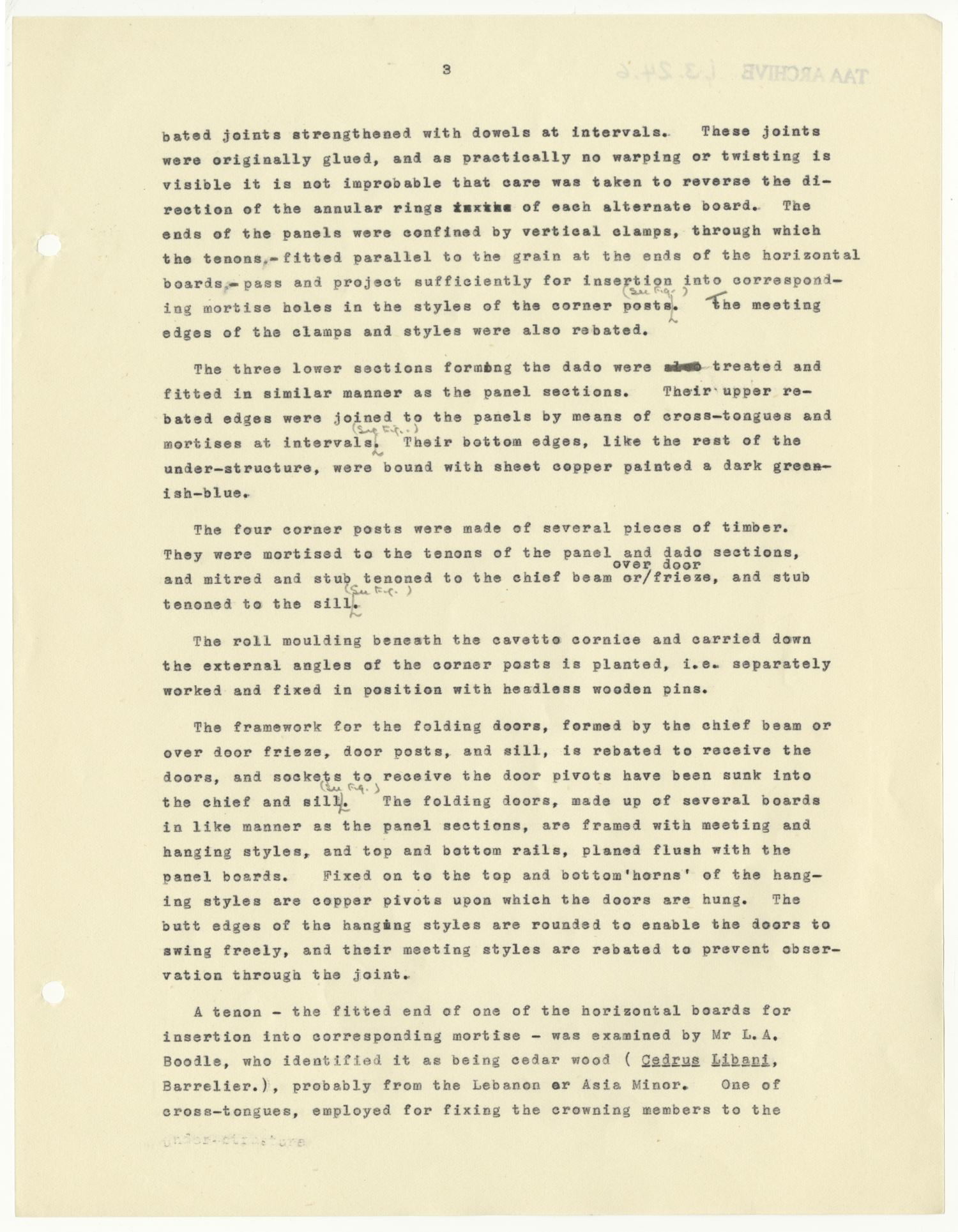
Annotated typewritten report on first sepulchral shrine, page 3. Carter uses the correct object number (207) for this shrine but refers to it as the "fourth outermost shrine". Boodle is also mentioned on this page.

© Griffith Institute,
University of Oxford
3
bated joints strengthened with dowels at intervals. These joints
were originally glued, and as practically no warping or twisting is
visible it is not improbable that care was taken to reverse the di-
rection of the annular rings in the of each alternate board. The
ends of the panels were confined by vertical clamps, through which
the tenons – fitted parallel to the grain at the ends of the horizontal
boards – pass and project sufficiently for insertion into correspond-
ing mortise holes in the styles of the corner posts <(see Fig.)>. t/<T>he meeting
edges of the clamps and styles were also rebated.
The three lower sections formo/<i>ng the dado were also treated and
fitted in similar manner as the panel sections. Their upper re-
bated edges were joined to the panels by means of cross-tongues and
mortises at intervals <(see Fig.)>. Their bottom edges, like the rest of the
under-structure, were bound with sheet copper painted a dark green-
ish-blue.
The four corner posts were made of several pieces of timber.
They were mortised to the tenons of the panel and dado sections,
and mitred and stub tenoned to the chief beam or /<over door>frieze, and stub
tenoned to the sill <(see Fig.)>.
The roll moulding beneath the cavetto cornice and carried down
the external angles of the corner posts is planted, i.e. separately
worked and fixed in position with headless wooden pins.
The framework for the folding doors, formed by the chief beam or
over door frieze, door posts, and sill, is rebated to receive the
doors, and sockets to receive the door pivots have been sunk into
the chief and sill <(see Fig.)>. The folding doors, made up of several boards
in like manner as the panel sections, are framed with meeting and
hanging styles, and top and bottom rails, planed flush with the
panel boards. Fixed on to the top and bottom ‘horns’ of the hang-
ing styles are copper pivots upon which the doors are hung. The
butt edges of the hangn/<i>ng styles are rounded to enable the doors to
swing freely, and their meeting styles are rebated to prevent obser-
vation through the joint.
A tenon – the fitted end of one of the horizontal boards for
insertion into corresponding mortise – was examined by Mr. L.A.
Boodle, who identified it as being cedar wood (Cedrus Libani,
Barrelier.), probably from the Lebanon e/<o>r Asia Minor. One of
cross-tongues, employed for fitting the crowning members to the