
TAA i.3.24.5
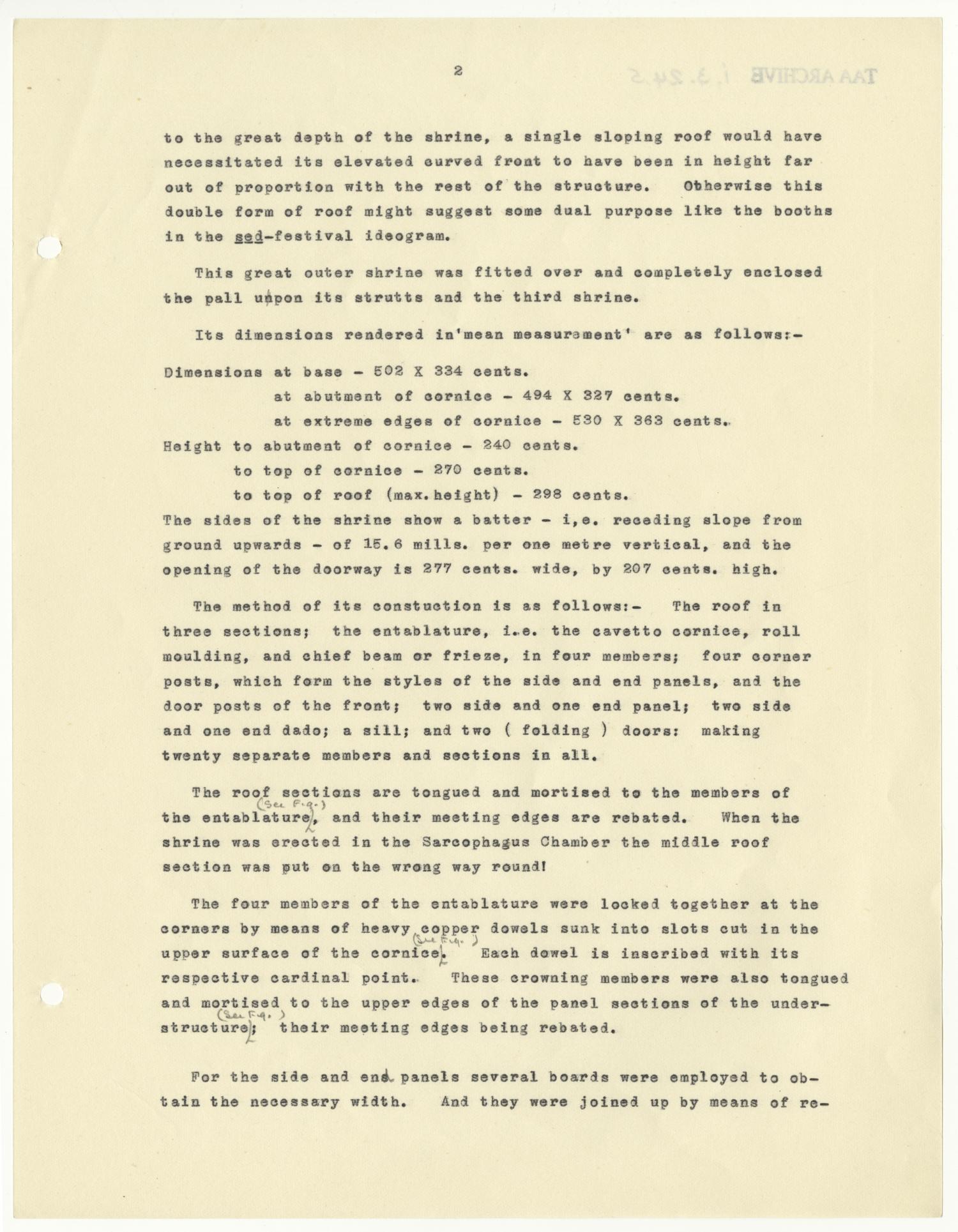
Annotated typewritten report on first sepulchral shrine, page 2. Carter uses the correct object number (207) for this shrine but refers to it as the "fourth outermost shrine".

© Griffith Institute,
University of Oxford
2
to the great depth of the shrine, a single sloping roof would have
necessitated its elevated curved front to have been in height far
out of proportion with the rest of the structure. Otherwise this
double form of roof might suggest some dual purpose like the booths
in the sed-festival ideogram.
This great outer shrine was fitted over and completely enclosed
the pall unpon its struttssic and the third shrine.
Its dimensions rendered in ‘mean measurement’ are as follows:-
Dimensions at base – 502 X 334 cents.
at abutment of cornice – 494 x 327 cents.
at extreme edges of cornice – 530 x 363 cents.
Height to abutment of cornice – 240 cents.
to top of cornice – 270 cents.
to top of roof (max. height) – 298 cents.
The sides of the shrine show a batter – i,e. receding slope from
ground upwards – of 15.6 mills. per one metre vertical, and the
opening of the doorway is 277 cents. wide, by 207 cents. high.
The method of its construction is as follows:- The roof in
three sections; the entablature, i.e. the cavetto cornice, roll
moulding, and chief beam or frieze, in four members; four corner
posts, which form the styles of the side and end panels, and the
door posts of the front; two side and one end panel; two side
and one end dado; a sill; and two (folding) doors: making
twenty separate members and sections in all.
The roof sections are tongued and mortised to the members of
the entablature <(see Fig.)>, and their meeting edges are rebated. When the
shrine was erected in the Sarcophagus Chamber the middle roof
section was put on the wrong way round!
The four members of the entablature were locked together at the
corners by means of heavy copper dowels sunk into slots cut in the
upper surface of the cornice <(see Fig.)>. Each dowel is inscribed with its
respective cardinal point. These crowning members were also tongued
and mortised to the upper edges of the panel sections of the under-
structure <(see Fig.)>; their meeting edges being rebated.
For the side and ens/<d> panels several boards were employed to ob-
tain the necessary width. And they were joined up by means of re-