
TAA i.3.23.50
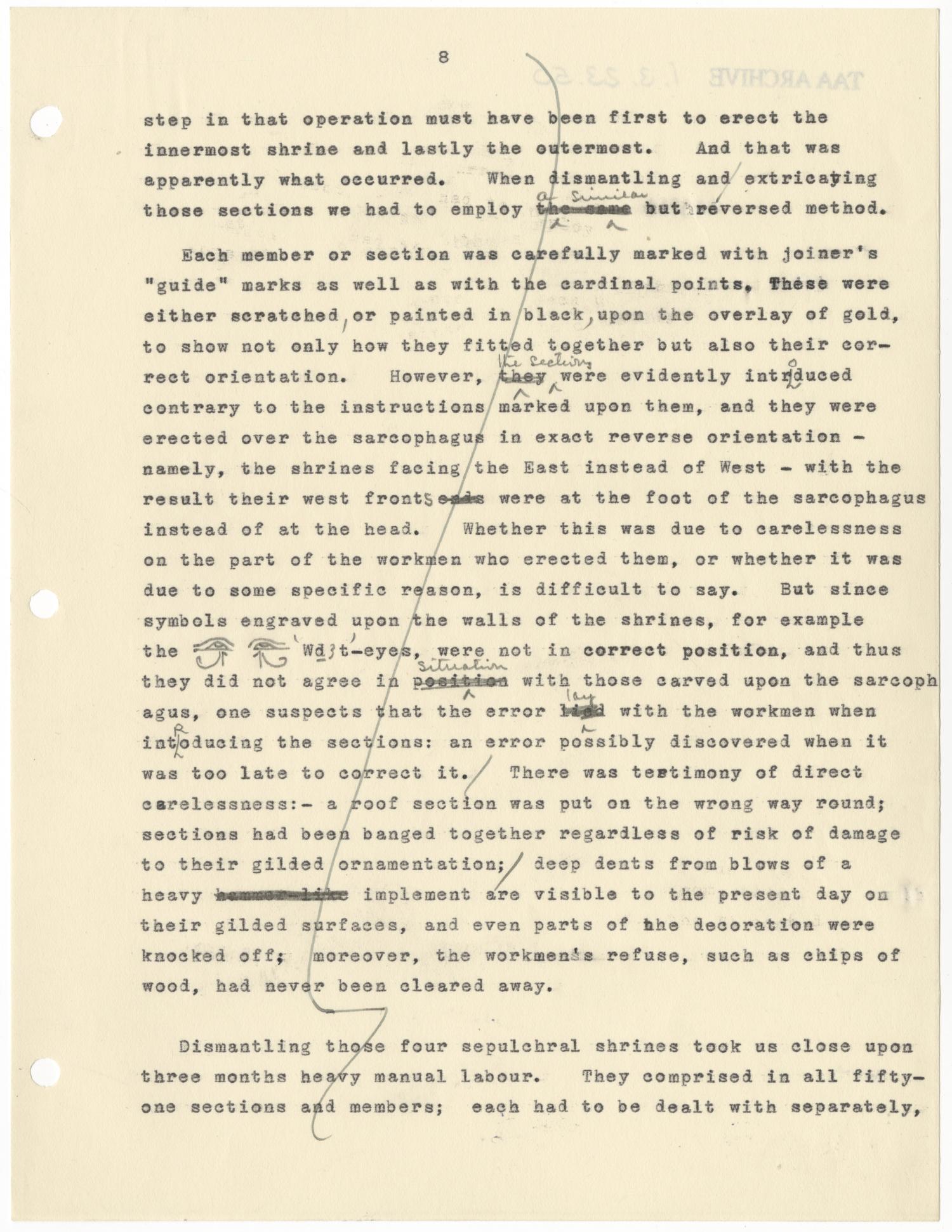
Page 8 of Carter's typescript notes on shrines.
The whole text or part of the text is fully struck through on this page but is not indicated in the transcription. On this page, strikethrough formatting is reserved for the author’s edits and deletions within the main body of the text, which would otherwise be difficult to distinguish.

© Griffith Institute,
University of Oxford
8
step in that operation must have been first to erect the
innermost shrine and lastly the outermost. And that was
apparently what occurred. When dismantling and extricay/<t>ing
those sections we had to employ the same/<a similar> but reversed method.
Each member or section was carefully marked with joiner’s
“guide” marks as well as with the cardinal points. These were
either scratched<,> or painted in black<,> upon the overlay of gold,
to show not only how they fitted together but also their cor-
rect orientation. However, they/<the sections> were evidently intr<o>duced
contrary to the instructions marked upon them, and they were
erected over the sarcophagus in exact reverse orientation –
namely, the shrines facing towards the East instead of West – with the
result their west front<s> ends were at the foot of the sarcophagus
instead of at the head. Whether this was due to carelessness
on the part of the workmen who erected them, or whether it was
due to some specific reason, is difficult to say. But since
symbols engraved upon the walls of the shrines, for example
the [ 𓂀 ] ‘wd3t’-eyes, were not in correct position, and thus
they did not agree in position/<situation> with those carved upon the sarcoph
agus, one suspects that the error led/<lay> with the workmen when
int<r>oducing the sections: an error possibly discovered when it
was too late to correct it. / There was testimony of direct
carelessness:- a roof section was put on the wrong way round;
sections had been banged together regardless of risk of damage
to their gilded ornamentation; / deep dents from blows of a
heavy hammer like implement are visible to the present day on
their gilded surfaces, and even parts of h/<t>he decoration were
knocked off; moreover, the workmen’s refuse, such as chips of
wood, had never been cleared away.
Dismantling those four sepulchral shrines took us close upon
three months heavy manual labour. They comprised in all fifty-
one sections and members; each had to be dealt with separately,