
TAA i.3.23.46
Page 5 of Carter's typescript notes on shrines.
The whole text or part of the text is fully struck through on this page but is not indicated in the transcription. On this page, strikethrough formatting is reserved for the author’s edits and deletions within the main body of the text, which would otherwise be difficult to distinguish.

© Griffith Institute,
University of Oxford
5
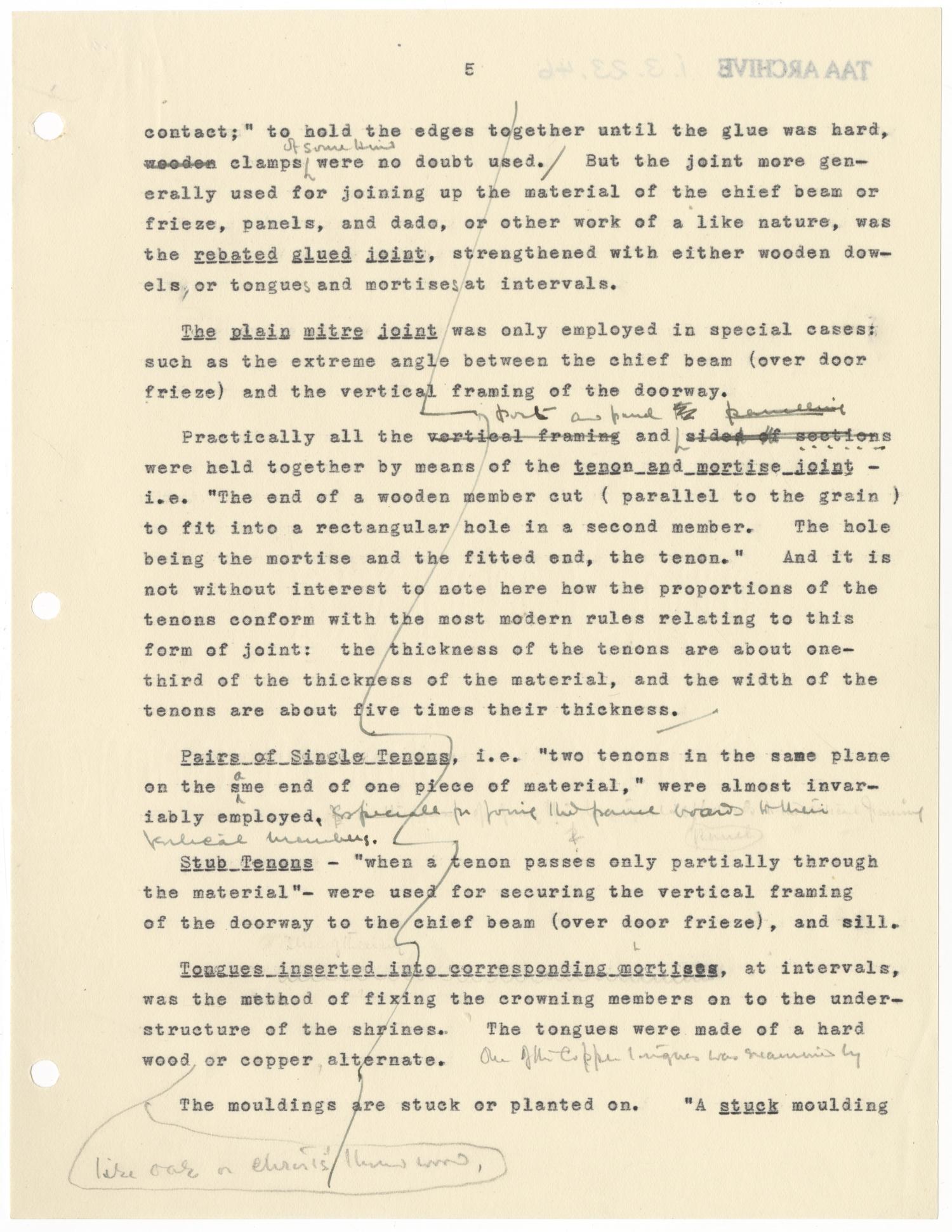
contact;” to hold the edges together until the glue was hard,
wooden clamps <of some kind> were no doubt used. / But the joint more gen-
erally was used for joining up the material of the chief beam or
frieze, panels, and dado, or other work of a like nature, was
the rebated gluedjoint, strengthened with either wooden dow-
els, or tongue<s> and mortise<s> at intervals.
The plain mitre joint was only employed in special cases:
such as the extreme angle between the chief beam (over door
frieze) and the vertical framing of the doorway.
Practically all the vertical framing and sides of sections/<post and panel panelling>
were held together by means of tenon and mortise joint –
i.e. “The end of a wooden member cut (parallel to the grain)
to fit into a rectangular hole in a second member. The hole
being the mortise and the fitted end, the tenon.” And it is
not without interest to note here how the proportions of the
tenons conform with the most modern rules relating to this
form of joint: the thickness of the tenons are about one-
third of the thickness of the material, and the width of the
tenons are about five times their thickness.
Pairs of Single Tenons, i.e. “two tenons in the same plane
on the s<a>me end of one piece of material,” were almost invar-
iably employed, especially for joining the panel boards to their
vertical members.
Stub Tenons – “when a tenon passes only partially through
the material” – were used for securing the vertical framing
of the doorway to the chief beam (over door frieze), and sill.
Tongues inserted into corresponding mortises, at intervals,
was the method of fixing the crowning members on to the under-
structure of the shrines. These tongues were made of a hard
wood <like oak or Christ’s thorn wood> or copper alternate. One of the copper tongues was examined by
The mouldings are stuck or planted on. “A stuck moulding