
TAA i.3.23.45
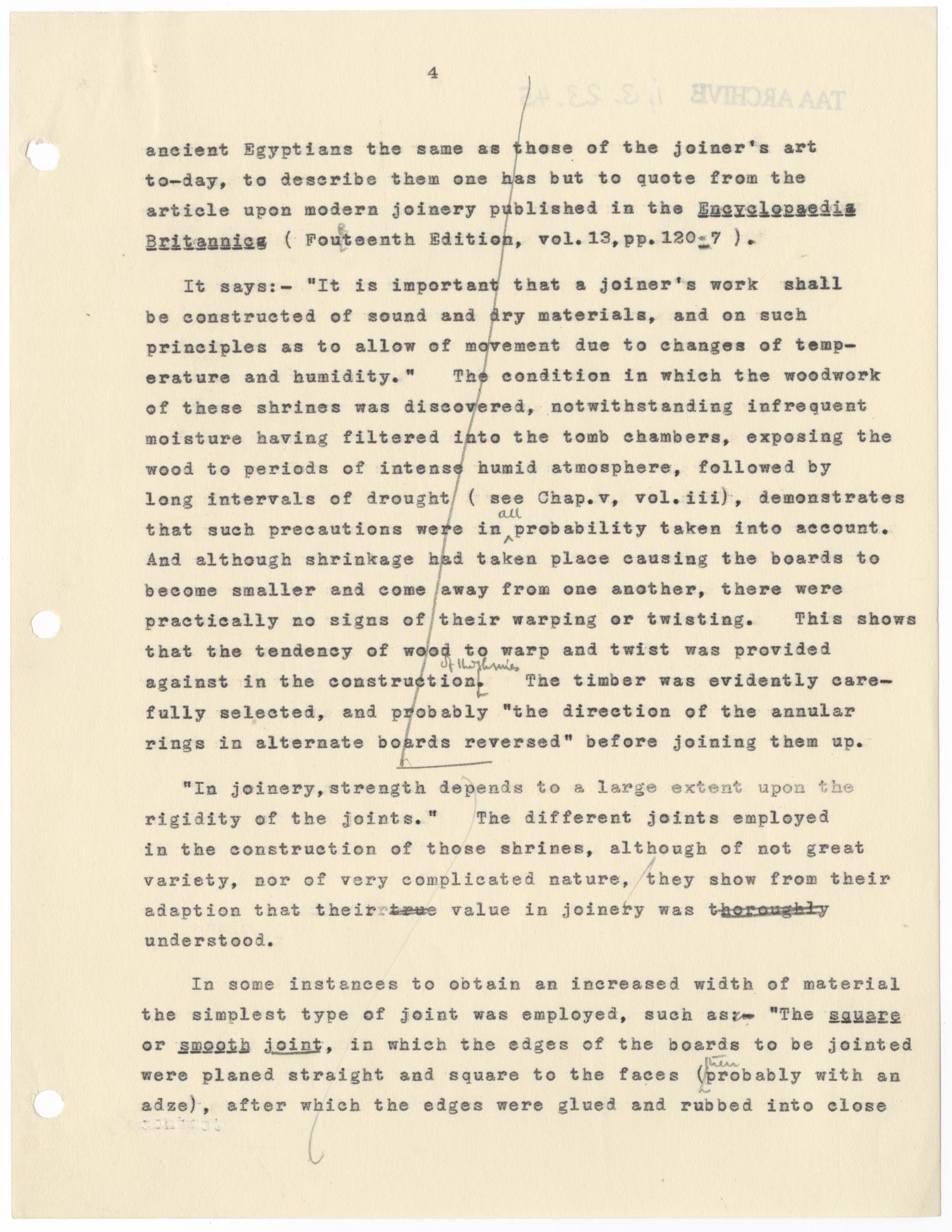
Page 4 of Carter's typescript notes on shrines.
The whole text or part of the text is fully struck through on this page but is not indicated in the transcription. On this page, strikethrough formatting is reserved for the author’s edits and deletions within the main body of the text, which would otherwise be difficult to distinguish.

© Griffith Institute,
University of Oxford
4
ancients Egyptians the same as those of the joiner’s art
to-day, to describe them one has but to quote from the
article upon modern joinery, published in the Encyclopaedia
Britannica (Fou<r>teenth Edition, vol. 13, pp. 120-7).
It says:- “It is important that a joiner’s work shall
be constructed of sound and dry materials, and on such
principles as to allow of movement due to changes of temp-
erature and humidity.” The condition in which the woodwork
of these shrines was discovered, notwithstanding infrequent
moisture having filtered into the tomb chambers, exposing the
wood to periods of intense humid atmosphere, followed by
long intervals of drought, (see Chap. V, vol. iii) demonstrates
that such precautions were in <all> probability taken into account.
And although shrinkage had taken place causing the boards to
become smaller and come away from one another, there were
practically no signs of their warping or twisting. This shows
that the tendency of wood to warp and twist was provided
against in the construction <of the shrines>. The timber was evidently care-
fully selected, and probably “the direction of the annular
rings in alternate boards reversed” before joining them up.
“In joinery, strength depends to a large extent upon the
rigidity of the joints.” The different joints employed
in the construction of those shrines, although of not great
variety, nor of very complicated nature, they show from their
adaption, that their true value in joinery was thoroughly
understood.
In some instances to obtain an increased width of material
the simplest type of joint was employed, such as:- “The square
or smooth joint, in which the edges of the boards to be jointed
were planed straight and square to the faces (<then> probably with an
adze, after which the edges were glued and rubbed into close