
TAA i.3.23.42
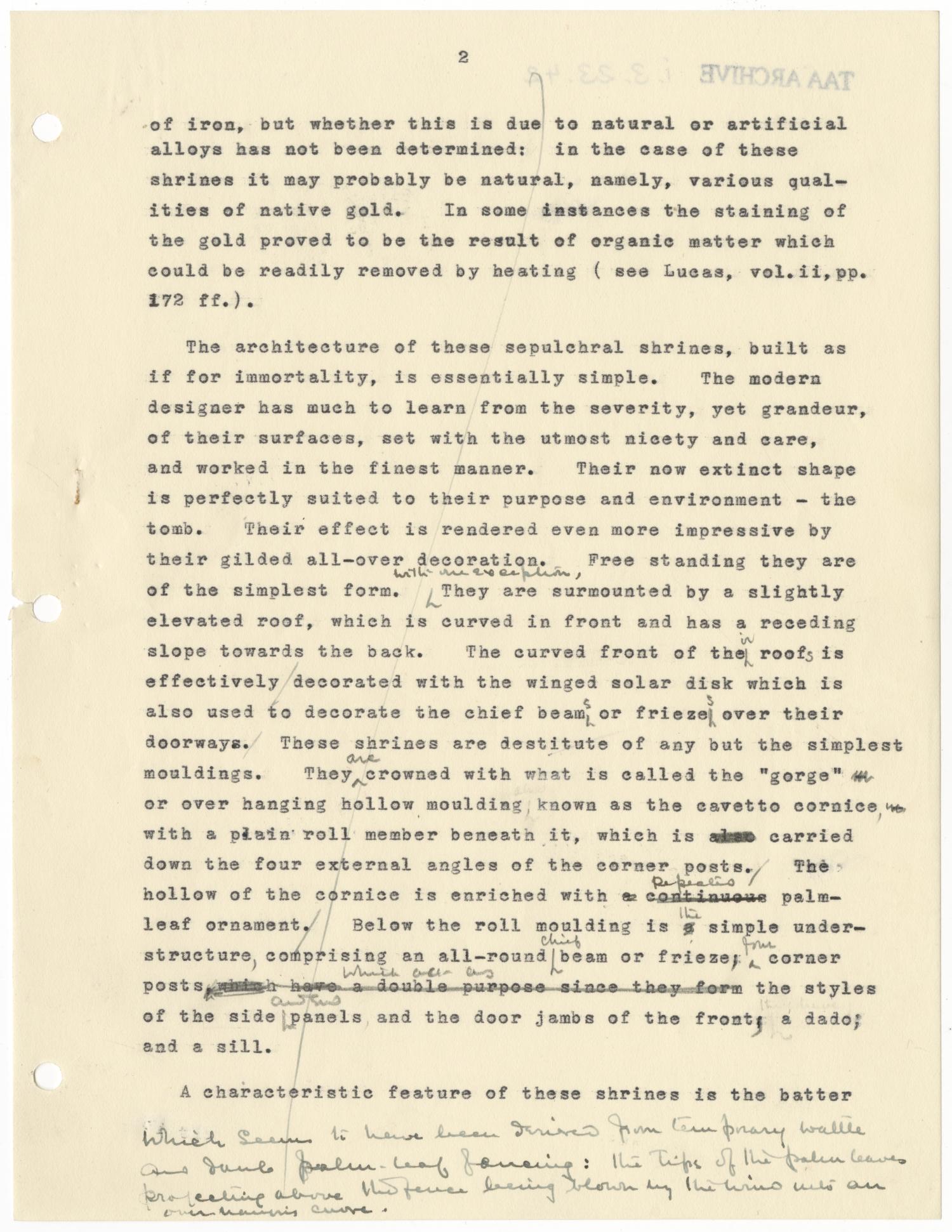
Page 2 of Carter's typescript notes on shrines.
The whole text or part of the text is fully struck through on this page but is not indicated in the transcription. On this page, strikethrough formatting is reserved for the author’s edits and deletions within the main body of the text, which would otherwise be difficult to distinguish.

© Griffith Institute,
University of Oxford
2
of iron, but whether this is due to natural or artificial
alloys has not been determined: in the case of these
shrines it may probably be natural, namely, various qual-
ities of native gold. In some instances the staining of
the gold proved to be the result of organic matter which
could be readily removed by heating (see Lucas, vol. ii, pp.
172 ff.).
The architecture of these sepulchral shrines, built as
if for immortality, is essentially simple. The modern
designer has much to learn from the severity, yet grandeur,
of their surfaces, set with the utmost nicety and care,
and worked in the finest manner. Their now extinct shape
is perfectly suited to their purpose and environment – the
tomb. Their effect is rendered even more impressive by
their gilded all-over decoration. Free standing they are
of the simplest form. <with one exception> They are surmounted by a slightly
elevated roof, which is curved in front and has a receding
slope towards the back. The curved front of the<ir> roof<s> is
effectively / decorated with the winged solar disk which is
also used to decorate the chief beam<s> or frieze<s> over their
doorways. / These shrines are destitute of any but the simplest
mouldings. They <are> crowned with what is called the “gorge” –
or over handing hollow moulding <also> known as the cavetto cornice, x[?]
with a plain roll member beneath it, which is also carried
down the four external angles of the corner posts. / The
hollow of the cornice is enriched with a continuous/<repeated> palm-
leaf ornament. / Below the roll moulding is a/<the> simple under-
structure, comprising an all-round <chief> beam or frieze, <four> corner
posts, which have a double purpose since they form/<which act as> the styles
of the side <and end> panels and the door jambs of the front;/<,> a dado;
and a sill.
A characteristic feature of these shrines is the batter
which seem to have been derived from temporary wattle
and daub palm-leaf fencing: the tips of the palm leaves
projecting above the fence being blown by the wind into an
over-hanging curve.