
TAA i.3.23.38
Page 26 of first draft on shrines, handwritten.

© Griffith Institute,
University of Oxford
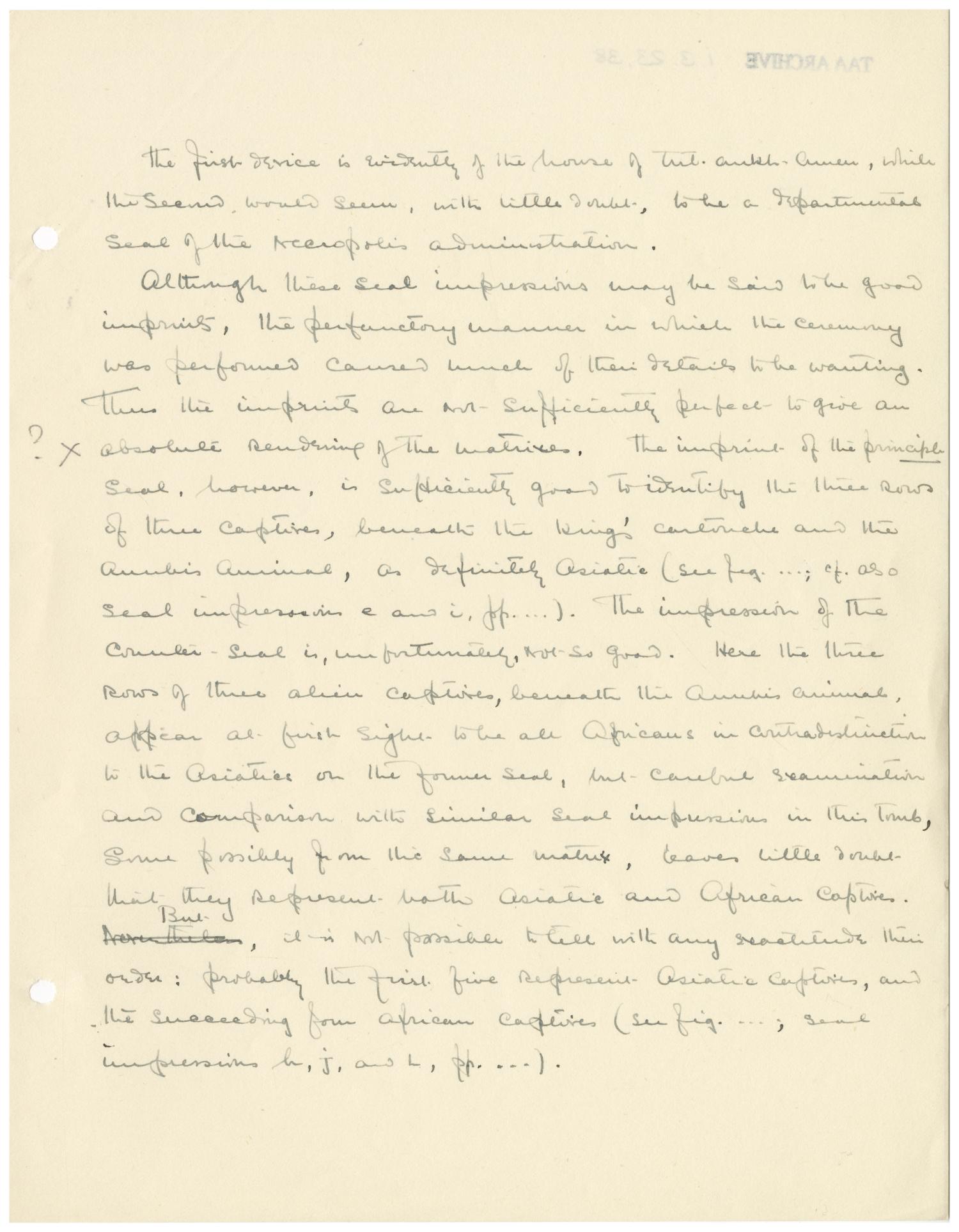
The first device is evidently of the house of Tut.Ankh.Amen, while
the second would seem, with little doubt, to be a departmental
seal of the Necropolis administration.
Although these seal impressions may be said to be good
imprints, the perfunctory manner in which the ceremony
was performed caused much of their details to be wanting.
Thus the imprints are not sufficiently perfect to give an
<? x> absolute rendering of the matrixes. The imprint of the principle
seal, however, is sufficiently good to identify the three rows
of three captives, beneath the king’s cartouche and the
Anubis animal, as definitely Asiatic (see fig. ..., cf. also
seal impressions e and i, pp. ...). The impression of the
counter-seal is, unfortunately, not so good. Here the three
rows of three alien captives, beneath the Anubis animal,
appear at first sight to be all Africans in contradistinction
to the Asiatics on the former seal, but careful examination
and ca/<o>mparison with similar seal impressions in this tomb,
some possibly from the same matrix, leaves little doubt
that they represent both Asiatic and African captives.
Nevertheless/<But>, it is not possible to tell with any exactitude their
order: probably the first five represent Asiatic captives, and
the succeeding four African captives (see fig .; seal
impressions h, J and L, pp. …).