
TAA i.3.23.37
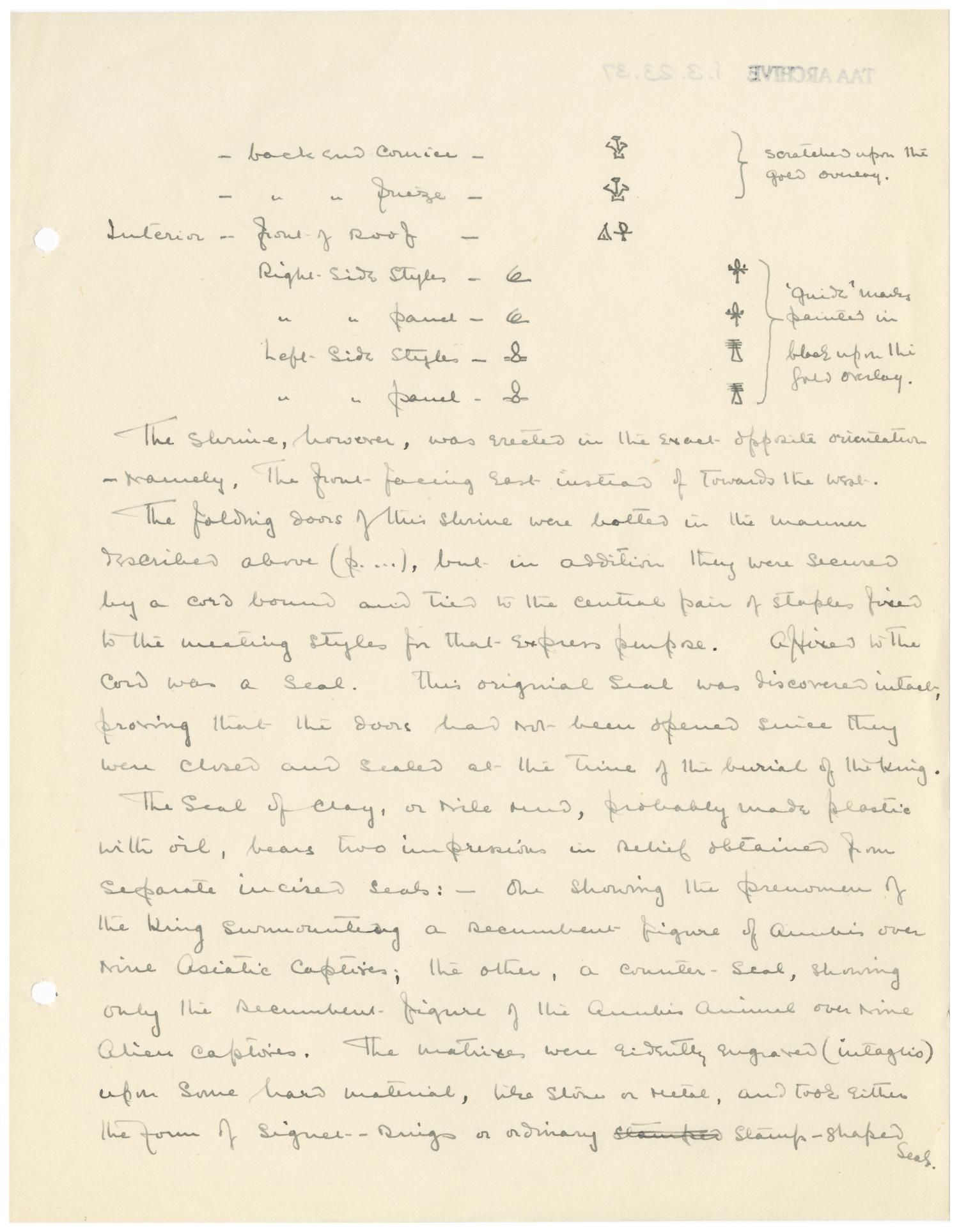
Page 25 of first draft on shrines, handwritten.

© Griffith Institute,
University of Oxford
– back end cornice – [ 𓂀 ] scratched upon the
– “ “ frieze – [ 𓂀 ] gold overlay.
Interior – front of roof – [ 𓂀 ]
Right-side styles – [ 𓂀 ] ‘guide’ marks
“ “ panel – [ 𓂀 ] painted in
Left-side styles – [ 𓂀 ] black upon the
“ “ panel – [ 𓂀 ] gold overlay.
The shrine, however, was erected in the exact opposite orientation
– namely, the front facing east instead of towards the west.
The folding doors of this shrine were bolted in the manner
described above (p. ...), but in addition they were secured
by a cord bound and tied to the central pair of staples fixed
to the meeting styles for that express purpose. Affixed to the
cord was a seal. This original seal was discovered intact,
proving that the doors had not been opened since they
were closed and sealed at the time of the burial of the king.
The seal of clay, or Nile mud, probably made plastic
with oil, bears two impressions in relief obtained from
separate incised seals:- one showing the prenomen of
the King surmounting a recumbent figure of Anubis over
nine Asiatic captives; the other, a counter-seal, showing
only the recumbent figure of the Anubis animal over nine
alien captives. The matrixes were evidently engraved (intaglio)
upon some hard material, like stone or metal, and took either
the form of signet-rings or ordinary stamped stamp-shaped seals.