
TAA i.3.14.28
Typewritten letter from William F. Hume to Howard Carter on his publication about gold in ancient Egypt, page 2. Alfred Lucas and a colleague of Humes (named as Greaves) are mentioned on this page.
© Griffith Institute,
University of Oxford
GEOLOGICAL SURVEY OF EGYPT
Dawawin Post Office,
CAIRO (Egypt).
Telegraphic address: “GEOSURVEY, CAIRO”
PLEASE ADDRESS COMMUNICATIONS
TO THE DIRECTOR
NOT TO INDIVIDUALS
AND QUOTE THIS No. …….
= 2 =
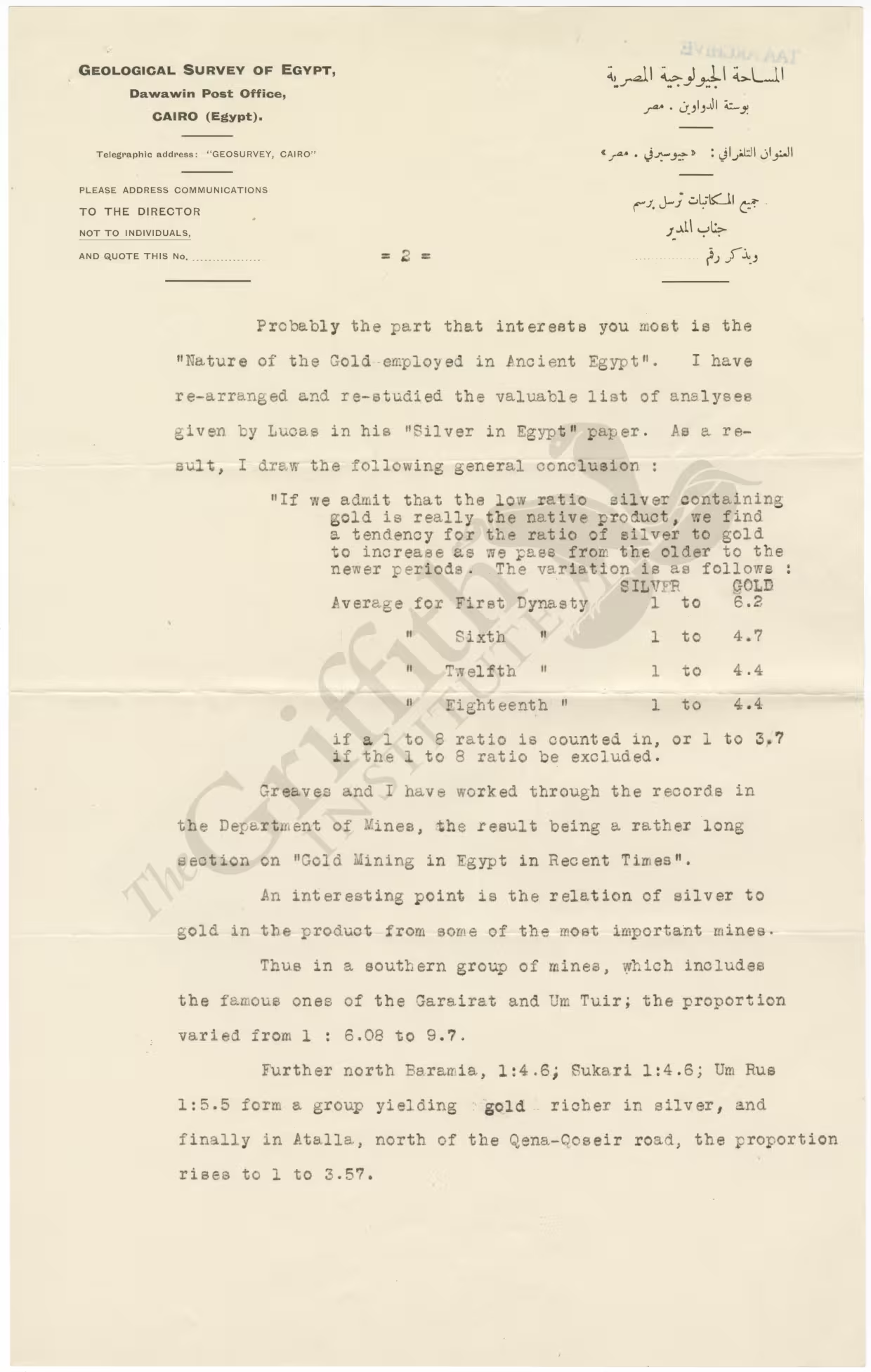
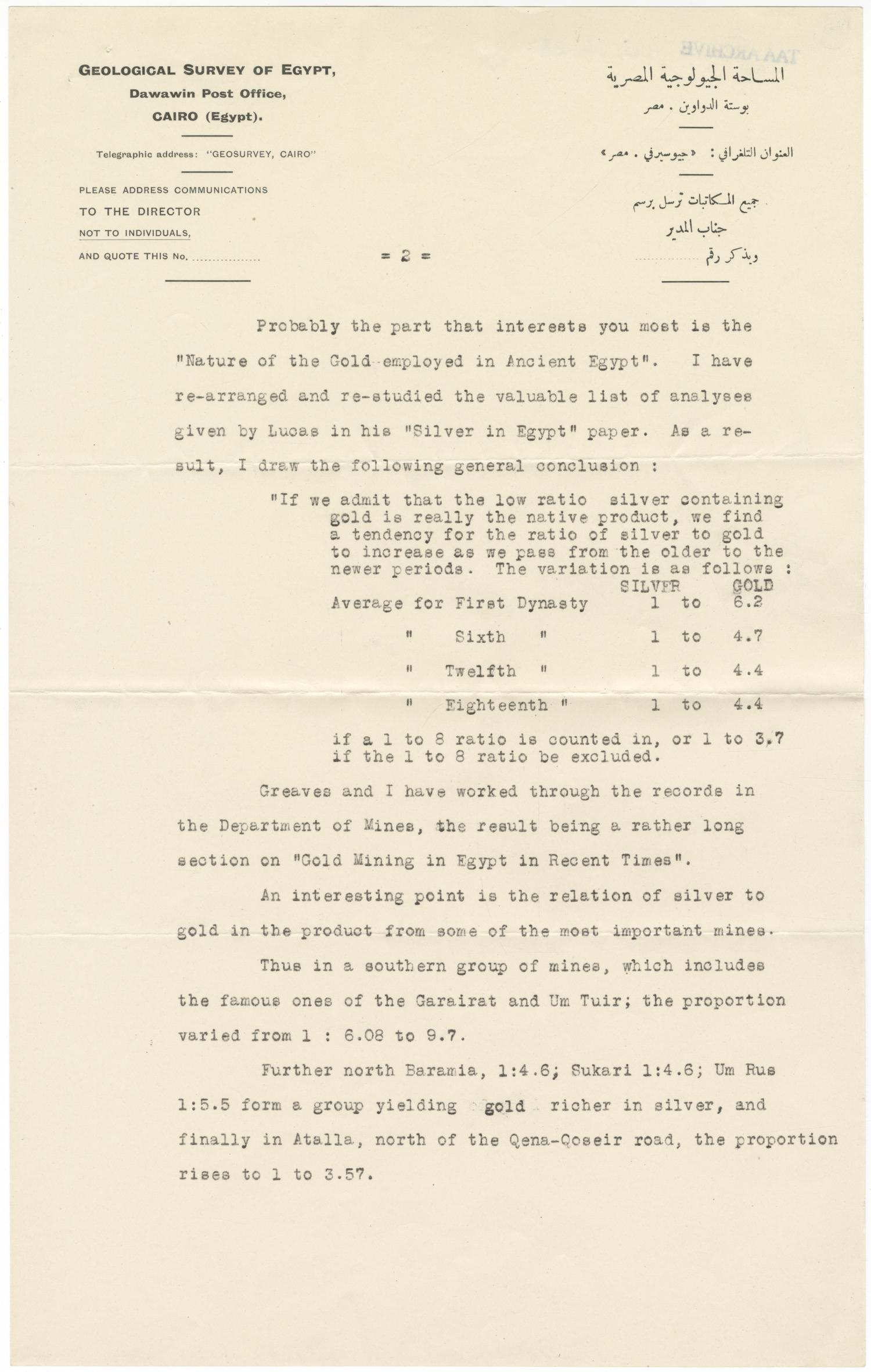
Probably the part that interests you most is the
“Nature of the Gold employed in Ancient Egypt”. I have
re-arranged and re-studied the valuable list of analyses
given by Lucas in his “Silver in Egypt” paper. As a re-
sult, I draw the following general conclusion:
“If we admit that the low ratio silver containing
gold is really the native product, we find
a tendency for the ratio of silver to gold
to increase as we pass from the older to the
newer periods. The variation is as follows:
SILVER GOLD
Average for First Dynasty 1 to 6.2
“ Sixth “ 1 to 4.7
“ Twelfth “ 1 to 4.4
“ Eighteenth “ 1 to 4.4
if a 1 to 8 ratio is counted in, or 1 to 3.7
if the 1 to 8 ratio be excluded.
Greaves and I have worked through the records in
the Department of Mines, the result being a rather long
section on “Gold Mining in Egypt in Recent Times”.
An interesting point is the relation of silver to
gold in the product from some of the most important mines.
Thus in a southern group of mines, which includes
the famous ones of the Garairat and Um Tuir; the proportion
varied from 1: 6.08 to 9.7.
Further north Baramia, 1:4.6; Sukari 1:4.6, Um Rus
1:5.5 form a group yielding gold richer in silver, and
finally in Atalla, north of the Qena-Qoseir road, the proportion
rises to 1 to 3.57.