TAA i.3.14.2
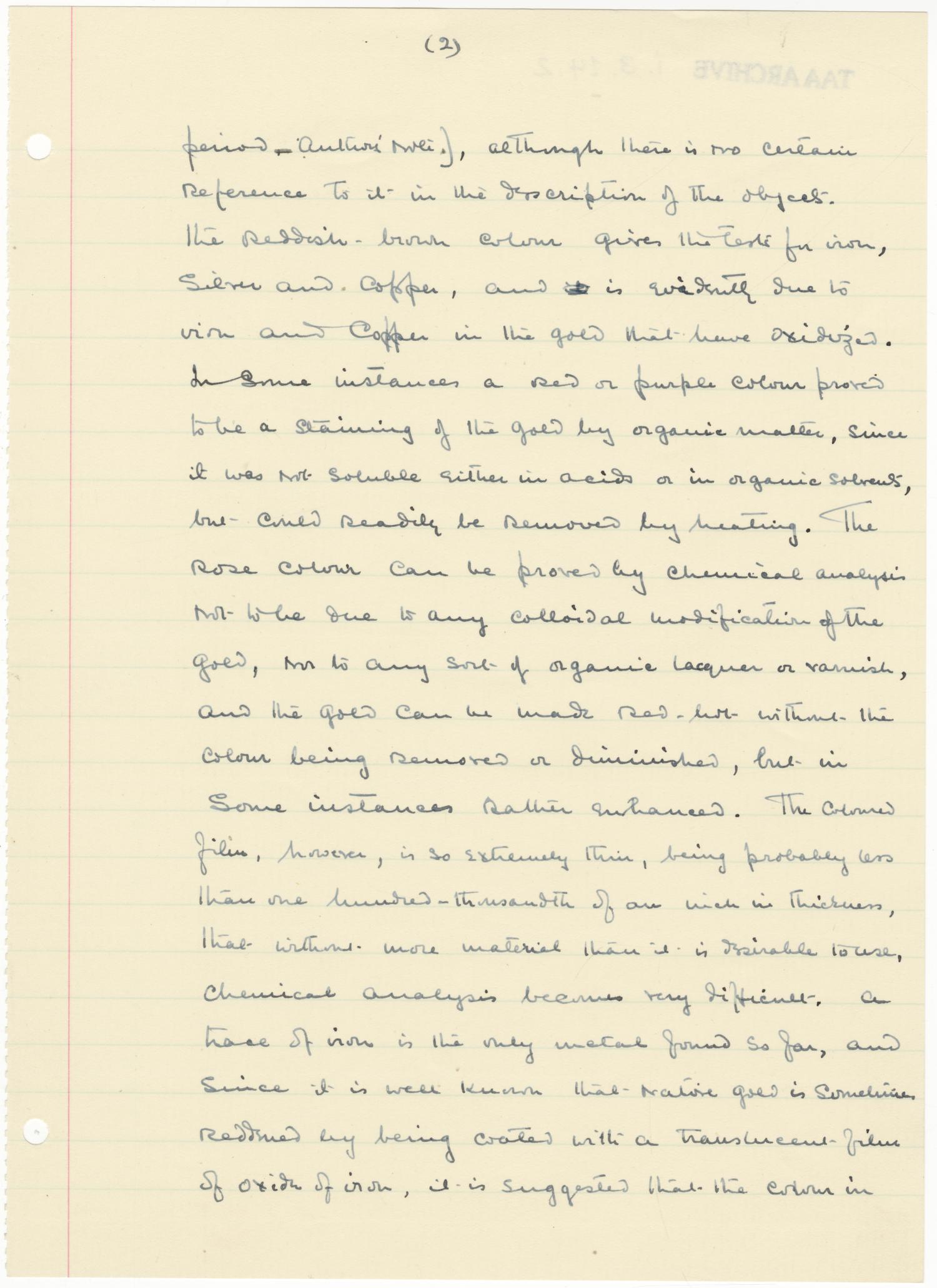
Handwritten notes on gold found in jewellery and other items from the New Kingdom, page 2. This page includes a quotation of Alfred Lucas' account published in The Tomb of Tut-Ankh-Amen ii (1927), pp. 172 ff.

© Griffith Institute,
University of Oxford
(2)
period – Author’s Note.), although there is no certain
reference to it in the description of the objects.
The reddish-brown colour gives the test for iron,
silver and copper, and it is evidently due to
iron and copper in the gold that have oxidized.
In some instances a red or purple colour proved
to be a staining of the gold by organic matter, since
it was not soluble either in acids or in organic solvents,
but could readily be removed by heating. The
rose colour can be proved by chemical analysis
not to be due to any colloidal modification of the
gold, nor to any sort of organic lacquer or varnish,
and the gold can be made red-hot without the
colour being removed or diminished, but in
some instances rather enhanced. The coloured
film, however, is so extremely thin, being probably less
than one hundred-thousandth of one inch in thickness,
that without more material than it is desirable to use,
chemical analysis becomes very difficult. A
trace of iron is the only metal found so far, and
since it is well known that native gold is sometimes
reddened by being coated with a translucent film
of oxide of iron, it is suggested that the colour in