
TAA i.2.1.91
Carter separates 231 into a and b (two straight gilt sticks) on the relevant object card but they are subsumed under 231 on the Handlist.
For objects on south(-east) side, see list on object card TAA i.1.212-21.

© Griffith Institute,
University of Oxford
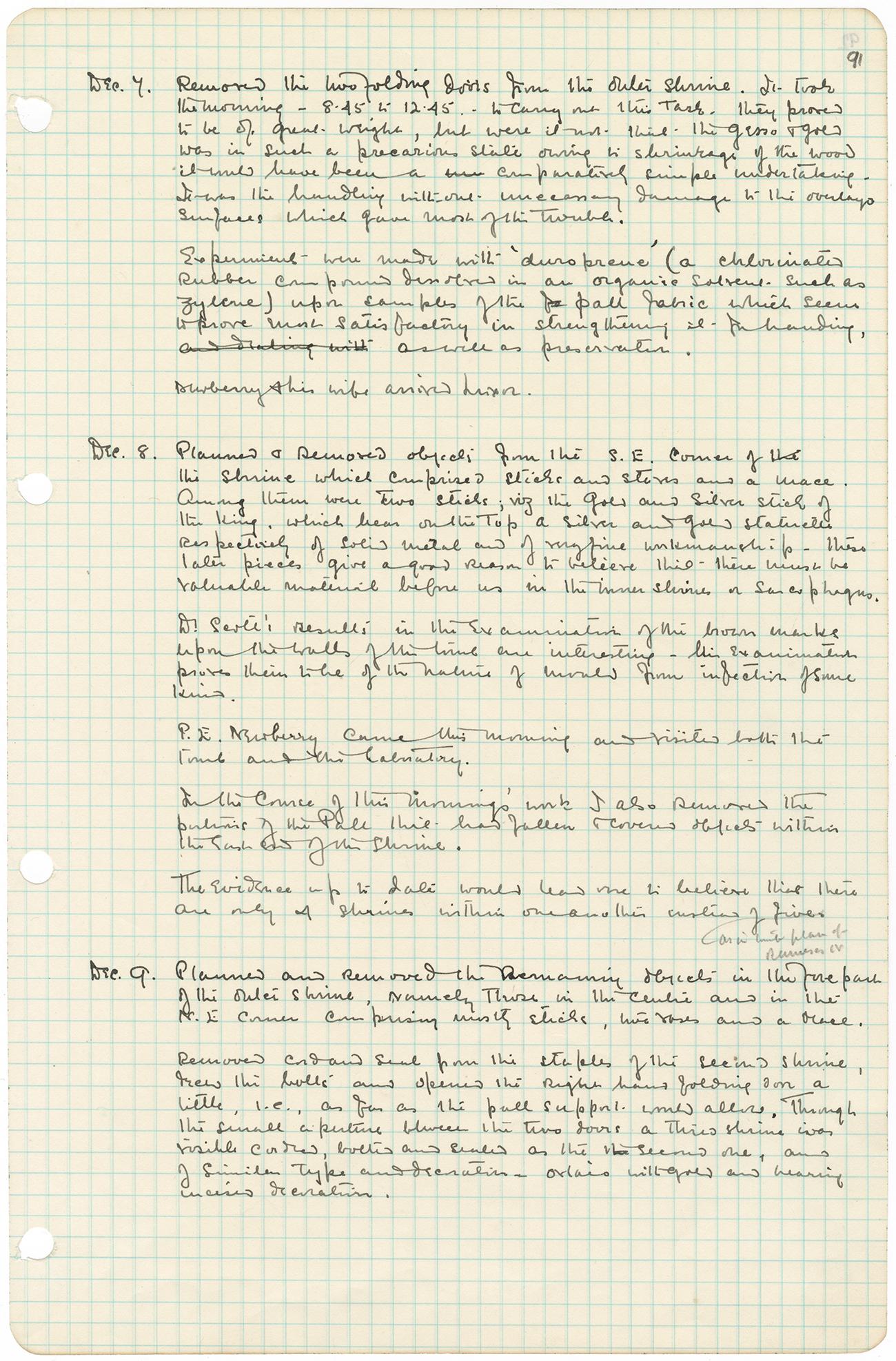
Dec. 7.
Removed the two folding doors from the Outer Shrine. It took
the morning - 8⸳45 to 12⸳45 - to carry out this task. They proved
to be of great weight, but were it not that the gesso & gold
was in such a precarious state owing to shrinkage of the wood
it would have been a comparatively simple undertaking.
It was the handling without unnecessary damage to the overlays
surfaces which gave most of the trouble.
Experiments were made with 'duroprene' (a chlorinated
rubber compound dissolved in an organic solvent such as
zylenesic {xylene}) upon samples of the fa pall fabric which seems
to prove most satisfactory in strengthening it for handling,
and dealing with as well as preservation.
Newberry & his wife arrived Luxor.
Dec. 8.
Planned & removed objects from the S. E. corner of the
the Shrine which comprised sticks and staves and a mace.
Among them were two sticks; viz the Gold and Silver stick of
the King, which bear on the top a Silver and gold statuette
respectively of solid metal and of very fine workmanship - these
later pieces give a good reason to believe that there must be
valuable material before us in the inner shrines or Sarcophagus.
Dr Scott's results in the Examination of the brown marks
upon the walls of the tomb are interesting - his Examination
proves them to be of the nature of mould from infection of some
kind.
P. E. Newberry came this morning and visited both the
Tomb and the Laboratory.
In the course of this morning's work I also removed the
portions of the Pall that had fallen & covered objects within
the East end of the Shrine.
The evidence up to date would lead one to believe that there
are only 4 shrines within one another instead of five <as in tomb plan of
Rameses IV>
Dec. 9.
Planned and removed the remaining objects in the forepart
of the outer shrine, namely those in the centre and in the
N. E. Corner comprising mostly sticks, two vases and a Mace.
Removed cord and seal from the staples of the Second Shrine,
drew the bolts and opened the right hand folding door a
little, i.e., as far as the pall support would allow. Through
the small aperture between the two doors a Third shrine was
visible corded, bolted and sealed as the the Second one, and
of similar type and decoration - overlaid with gold and bearing
incised decoration.