
TAA i.2.1.90

© Griffith Institute,
University of Oxford
{on page between entries for 6 and 7 December 1923}
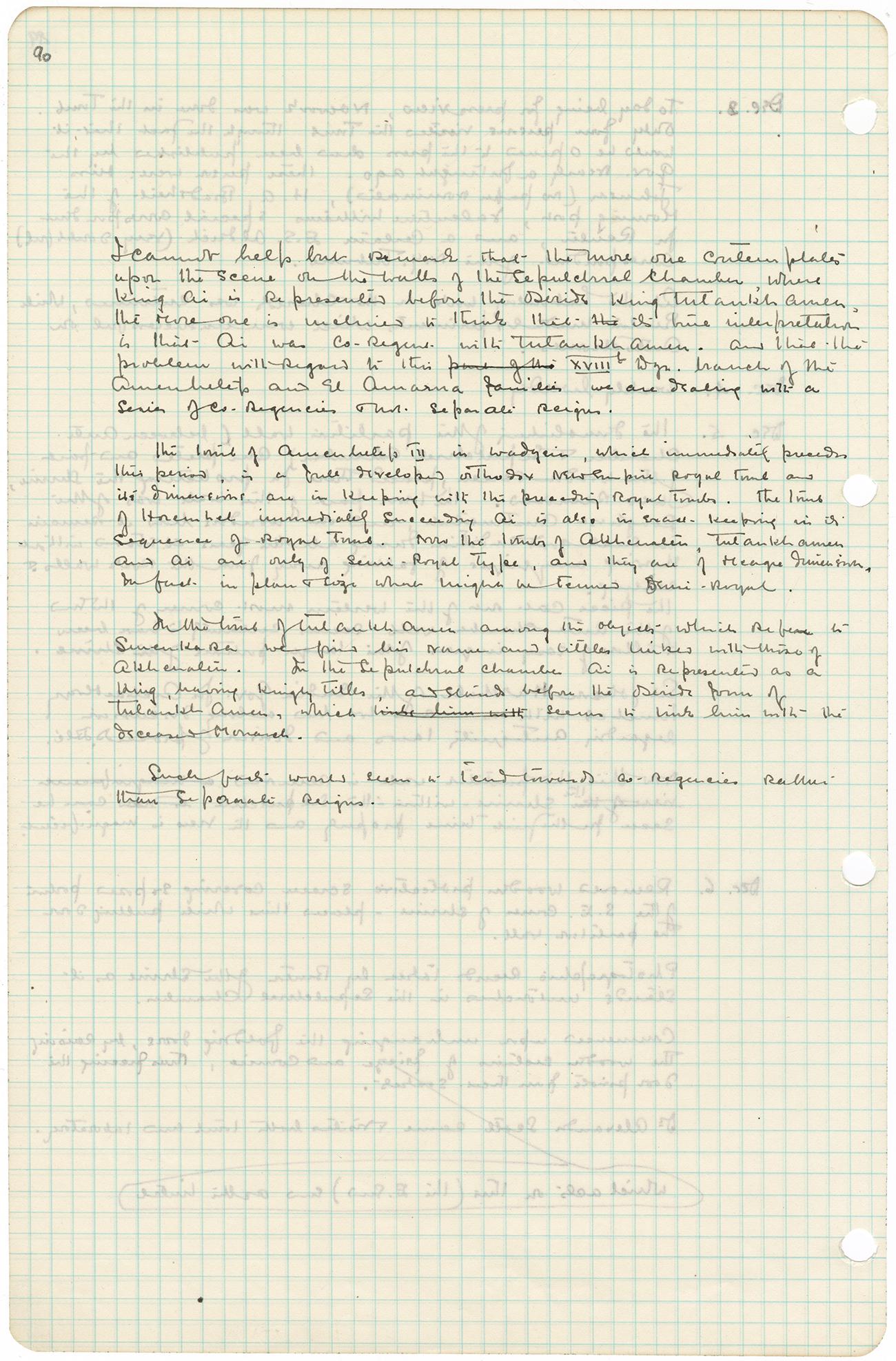
I cannot help but remark that the more one contemplates
upon the scene on the walls of the Sepulchral Chamber, where
King Ai is represented before the Osiride King TutankhAmen,
the more one is inclined to think that the its true interpretation
is that Ai was Co-Regent with TutankhAmen. And that the
problem with regard to this part of the XVIIIth Dyn. branch of the
Amenhetep and El Amarna families we are dealing with a
series of Co-Regencies & not separate reigns.
The tomb of Amenhetep III in Wadyein, which immediately precedes
this period, is a full developed orthodox New Empire Royal tomb and
its dimensions are in keeping with the preceding Royal Tombs. The tomb
of Horemheb immediately succeeding Ai is also in exact keeping in its
sequence of Royal Tomb. Now the tombs of Akhenaten, Tutankhamen
and Ai are only of semi-Royal Type, and they are of meagre dimension.
In fact in plan & size what might be termed D/Semi-Royal.
In the tomb of TutankhAmen among the objects which referen to
SmenKaRa we find his name and titles linked with those of
Akhenaten. In the Sepulchral Chamber Ai is represented as a
King, having kingly titles, and stands before the Osiride form of
TutankhAmen, which links him with seems to link him with the
deceased Monarch.
Such facts would seem to tend towards co-regencies rather
than separate reigns.