
TAA i.2.1.107

© Griffith Institute,
University of Oxford
Feb. 1.
Jan. 31
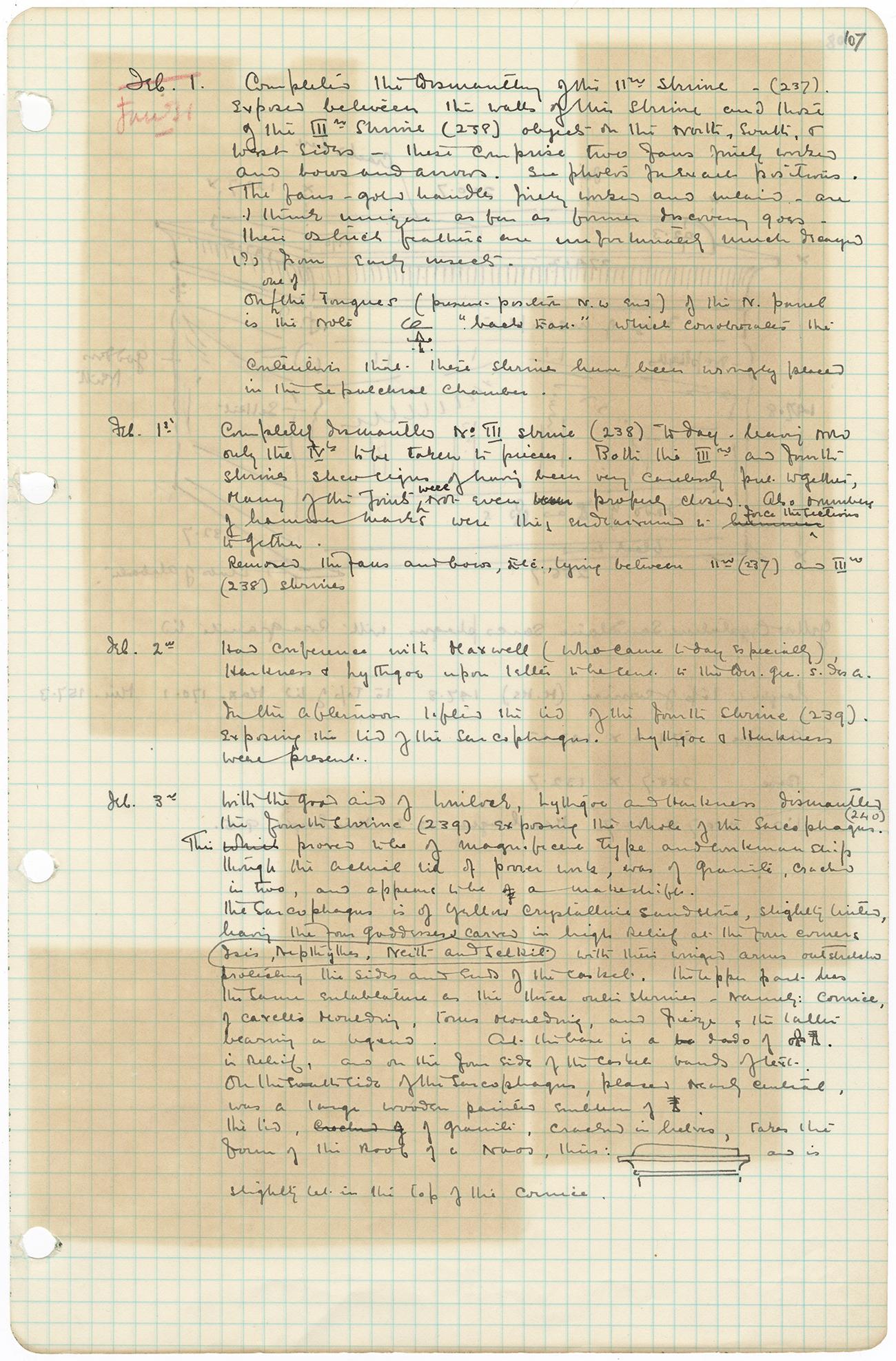
Completed the dismantling of the IInd shrine - (237).
Exposed between the walls of this shrine and those
of the IIIrd shrine (238) objects on the North, South, &
West sides - these comprise two fans finely worked
and bows and arrows. See photos for exact positions.
The fans - gold handles finely worked and inlaid - are
I think unique as far as former discovery goes.
Their ostrich feathers are unfortunately much dacayed
(?) from early insects.
On <one of> the tongues (present position N. W end) of the N. panel
is the note [ 𓂀 ] "back East" which corroborates the
contention that these shrines have been wrongly placed
in the Sepulchral Chamber.
Feb. 1st
Completely dismantled No III shrine (238) today - leaving now
only the IVth to be taken to pieces. Both the IIIrd and fourth
shrines shew signs of having been very carelessly put together,
many of the joints <were> not even been properly closed. Also numbers
of hammer marks where they endeavoured to hammer <force the sections>
together.
Removed the fans and bows, Etc., lying between IInd (237) and IIIrd
(238) shrines.
Feb. 2nd
Had conference with Maxwell (who came today especially),
Harkness & Lythgoe upon letter to be sent to the Dir. Gen. S. des. A.
In the afternoon lifted the lid of the fourth shrine (239).
Exposing the lid of the sarcophagus. Lythgoe & Harkness
were present.
Feb. 3rd
With the good aid of Winlock, Lythgoe and Harkness dismantled
the fourth shrine (239) exposing the whole of the Sarcophagus <(240)>.
This which proved to be of magnificent type and workmanship
though the actual lid of poorer work, was of granite, cracked
in two, and appears to be of a makeshift.
The sarcophagus is of yellow crystalline sandstone, slightly tinted,
having the four goddesses <Isis, Nepthythes, Neith, and Selkit> carved in high relief at the four corners
with their winged arms outstretched
protecting the sides and ends of the casket. The upper part has
the same entablature as the three outer shrines - namely: cornice,
of cavetto moulding, torus moulding, and frieze, the latter
bearing a legend. At the base is a ba dado of [ 𓂀 ].
in relief, and on the four sides of the casket bands of text.
On the south side of the Sarcophagus, placed nearly central,
was a large wooden painted emblem of [ 𓂀 ].
The lid, cracked of of granite, cracked in halves, takes the
form of the roof of a naos, thus: [ 𓂀 ] and is
slightly let in the top of the cornice.