
TAA i.2.1.133
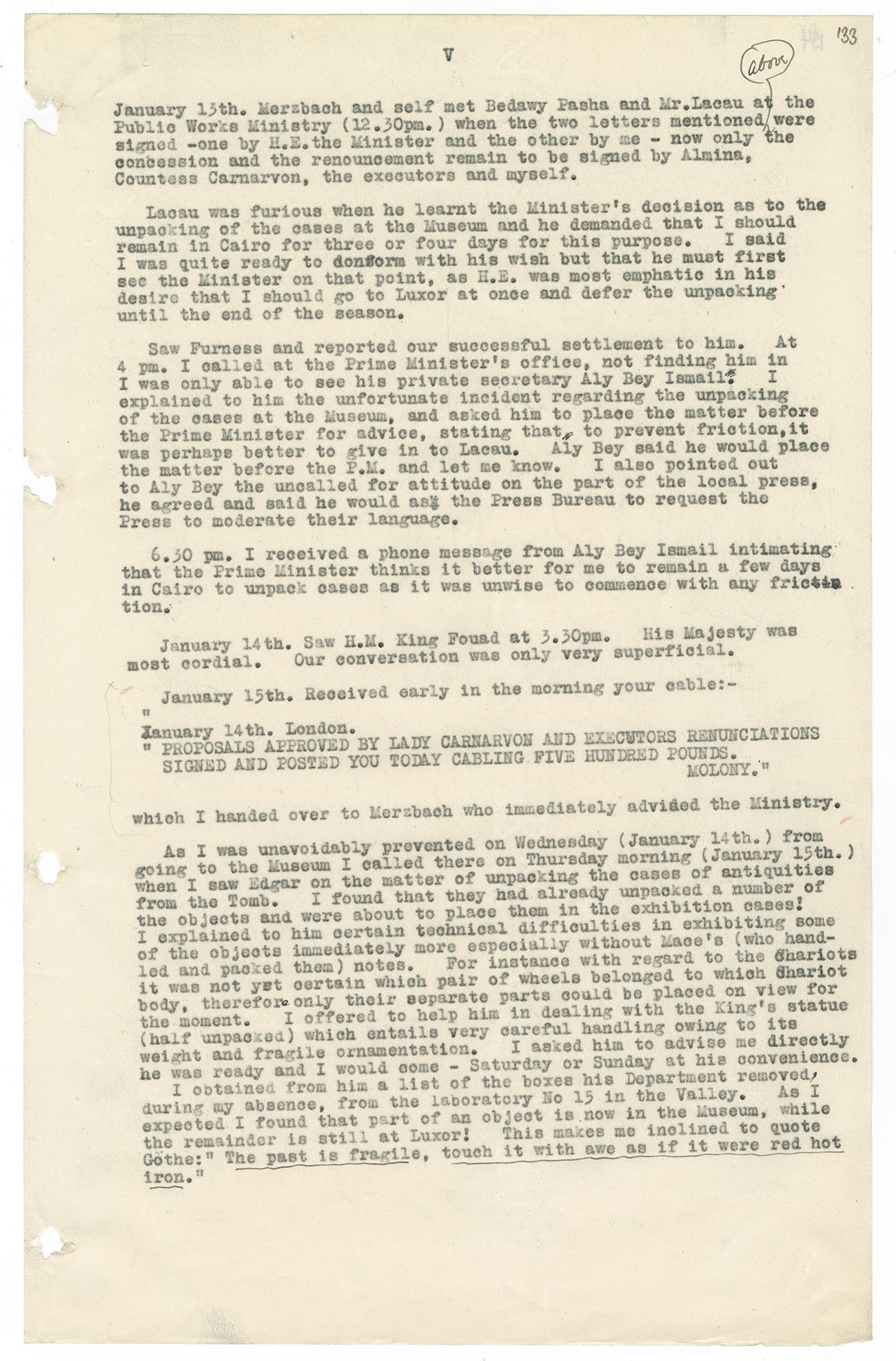
Confidential letter from Howard Carter to his solicitor Richard Bethell Molony regarding negotiations with the Egyptian Government, recounting events from 15 December 1924 – 16 January 1925, page 5.
Several people are mentioned on this page, including: George Merzbach Bey, Abd el Hamid Bedawy Pasha, Pierre Lacau, 'H.E. the Minister', Almina Herbert Countess Carnarvon, Sir Robert Allason Furness, Aly Bey Ismail, 'Prime Minister' Ziwar Pasha, H.M. King Fouad, Lady Carnarvon, C.C. Edgar and Arthur Mace.

© Griffith Institute,
University of Oxford
V 131
January 13th. Merzbach and self met Bedawy Pasha and Mr. Lacau at the
Public Works Ministry (12.30pm.) when the two letters mentioned <above> were
signed – one by H.E. the Minister and the other by me – now only the
concession and the renouncement remain to be signed by Almina,
Countess Carnarvon, the executors and myself.
Lacau was furious when he learnt the Minister’s decision as to the
unpacking of the cases at the Museum and he demanded that I should
remain in Cairo for three or four days for this purpose. I said
I was quite ready to d/<c>ons/<f>orm with his wish but that he must first
see the Minister on that point, as H.E. was most emphatic in his
desire that I should go to Luxor at once and defer the unpacking
until the end of the season.
Saw Furness and reported our successful settlement to him. At
4 pm. I called at the Prime Minister’s office, not finding him in
I was only able to see his private secretary Aly Bey Ismail?/<.> I
explained to him the unfortunate incident regarding the unpacking
of the cases at the Museum, and asked him to place the matter before
the Prime Minister for advice, stating that, to prevent friction, it
was perhaps better to give in to Lacau. Aly Bey said that he would place
the matter before the P.M. and let me know. I also pointed out
to Aly Bey the uncalled for attitude on the part of the local press,
he agreed and said he would asy/<k> the Press Bureau to request the
Press to moderate their language.
6.30 pm. I received a phone message from Aly Bey Ismail intimating
that the Prime Minister thinks it better for me to remain for a few days
in Cairo to unpack the cases as it was unwise to commence with any frictio
tion.
January 14th. Saw H.M. King Fouad at 3.30pm. His Majesty was
most cordial. Our conversation was only very superficial.
January 15th. Received early in the morning your cable:-
“X/<J>anuary 14th. London.
“PROPOSALS APPROVED BY LADY CARNARVON AND EXECUTORS RENUNCIATIONS
SIGNED AND POSTED TO YOU TODAY CABLING FIVE HUNDRED POUNDS.
MOLONY”
which I handed over to Merzbach who immediately advid/<s>ed the Ministry.
As I was unavoidably prevented on Wednesday (January 14th.) from
going to the Museum I called there on Thursday morning (January 15th.)
when I saw Edgar on the matter of unpacking the cases of antiquities
from the Tomb. I found that they had already unpacked a number of
the objects and were about to place them in the exhibition cases!
I explained to him certain technical difficulties in exhibiting some
of the objects immediately more especially without Mace’s (who hand-
led and packed them) notes. For instance with regard to the C/<c>hariots
it was not yet certain which pair of wheels belonged to which C/<c>hariot
body, therefor<e> only their separate parts could be placed on view for
the moment. I offered to help him in dealing with the King’s statue
(half unpacked) which entails very careful handling owing to its
weight and fragile ornamentation. I asked him to advise me directly
he was ready and I would come – Saturday or Sunday at his convenience.
I obtained from him a list of the boxes his Department removed<,>
during my absence, from the laboratory No 15 in the Valley. As I
expected I found that part of an object is now in the Museum, while
the remainder is still at Luxor! This makes me inclined to quote
Göthe: "The past is fragile, touch it with awe as if it were red hot
iron."